
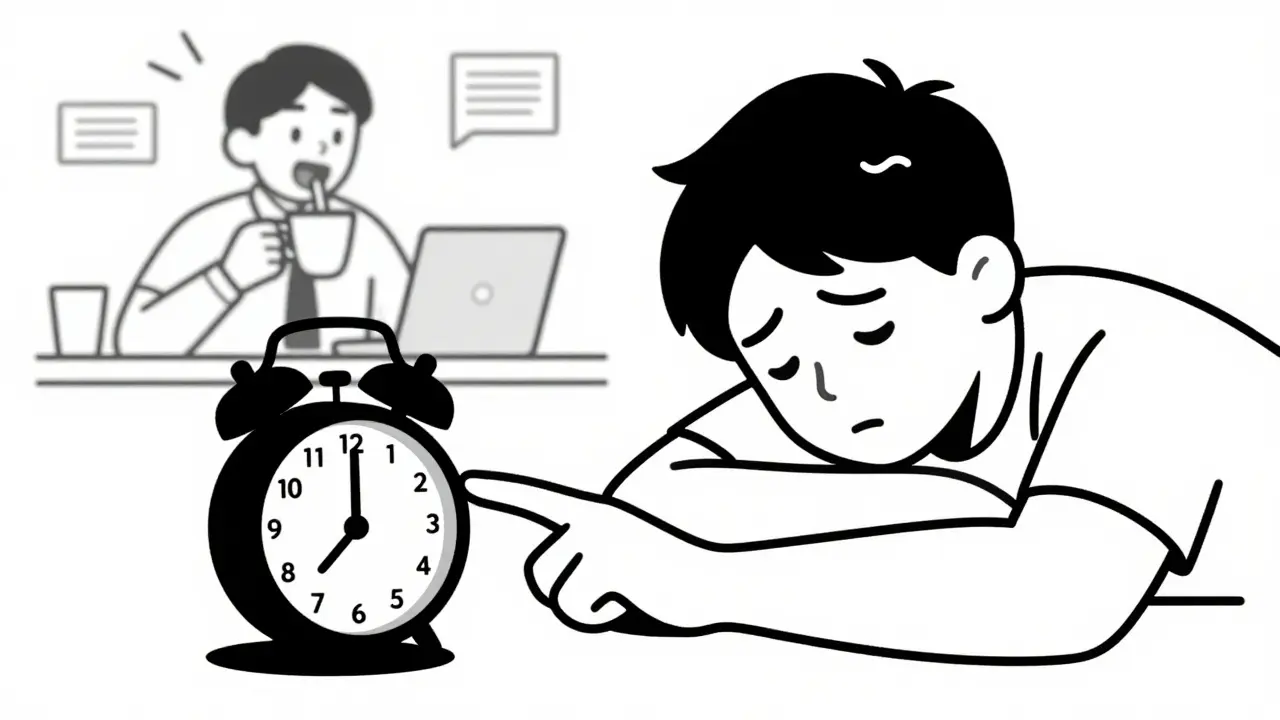
You hit snooze five times. Your brain feels like it’s wading through mud. Meanwhile, your coworker is already on their third coffee, having finished a workout and two emails before you even opened your eyes. Is your coworker just more disciplined? Or are you simply fighting biology?
The answer lies in your chronotype, which is your body's natural preference for sleeping and waking at certain times of the day. It’s not about laziness or willpower. It’s about your internal clock. Understanding whether you’re a morning lark, a night owl, or somewhere in between can transform how you work, study, and live.
Key Takeaways
- Chronotypes are biological: About 40% of people are larks, 30% are owls, and 30% fall in the middle. This is largely genetic.
- Social Jet Lag is real: Forcing an owl to wake at 6 AM causes stress similar to traveling across time zones, leading to poorer health outcomes.
- Owls aren’t lazy: Night owls often perform better cognitively when allowed to work during their peak hours, despite societal bias toward early risers.
- You can shift slightly: While you can’t change your DNA, light exposure and caffeine timing can help adjust your schedule by a few hours.
- Workplaces are changing: Flexible scheduling based on chronotype is becoming a standard productivity tool in modern offices.
What Is a Chronotype?
Your chronotype is determined by your circadian rhythm, which is the 24-hour internal cycle that regulates physiological processes like sleep-wake cycles. Think of it as your body’s preferred operating system. Some systems boot up fast and shut down early; others take longer to start but run smoothly late into the night.
The concept has been studied since the 1970s, but it gained serious scientific traction with the development of the Munich ChronoType Questionnaire (MCTQ) by Till Roenneberg in the early 2000s. The MCTQ calculates your "sleep midpoint"-the exact center of your sleep period on days when you don’t have to wake up for work or school. This midpoint reveals your true biological preference, stripped of social pressure.
Most people fall into a bell curve. According to data from the Society for Research on Biological Rhythms (SRBR), the average sleep pattern centers around midnight to 8 AM. However, extreme larks might sleep from 9 PM to 5 AM, while extreme owls might stay up until 4 AM and wake at noon. That’s nearly a 12-hour difference in biological timing between two healthy adults.
Morning Larks vs. Night Owls: The Breakdown
Let’s look at who we are. You likely fit into one of three categories:
- Morning Larks (Early Birds): These people feel alert soon after waking. They tend to go to bed early and wake up early without much struggle. About 40% of the population identifies as larks.
- Night Owls (Evening Types): These individuals find it hard to fall asleep before midnight and peak in mental clarity later in the evening. Roughly 30% of people are owls.
- Hummingbirds (Intermediate): The remaining 30% don’t strongly lean either way. They can adapt relatively easily to different schedules.
There’s also a gender split. Data from SleepWatch App analyzing over 10,000 users showed that early sleepers are 75% more likely to be female. Why? Hormonal fluctuations and societal expectations may play a role, but the biological basis remains strong.
The Health and Cognitive Divide
Society has long favored larks. Schools start at 8 AM. Offices open at 9 AM. But does this favor everyone equally? Recent research suggests otherwise.
A groundbreaking 2023 study from Imperial College London challenged the old narrative that larks are always healthier or smarter. Among older adults, night owls actually performed better on cognitive tests than morning larks. This flips the script on previous assumptions. However, context matters. When owls are forced to live like larks, they suffer.
This mismatch is called social jet lag, a term coined by Professor Till Roenneberg. It describes the discrepancy between your biological clock and the clock society demands you follow. If you’re an owl forced to wake at 6 AM, your body thinks it’s still nighttime. This chronic misalignment leads to significant health risks.
| Factor | Morning Larks | Night Owls |
|---|---|---|
| Average Sleep Duration | ~7.8 hours (48 mins more than owls) | ~6.9 hours |
| Sleep Consistency | High (7% greater consistency) | Lower |
| Cognitive Performance (Older Adults) | Standard | Better (per Imperial College 2023) |
| Risk of Metabolic Issues | Baseline | Higher (27-30% increased risk of obesity/diabetes) |
| Academic Impact (when forced early) | Minimal impact | Significant drop in GPA and sleep quality |
The stakes are high. A massive 2018 study of 430,000 people found that evening chronotypes faced higher mortality risks compared to morning types. They also experienced higher rates of depression (29% higher) and metabolic syndrome. Much of this isn’t because being an owl is inherently unhealthy, but because owls are constantly fighting against a world built for larks.
Why Are We Becoming Later Sleepers?
If genetics dictate our chronotype, why do so many people feel like their sleep patterns are shifting? Environment plays a huge role.
A 2012 analysis showed that average chronotypes shifted 15 minutes later over just nine years. The culprit? Artificial light. Our ancestors synced their sleep with the sun. Today, we bathe in blue light from phones, laptops, and LED bulbs well past sunset. This suppresses melatonin, the hormone that signals sleepiness, pushing our bodies into "owl mode" even if we’re genetically wired to be larks.
Dr. Kenneth Wright’s 2013 study at the University of Colorado Boulder proved this powerfully. He took participants camping for a week with no electric lights. Within days, their sleep timing synchronized with sunrise and sunset. The differences between owls and larks nearly vanished. This shows that while genetics set the range, environment determines where you sit within that range.
How to Schedule Around Your Chronotype
You can’t change your genes, but you can manage your environment. Here’s how to align your life with your biology.
For Night Owls Trying to Survive a 9-to-5
If you’re an owl in a lark’s world, you need strategic defenses. Baylor University’s research highlights specific behaviors that worsen the situation for owls: consuming caffeine late (average 4:18 PM for owls vs. 1:27 PM for larks) and using social media in bed (40 minutes extra).
To mitigate social jet lag:
- Cut caffeine early: Stop caffeine intake by 2:00 PM. Caffeine has a half-life of 5-6 hours, meaning half of that 4 PM coffee is still in your system at 10 PM.
- Protect your morning light: Get bright light exposure (minimum 10,000 lux) within 30 minutes of waking. This signals your brain to stop producing melatonin and anchors your circadian rhythm.
- Create a dark cave: Ensure your bedroom is completely dark (0-5 lux). Use blackout curtains. Even small amounts of light can disrupt deep sleep.
- Delay bedtime routines: Don’t force yourself to read at 9 PM if you’re not tired. Instead, engage in relaxing activities later, but avoid screens.
For Morning Larks Who Feel Burned Out
Larks often get more sleep (averaging 48 minutes more than owls) and report feeling more rested. However, larks can suffer in afternoon-heavy schedules. If your job requires peak performance at 4 PM, you’re working against your biology.
Strategies for larks:
- Front-load heavy tasks: Schedule complex problem-solving, creative work, or important meetings before noon.
- Use afternoons for admin: Save routine emails, filing, and low-energy tasks for the post-lunch slump.
- Don’t push too late: Recognize your wind-down time. If you’re exhausted by 8 PM, accept it rather than forcing productivity.
The Workplace Revolution
Fortunately, the corporate world is starting to catch up. A 2023 Gartner survey found that 42% of global organizations now offer flexible scheduling options, partly due to chronotype awareness. This is up from 28% in 2020.
Why? Because it works. Productivity studies show up to 18% improvement when work schedules align with employee chronotypes. Remote work has accelerated this trend, with 67% of remote-first companies implementing flexible policies compared to only 38% of office-based firms.
Younger workers are driving this change. Pew Research Center data from 2022 shows that 52% of Gen Z workers identify as night owls, compared to just 31% of Baby Boomers. As Gen Z enters leadership roles, expect more companies to abandon the rigid 9-to-5 model in favor of core-hours flexibility.
Can You Change Your Chronotype?
Short answer: Not really. Long answer: You can shift it slightly.
Baylor University’s 2023 longitudinal study followed college students over a semester. They found that 28% of students showed measurable chronotype shifts through behavioral changes. Students who moved from evening to morning types saw their GPAs rise by 0.45 points on average.
However, this shift comes with effort. It typically takes 2-4 weeks of consistent behavior change to see results. Key factors include:
- Consistent wake times (even on weekends)
- Morning light exposure
- Reduced evening screen time
- Strategic caffeine management
If you try these strategies for a month and see no change, your biology is likely dominant. In that case, focus on accommodation rather than conversion. Find a job, partner, or lifestyle that respects your natural rhythm.
How do I know my chronotype?
The most accurate way is to track your sleep midpoint on free days (weekends or vacation) for at least two weeks. Calculate the middle of your sleep period. If your midpoint is before midnight, you’re likely a lark. If it’s after 2 AM, you’re likely an owl. You can also use the Munich ChronoType Questionnaire (MCTQ) for a detailed assessment.
Is being a night owl bad for your health?
Not inherently. Night owls have shown equal or better cognitive performance in some studies. However, being an owl in a society that favors early rising leads to "social jet lag," which increases risks for obesity, diabetes, depression, and cardiovascular issues. The risk comes from the mismatch, not the chronotype itself.
Can teenagers be night owls?
Yes, and it’s biologically normal. During puberty, the body’s internal clock shifts later, making teens naturally inclined to stay up late and wake up late. This is why many experts advocate for later school start times for adolescents.
Does blue light really affect my chronotype?
Yes. Blue light from screens suppresses melatonin production, signaling to your brain that it’s daytime. This delays sleep onset and can shift your chronotype later over time. Using blue-light filters or avoiding screens 1-2 hours before bed can help maintain an earlier sleep phase.
Should I try to change my chronotype to fit my job?
Only if necessary. Small shifts (1-2 hours) are possible with consistent light and caffeine management. However, trying to flip from a severe owl to a severe lark is difficult and unsustainable. It’s often better to negotiate flexible hours or seek employers who value output over presence.
