
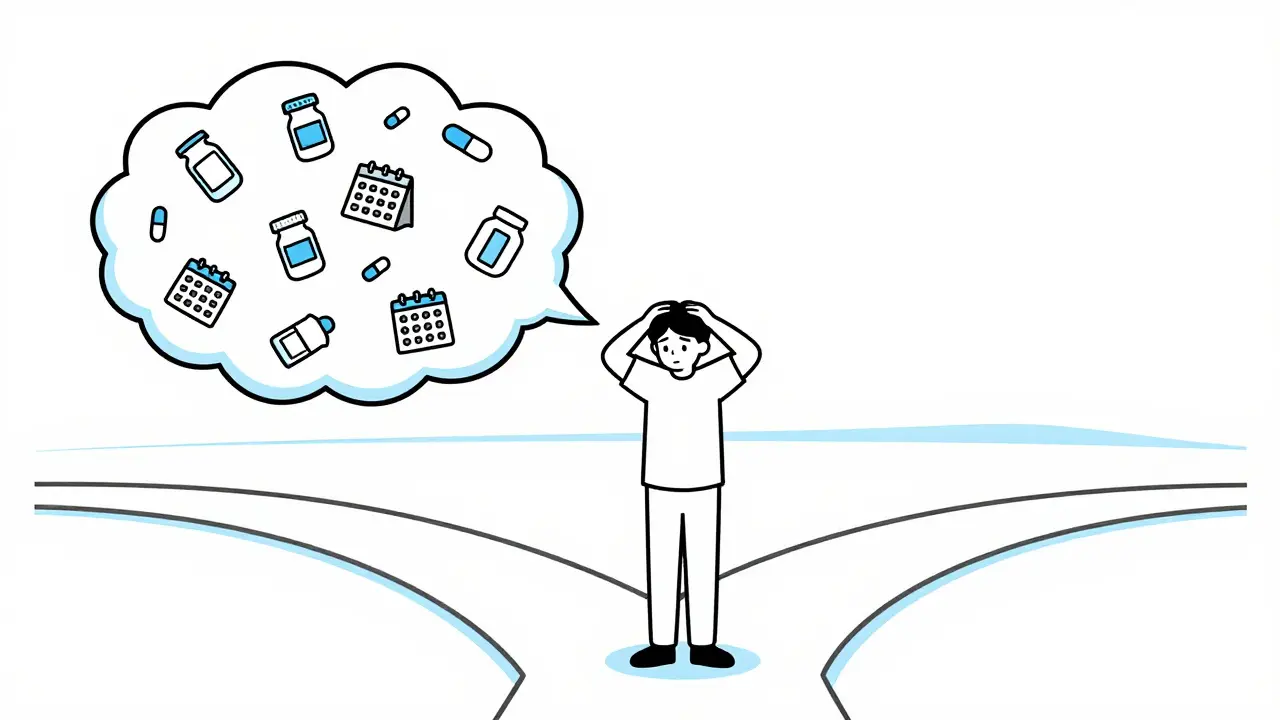
- Collaborative care (pharmacists + psychiatrists) is significantly more effective than standard care alone.
- Simplifying dosing to once-a-day increases adherence rates from 52% to 87%.
- Long-acting injectables offer a massive jump in stability compared to daily oral pills.
- Social factors, like housing stability, are just as important as the medical plan.
Why sticking to the plan is so hard
When we talk about medication adherence, we aren't just talking about memory. For someone with Schizophrenia, for example, the rate of sticking to antipsychotics is only about 50%. Why? Often, it's a lack of insight into the illness-where the mind tells you that you're fine even when you aren't. Other times, the side effects are just too brutal to handle, or the dosing schedule is too complex to manage during a depressive episode.
Life circumstances play a massive role too. Consider the difference in stability: people with a permanent home are much more likely to stay on their meds than those experiencing homelessness. In some studies, adherence for homeless patients with psychiatric conditions plummeted to as low as 26%. It's hard to maintain a medical regimen when you don't have a safe place to store your pills or a reliable way to get to the pharmacy.
The power of the pharmacist-psychiatrist team
For a long time, the doctor wrote the script and the pharmacist filled it, but they rarely talked to each other about the patient's daily struggle. That's changing. Collaborative care models-where a pharmacist and a psychiatrist work as a team-are showing a 142% greater improvement in adherence compared to usual care.
Why does this work? Pharmacists are experts in Medication Therapy Management (MTM). They can spot drug interactions, suggest ways to manage side effects, and help create an actual action plan. When a pharmacist-led program was implemented in Northern California, hospitalizations dropped by 18.3% within just 90 days. It turns out that having a dedicated "medication specialist" to talk to makes the process feel less like a chore and more like a supported journey.
| Intervention | Estimated Impact | Best For... |
|---|---|---|
| Collaborative Care (Pharmacist + Doctor) | Up to 40% increase | Severe mental illness & complex regimens |
| Regimen Simplification (1x daily) | 87% adherence rate | Patients with memory issues or busy schedules |
| Long-Acting Injectables (LAIs) | 87% vs 56% (oral) | Chronic non-adherence to daily pills |
| Digital Health Apps | ~2% increase | Mild-to-moderate forgetfulness |

Practical ways to bridge the gap
If you're struggling to stay on track, there are concrete changes you can request from your healthcare provider. One of the most effective is simply asking for a simplified regimen. Data from the National Alliance on Mental Illness shows that 87% of people on once-daily dosing stay adherent, compared to only 52% for those taking meds multiple times a day. Yet, most providers don't even bring this up unless the patient asks. If your current schedule is overwhelming, ask your doctor: "Is there a once-a-day alternative?"
For those who find daily pills nearly impossible, Long-Acting Injectable antipsychotics are a game-changer. Instead of a morning struggle, a single shot can provide coverage for weeks or months. In a 2023 study published in JAMA Psychiatry, these injectables showed an 87% adherence rate, dwarfing the 56% seen with oral medications. It removes the daily "decision" to take the med and replaces it with a scheduled clinical visit.
We're also seeing a shift toward "digital phenotyping." This is a fancy way of saying that researchers are using smartphone data-like how often you move or how you use your apps-to predict when someone might stop taking their meds. Some new systems can actually predict an adherence lapse 72 hours before it happens with over 80% accuracy. While this is still emerging, it means that in the near future, your care team might reach out with a supportive text exactly when you're starting to slip.
Overcoming the invisible barriers
It's not just about the pills; it's about the cost and the system. Many people stop their medication simply because they can't afford the refill. Tools that provide cost transparency and assistance programs are essential. If you're choosing between groceries and your prescription, the most advanced medical plan in the world won't help.
Another huge barrier is the "worthlessness" factor. In elderly patients, feelings of depression and hopelessness often lead to a "why bother?" mentality. General adherence programs (like pill organizers) don't work for this. What does work is targeted therapy that addresses the emotional state first. When the patient feels a sense of value and hope, the motivation to maintain their health follows.

How to build a better support system
If you're a caregiver or a patient, don't rely on a single point of contact. Building a support web is the best way to prevent a relapse. This includes:
- The Pharmacist: They can suggest generics to lower costs or different formulations to reduce side effects.
- Predictive Tools: Use apps that don't just remind you to take a pill, but track your mood and symptoms.
- Peer Support: Connecting with others who have the same condition can help normalize the side effects and provide tips for managing them.
- Integrated Care: Ensure your therapist and psychiatrist are talking. If your therapist knows you've stopped your meds, they can help you work through the emotional reasons why before the next doctor's appointment.
What is a "good" adherence rate for mental health meds?
Generally, medical professionals look for at least 80% adherence-meaning you take the medication correctly at least 80% of the time-to achieve the best therapeutic outcomes. This is often measured by the Proportion of Days Covered (PDC) metric.
Why are pharmacists so important for mental health adherence?
Pharmacists specialize in how drugs interact and their side effect profiles. Collaborative care models involving pharmacists have shown a 142% greater improvement in adherence because they can provide more frequent, specialized education and management than a psychiatrist who may only see a patient once a month.
Do long-acting injectables actually work better than pills?
In terms of adherence, yes. Research shows a jump from 56% adherence with oral pills to 87% with injectables. This is because they remove the need for a daily habit and provide a consistent dose over a long period.
How does housing affect medication adherence?
Housing stability is a primary social determinant of health. Those experiencing homelessness have significantly lower adherence rates (some as low as 26%) due to lack of storage, instability in pharmacy access, and the high stress of survival, which overrides the routine of medication.
Can digital apps really help with non-adherence?
Digital tools have a modest impact on their own (often only a 2% increase). However, the future is in "digital phenotyping," where AI uses smartphone data to predict lapses in adherence before they happen, allowing doctors to intervene proactively.
What to do if you're struggling
If you've missed doses, don't just double up on your next pill-that can be dangerous depending on the medication. Instead, call your pharmacist immediately. They can tell you the safest way to get back on track.
Next, schedule a "medication review" with your doctor. Be honest about why you're missing doses. Is it the cost? A specific side effect like weight gain or insomnia? A complex schedule? When you give your provider a specific reason, they can give you a specific solution, like switching to a long-acting injectable or simplifying your dose to once a day. Remember, the goal isn't perfect compliance; it's finding a sustainable way for you to feel better.

15 Comments
Robin Walton
April 9 2026
It's so important to remember that everyone's journey with medication is different and there's no shame in struggling to keep up with a routine.
Franklin Anthony
April 10 2026
big pharma just wants us on these long acting injectables so we cant stop if we realize the meds are actually controlling our minds its all a game for them
Victor Parker
April 11 2026
Totally agree on the tracking apps being useless! 🙄 They just want your data to sell to the government anyway :)
Emily Wheeler
April 12 2026
The intersection of social stability and pharmacological adherence is a fascinating conceptual framework because it suggests that our mental health is not merely a chemical imbalance within the individual but rather a reflection of the precariousness of our external environment, and I believe that if we can collectively advocate for housing as a fundamental human right, we might actually see these adherence percentages climb in a way that no amount of pharmaceutical intervention could ever achieve on its own.
Thabo Leshoro
April 13 2026
The pharmacokinetics of the long-acting options are truly impressive!!! It helps so much with the patient's stability!!!
Chad Miller
April 13 2026
why do people care about this stuff just wake up and take the pill its not that hard honestly
emmanuel okafor
April 15 2026
we are all just trying to find a way to feel peace in a loud world and if a pharmacist can help us get there that is a beautiful thing
Rakesh Tiwari
April 16 2026
Oh, how wonderful that we've discovered the revolutionary secret that having a home helps you stay organized. Truly a breakthrough in medical science.
Camille Sebello
April 17 2026
I have a cousin who stopped her meds!! Does she still live in that apartment?? I bet her family is lying about her progress!!!
Doug DeMarco
April 18 2026
I've seen so many people struggle with this! Just remember you're not alone and it's totally okay to ask for help 👊✨
Simon Jenkins
April 19 2026
The sheer audacity of suggesting a digital app as a solution!
It is absolutely tragic that we have devolved to a point where a notification on a glass screen is considered a medical intervention! The tragedy of the modern psyche is simply breathtaking!
Sarina Montano
April 20 2026
The concept of digital phenotyping is such a kaleidoscope of possibility for preventative care. It's like having a silent sentinel that whispers a warning before the storm hits, allowing a clinician to pivot from reactive to proactive treatment in a way that feels almost magical.
Will Gray
April 20 2026
This is exactly why the American healthcare system is failing; we focus on these 'collaborative' fantasies while ignoring the systemic collapse caused by globalist influence in our pharmacies.
Ben hogan
April 21 2026
typical academic fluff trying to solve a problem with more bureaucracy and 'teams' when the reality is that the human condition is just fundamentally broken and no amount of pharmacist hand-holding changes that
Kelly DeVries
April 22 2026
honey please just get the shot and stop complaining about the routine its literally a five minute visit once a month lol