
Drug Rash Symptom Checker
This tool helps you assess if your rash might be a serious drug reaction. It is not a substitute for medical advice. If you experience any severe symptoms, seek emergency care immediately.
Step 1: Describe your rash
Step 2: Describe your symptoms
Step 3: Timing and medication
EMERGENCY: Seek medical attention immediately
These symptoms require urgent evaluation and treatment in a hospital setting.
More than 1 in 20 people taking prescription drugs will develop a skin rash as a side effect. It’s not always an allergy. It’s not always dangerous. But it can be - and knowing the difference could save your life.
What Does a Drug Rash Look Like?
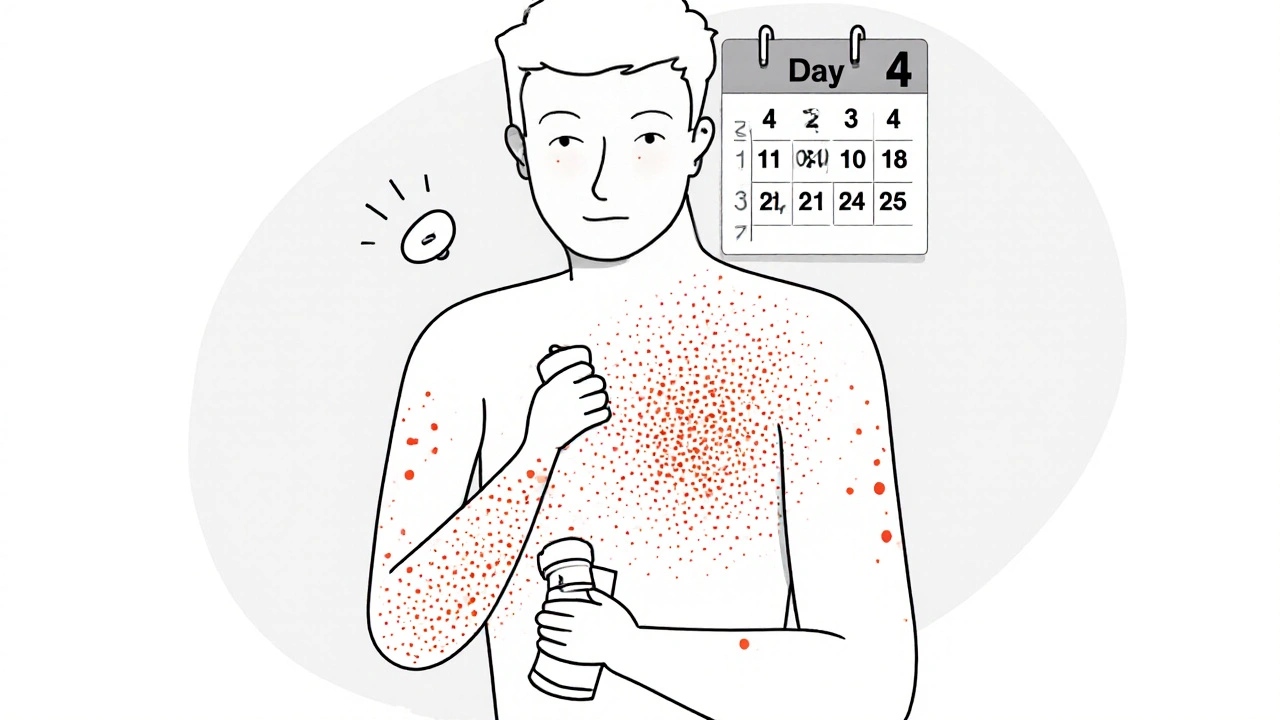
Drug rashes don’t look the same every time. The most common type - called a morbilliform or maculopapular rash - looks like small, red, flat or slightly raised spots. They often start on your chest, back, or upper arms, then spread. You might feel itchy, but not always. Fever can come with it. This rash usually shows up 4 to 14 days after you start a new medication. Sometimes it appears even after you’ve stopped taking it.
Other types are more obvious. Hives - raised, red, itchy welts - can pop up within minutes or hours. These often mean your body is having an immediate allergic reaction. If they come with swelling of the lips, tongue, or throat, or trouble breathing, get help right away.
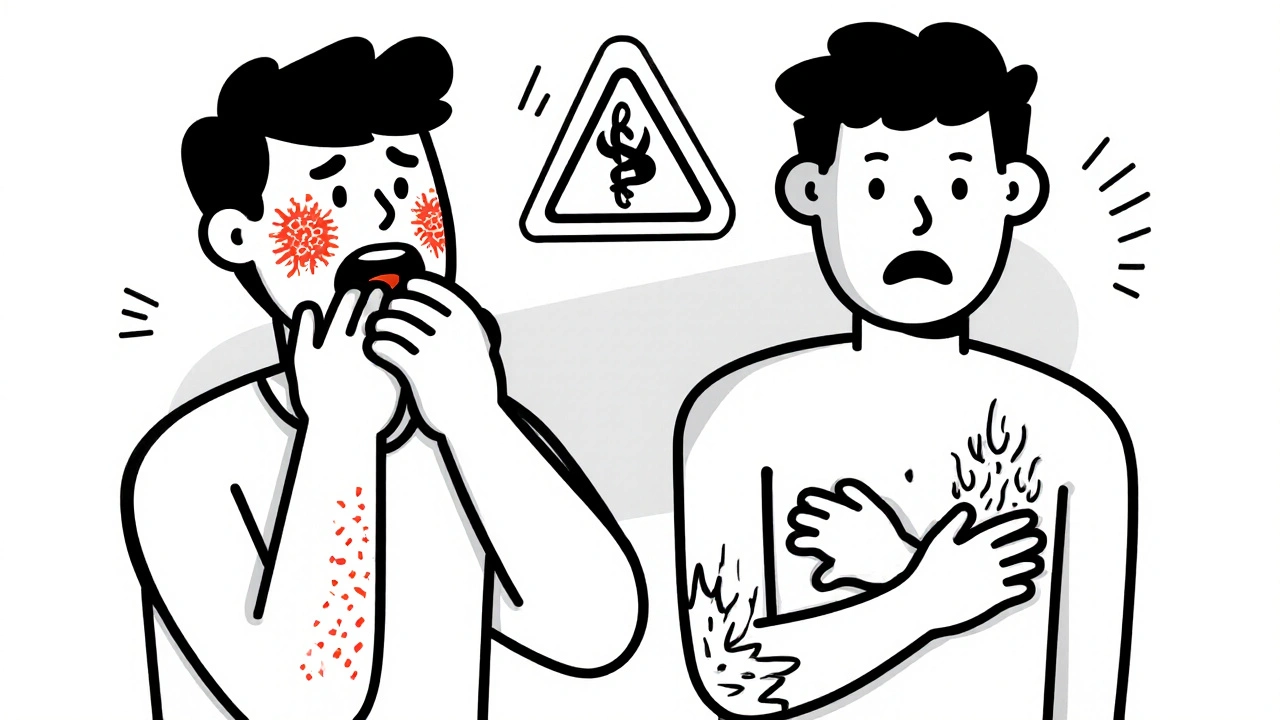
Then there’s the rare but deadly kind: Stevens-Johnson Syndrome (SJS) or Toxic Epidermal Necrolysis (TEN). These start like a bad flu - fever, sore throat, burning eyes - then your skin begins to blister and peel, like a severe burn. The top layer of skin dies and sloughs off. This isn’t a rash you can ignore. It needs emergency care. Mortality rates for SJS are 5% to 15%. For TEN, they jump to 25% to 35%.
Another serious reaction is DRESS - Drug Reaction with Eosinophilia and Systemic Symptoms. It’s slow to show up, often 2 to 6 weeks after starting a drug. You get a widespread rash, swollen lymph nodes, fever, and internal organ involvement - liver, kidneys, lungs. Blood tests will show high levels of eosinophils, a type of white blood cell. This isn’t just a skin problem. It’s a full-body crisis.
Which Medications Cause Rashes?
Any drug can trigger a rash. But some are far more likely. Antibiotics top the list, especially penicillin and sulfa drugs. About 80% of severe allergic reactions to drugs are caused by penicillin. NSAIDs like ibuprofen and naproxen are common culprits too, though they often cause non-allergic reactions - meaning your immune system isn’t involved, but your skin still reacts.
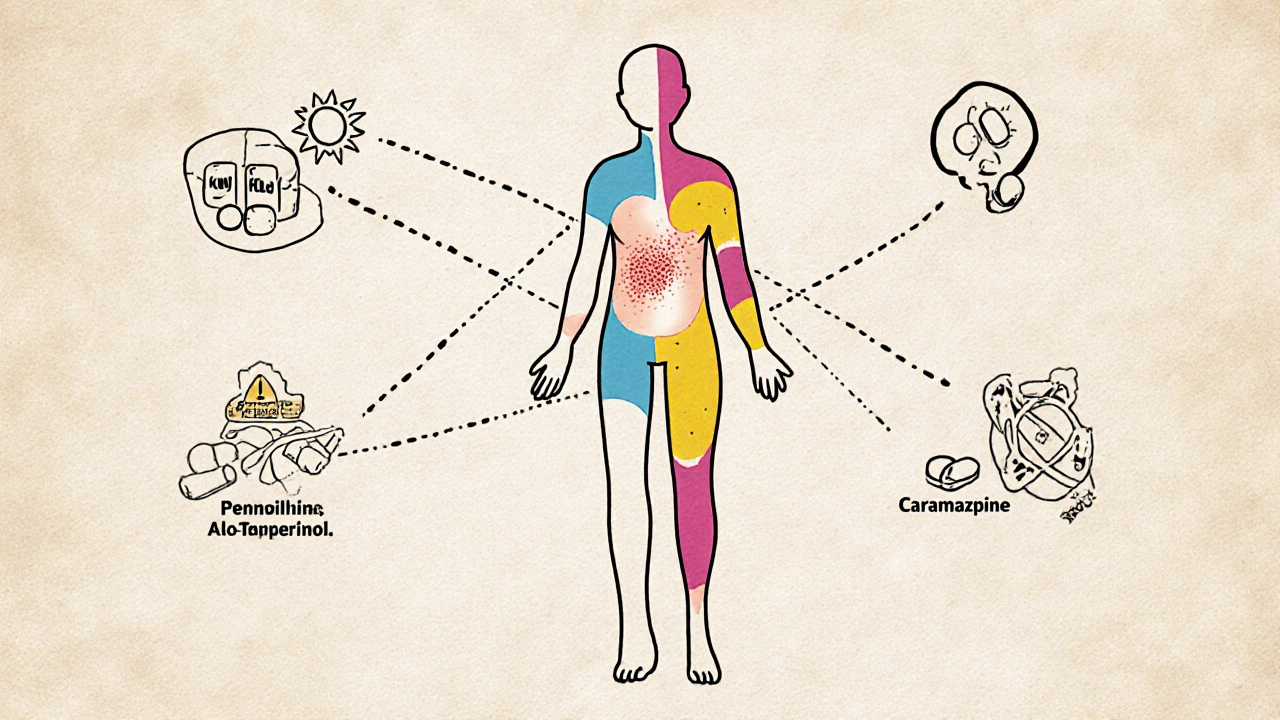
Anticonvulsants - drugs for seizures - are another big group. Carbamazepine, phenytoin, lamotrigine, and phenobarbital are linked to DRESS and SJS. Allopurinol, used for gout, is especially risky. In people with certain genes (like HLA-B*5801), the risk of a life-threatening reaction is 580 times higher.
Other high-risk drugs include:
- Minocycline and other tetracycline antibiotics
- Vancomycin
- Chemotherapy drugs
- Thiazide diuretics like hydrochlorothiazide
- Fluoroquinolones like ciprofloxacin
Photosensitivity is another hidden danger. Some drugs make your skin hyper-sensitive to sunlight. Doxycycline, ciprofloxacin, and hydrochlorothiazide can cause a rash that looks like a bad sunburn - even after brief sun exposure.
Allergic vs. Non-Allergic Reactions
Not every drug rash is an allergy. That’s a key point. Allergic reactions involve your immune system. Your body makes antibodies against the drug, then attacks it - releasing histamine and causing hives, swelling, or anaphylaxis. These usually happen after you’ve taken the drug before.
Non-allergic reactions are direct chemical effects. Your skin cells just get irritated. Aspirin, radiocontrast dye, and opioids like morphine often cause these. You might get hives or flushing without any immune involvement. You can’t test for these the way you test for penicillin allergies.
Timing tells the story. A rash that appears within an hour? Likely IgE-mediated allergy. A rash that shows up two weeks after starting a new drug? Almost always T-cell mediated - delayed, not allergic in the classic sense. This matters because delayed reactions are harder to spot and often mistaken for infections or other skin conditions.
Who’s at Higher Risk?
If you’re on five or more medications, your chance of developing a drug rash jumps to 35%. That’s because more drugs mean more chances for interactions and side effects. Older adults are especially vulnerable.
People with active viral infections - like Epstein-Barr virus (mono) or HIV - are 5 to 10 times more likely to get a severe rash from antibiotics, especially amoxicillin. The immune system is already on high alert, so it overreacts.
Those with weakened immune systems - from cancer, transplants, or autoimmune diseases - have a 3 to 5 times higher risk. And if you have a family history of severe drug reactions, your risk may be elevated too.
Genetics play a role. People of Southeast Asian descent with the HLA-B*1502 gene are at extreme risk for carbamazepine-induced SJS. Han Chinese with HLA-B*5801 have a 580-fold higher risk for allopurinol-induced reactions. Testing for these genes before prescribing can prevent tragedy.
What Should You Do If You Get a Rash?
Don’t panic. But don’t ignore it either.
For mild rashes - red spots, mild itching, no fever, no blistering - contact your doctor. Don’t stop your medication unless they tell you to. Some drugs, like seizure meds or blood pressure pills, can be deadly if stopped suddenly.
At home, you can try:
- Lukewarm baths with a gentle, soap-free cleanser
- Applying fragrance-free moisturizer within 3 minutes of bathing
- Over-the-counter hydrocortisone 1% cream twice a day
- Oral antihistamines like cetirizine or loratadine for itching
But if you see any of these signs, go to the ER immediately:
- Blisters or peeling skin
- Sores in your mouth, eyes, or genitals
- High fever or flu-like symptoms
- Swelling of the face, lips, or tongue
- Difficulty breathing or swallowing
These are red flags for SJS, TEN, or DRESS. Delaying care can be fatal.
How Is It Diagnosed?
There’s no single test for most drug rashes. Doctors rely on timing, symptoms, and eliminating other causes. They’ll ask: When did you start the drug? What else did you take? Did you have an infection? Have you had this rash before?
For suspected penicillin allergy, skin testing is now 95% accurate. If you think you’re allergic but never got tested, you might be avoiding a safe, effective drug unnecessarily. About 15% of people who say they’re allergic to penicillin can actually take it without issue.
For DRESS or SJS, blood tests show elevated eosinophils, liver enzymes, or kidney markers. Biopsies of the skin can confirm the type of reaction. Genetic testing is becoming more common for high-risk drugs in high-risk populations.
Diagnosing nummular dermatitis - coin-shaped patches - is tricky. Up to 40% of drug-induced cases are mistaken for eczema. If your rash doesn’t improve with standard eczema treatments, ask if a medication could be the cause.
How Is It Treated?
The first step is always stopping the drug - but only under medical supervision. For mild rashes, that’s often enough. The rash fades in 1 to 2 weeks.
For moderate cases, doctors may prescribe stronger topical steroids like clobetasol 0.05% ointment. Oral steroids like prednisone (0.5-1 mg/kg/day) are used for DRESS or severe reactions. Treatment can last 3 to 6 weeks.
SJS and TEN require hospitalization - often in a burn unit. Supportive care includes fluids, pain control, wound care, and preventing infection. There’s no proven drug therapy, though some centers use IVIG or cyclosporine. Outcomes depend on how fast treatment starts.
For photosensitivity, avoid sun exposure and switch to a non-reactive drug if possible. Sunscreen alone won’t fix it.
Can You Prevent It?
You can’t always prevent a drug rash, but you can reduce your risk.
- Keep a full list of all medications - including supplements and over-the-counter drugs - and share it with every doctor.
- Ask: “Could this cause a skin reaction?” before starting any new drug.
- If you’ve had a rash from a drug before, write it down and tell every provider. Don’t assume it was “just a rash.”
- For high-risk drugs like carbamazepine or allopurinol, ask if genetic testing is recommended for your background.
- Use the lowest effective dose for the shortest time possible.
- Watch for reactions after starting new drugs - especially antibiotics during viral infections.
Remember: A rash isn’t always a sign you’re allergic. But it’s always a sign your body is reacting. Listen to it. Tell your doctor. And never stop a vital medication on your own.
What Happens After the Rash Clears?
Most people recover fully. But you need to know what you’re allergic to - or sensitive to - going forward. Keep a written record. Add it to your medical file. Wear a medical alert bracelet if you’ve had a severe reaction.
Some drugs, like penicillin, can be retested safely years later. Skin testing can confirm whether you’ve outgrown the allergy.
Don’t assume you’re allergic to all drugs in the same class. If you had a rash from one antibiotic, you might still tolerate another. Always get tested before assuming.
And if you’ve had DRESS or SJS, avoid the triggering drug - and related ones - for life. Re-exposure can be fatal.
Can a drug rash appear days after stopping the medication?
Yes. Some drug rashes, especially morbilliform and DRESS types, can appear 1 to 2 days after you stop taking the drug. This happens because the immune system continues reacting even after the drug is cleared from your body. Don’t assume the rash means you’re getting better - it might mean your body is still responding.
Are all drug rashes allergic reactions?
No. Only about 15% of drug rashes are true IgE-mediated allergies. Most are delayed T-cell reactions or direct toxic effects. NSAIDs, for example, often cause non-allergic rashes. You can have a severe, blistering rash without your immune system being involved.
Can I take penicillin again if I had a rash as a child?
Maybe. About 15% of people who report a penicillin allergy in childhood can tolerate it as adults. Skin testing can confirm whether you’re still allergic. Many people outgrow it. Never assume you’re still allergic - get tested before refusing a potentially life-saving antibiotic.
Can I use steroid cream on a drug rash?
For mild rashes, over-the-counter hydrocortisone 1% cream is safe and helpful. For more severe cases, doctors may prescribe stronger steroids like clobetasol. But steroids don’t treat the cause - they only calm the inflammation. Stopping the drug is still the most important step.
Why do some people get rashes from drugs and others don’t?
It’s a mix of genetics, immune status, and drug metabolism. Certain genes like HLA-B*1502 or HLA-B*5801 make you far more likely to react. Viral infections, age, and taking multiple drugs also increase risk. Some people’s bodies break down drugs differently, leading to toxic buildup that irritates the skin.

8 Comments
Emily Craig
November 21 2025
Okay but like... why do we still let pharma companies push drugs that turn your skin into a volcano? I just took ibuprofen for a headache and now I’m side-eyeing every pill in my cabinet. This isn’t medicine, it’s Russian roulette with a prescription pad.
Shivam Goel
November 22 2025
The data is clear: 5.2% of patients on polypharmacy develop rashes; however, 87% of those cases are misdiagnosed as eczema or viral exanthems. The real issue lies in the absence of standardized pharmacovigilance protocols in primary care settings, compounded by EHRs that fail to flag high-risk drug-gene interactions (e.g., HLA-B*5801 + allopurinol). Without mandatory genetic screening in at-risk populations, we are merely delaying inevitable iatrogenic catastrophes.
Archana Jha
November 23 2025
they dont want you to know this but the rash is actually caused by the microchips in the pills that the government puts in to track you... also the FDA is owned by big pharma and they ban natural cures like turmeric and garlic which have been used for 5000 years... i got a rash after taking amoxicillin and then i drank lemon water and it vanished in 2 hours
giselle kate
November 23 2025
I’m tired of this weak-ass medical advice. You say ‘don’t panic’? What’s the point of having a body if you’re just supposed to tolerate being turned into a walking allergy? This isn’t science-it’s corporate damage control. We’re guinea pigs in a lab coat. And you want us to ‘ask our doctor’? My doctor doesn’t even know what a DRESS reaction is. Stop sugarcoating. Tell people to stop taking everything and live in a bunker.
Karen Willie
November 24 2025
I’ve seen so many patients panic over rashes and then stop life-saving meds on their own. It’s heartbreaking. If you get a mild rash, take a breath, document it, and call your provider. Don’t assume the worst. But also don’t ignore it. Your body is talking. Listen. And if you’ve had a bad reaction before? Write it down. Tell everyone. You’re not overreacting-you’re protecting your future self.
Leisha Haynes
November 25 2025
so i took minocycline for acne and got this weird red rash and thought oh great another dumb skin thing and then i saw the part about it being linked to sjs and like... i almost threw my pills in the toilet. i didnt. i called my dermatologist. she was like oh yeah that’s a thing. i switched meds. now i just have clear skin and no fear of dying from a zit. point is: dont be the person who googles symptoms and then ignores the ER signs
Aki Jones
November 26 2025
The systemic immunological cascade triggered by T-cell-mediated drug reactions-particularly in the context of HLA haplotype expression-is not merely a dermatological concern, but a multi-organ autoimmune destabilization event. The absence of routine pre-prescription genotyping in the U.S. healthcare infrastructure constitutes a state-sanctioned failure of preventive medicine. Furthermore, the normalization of NSAID-induced non-allergic dermatitis as 'benign' is a dangerous epistemological fallacy propagated by pharmaceutical marketing departments. The data is unequivocal: we are in a silent epidemic.
Amy Hutchinson
November 27 2025
wait so if i had a rash from penicillin when i was 8, does that mean i can’t take any antibiotics now? my mom says i’m allergic to everything. i just want to know if i can get a tooth pulled without dying. someone please tell me the truth.