
Danshen Interaction Risk Checker
Your Medication & Supplement Profile
This tool assesses your risk of dangerous interactions between Danshen and heart medications. Based on your inputs, it will show your risk level and recommended actions.
Risk Assessment Result
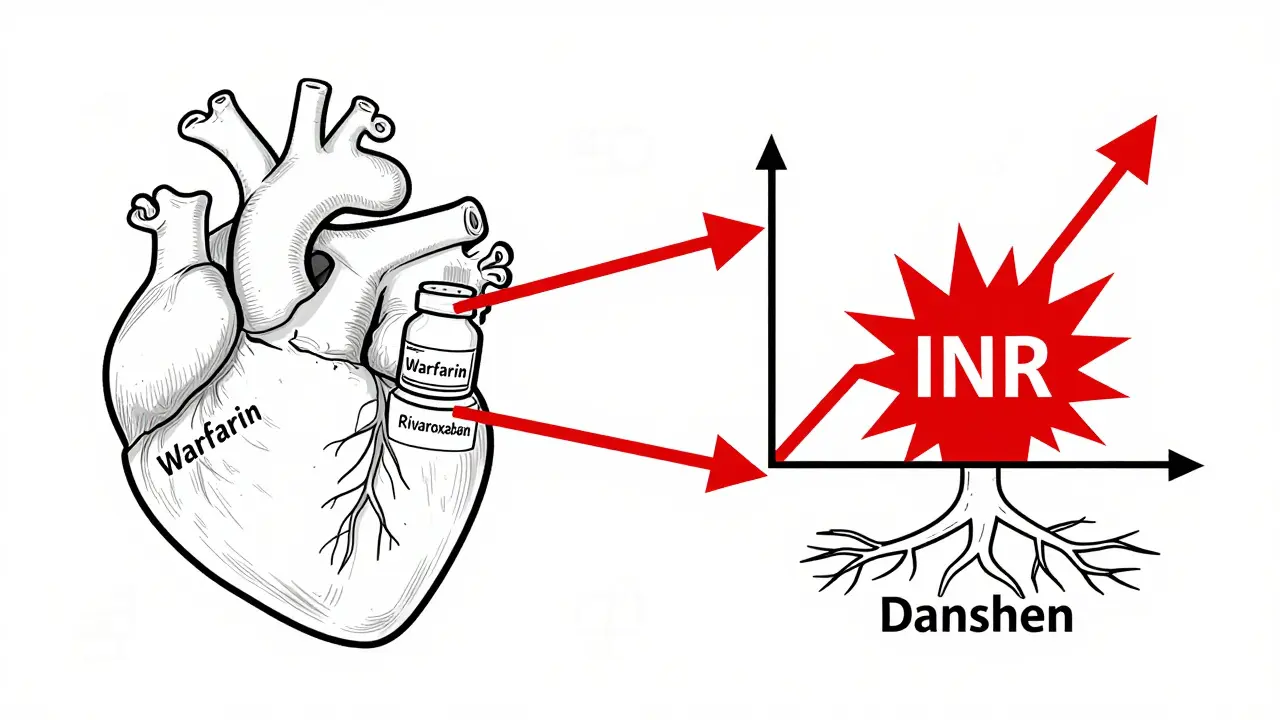
Many people turn to herbal supplements like Danshen thinking they’re safe because they’re natural. But when you’re taking heart medications-especially blood thinners-this assumption can be deadly. Danshen, also known as red sage or Chinese sage, has been used for centuries in Traditional Chinese Medicine to support heart health. Today, it’s sold widely in the U.S. and Europe as a supplement for circulation, angina, and stroke prevention. But here’s the truth: combining Danshen with common heart drugs like warfarin, rivaroxaban, or aspirin can send your INR levels through the roof, leading to uncontrolled bleeding, emergency hospital visits, and even death.
What Exactly Is Danshen?
How Danshen Interacts With Blood Thinners
Danshen doesn’t just gently thin your blood-it actively interferes with how your body processes prescription anticoagulants. It inhibits the CYP2C9 enzyme, the same liver enzyme that breaks down warfarin. When this enzyme is blocked, warfarin builds up in your bloodstream. One study showed Danshen reduced warfarin metabolism by 73%. That’s not a small effect. It’s like doubling your dose without telling your doctor.
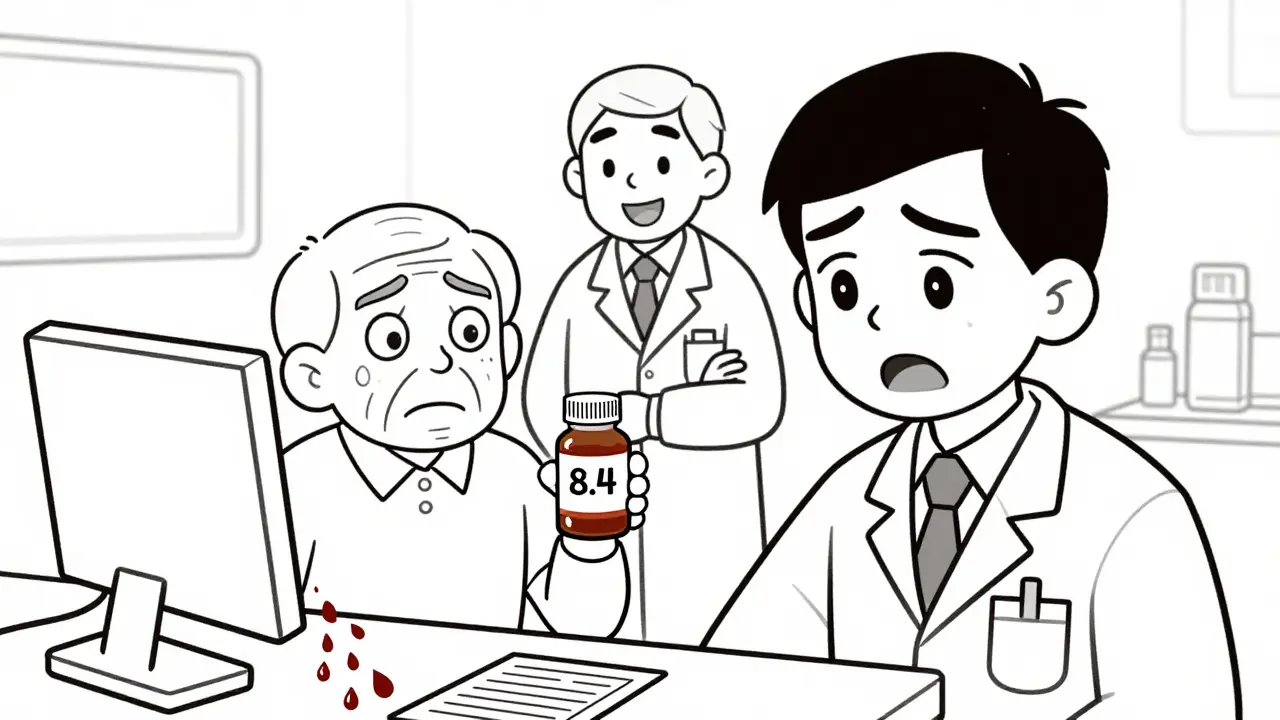
Case reports from the Cleveland Clinic are chilling. A 62-year-old man on warfarin for a mechanical heart valve took Danshen for two weeks. His INR-normally kept between 2.5 and 3.5-spiked to over 8.4. His hemoglobin dropped to 7.6 g/dL (normal is 13-17). He needed a blood transfusion. Another patient, a 48-year-old woman, saw her INR jump from 2.0 to 5.6 after taking Danshen every other day for a month. She almost bled internally. These aren’t rare anomalies. Between 2015 and 2019, 17 documented cases of Danshen-warfarin interactions occurred in Taiwan alone. All involved INR levels above 5.0.
Danger Doesn’t Stop at Warfarin
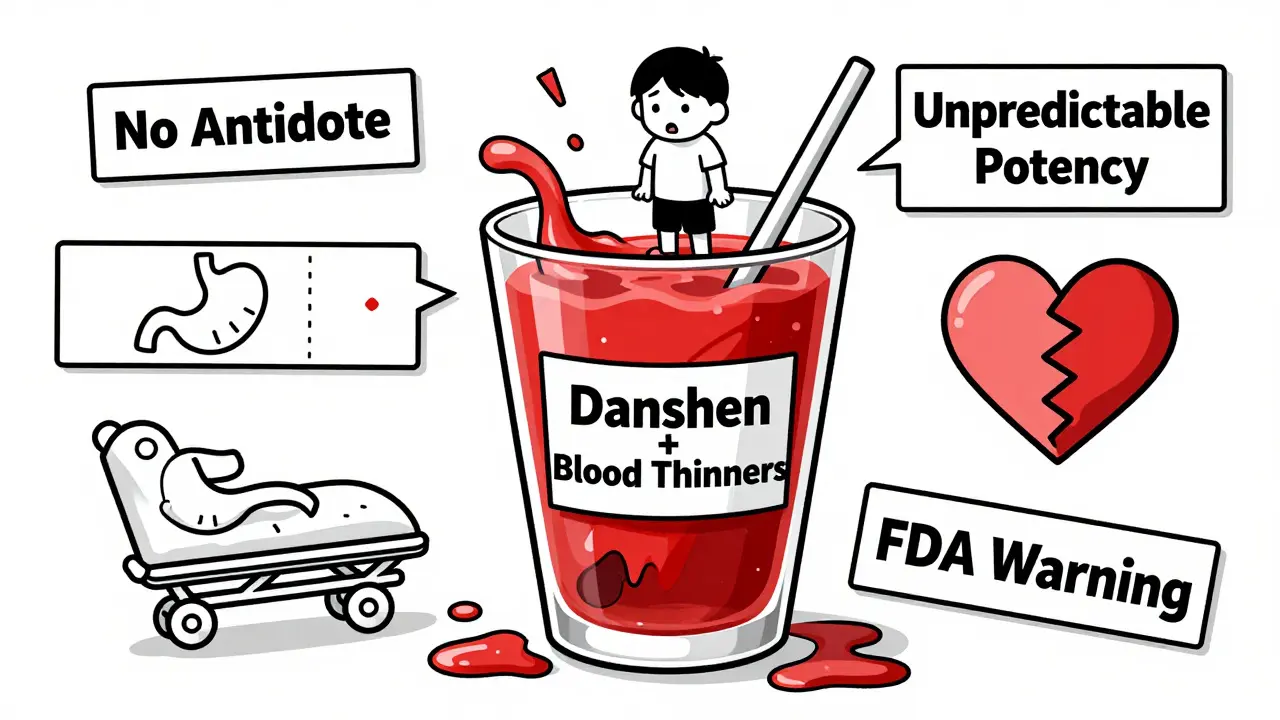
People think switching to newer blood thinners like rivaroxaban (Xarelto) or apixaban (Eliquis) makes them safe from herbal interactions. It doesn’t. A 2022 NIH study found Danshen strongly inhibits the metabolism of rivaroxaban. That means even if you’re not on warfarin, Danshen can still make your anticoagulant too strong. There’s no easy way to reverse this effect. With warfarin, you can give vitamin K. With rivaroxaban, you have andexanet alfa-but Danshen? No antidote exists. If you start bleeding, doctors can only try to manage it. That’s a terrifying gap in safety.
Real Patients, Real Consequences
Reddit threads from r/anticoagulants are full of stories like this: “My INR went from 2.5 to 6.0 after my TCM practitioner prescribed Danshen with my Eliquis.” “ER visit after taking Danshen with warfarin-never again.” These aren’t exaggerations. One man in his 60s had a bleeding gastric tumor. His INR was 5.5-after taking Danshen for just three days. He had no idea it could do this. Most patients don’t. A 2019 JAMA study found only 28% of people taking herbal supplements told their doctor. Why? They assume it’s harmless. Or they’re afraid their doctor will dismiss them. Either way, the silence kills.
Why Doctors Can’t Just Monitor Their Way Out
You might think, “I’ll just get my INR checked more often.” But that’s not enough. Danshen’s effects are unpredictable. Even if your INR is normal one week, it could spike the next because of a different batch of supplements. The Chinese Pharmacopoeia says Danshen products vary wildly in potency. There’s no way to standardize it. RxList admits there’s “not enough scientific information to determine an appropriate range of doses.” That’s not just a gap-it’s a red flag. No doctor can safely adjust your warfarin dose if they don’t know how strong the Danshen is. And most don’t even know you’re taking it.
Who’s at Highest Risk?
Chinese immigrants in the U.S. are disproportionately affected. A 2021 study found 41.7% regularly used Danshen while on heart medications-and only 32.4% told their doctor. Older adults, people with mechanical heart valves, and those with atrial fibrillation are especially vulnerable. The American College of Cardiology now recommends screening all patients on anticoagulants for Danshen use, especially those of Asian descent. But without routine questions from providers, these risks stay hidden.
What About Other Heart Medications?
Danshen doesn’t just play rough with blood thinners. It can also lower blood pressure. If you’re on beta-blockers, ACE inhibitors, or calcium channel blockers, adding Danshen could drop your pressure too far-leading to dizziness, fainting, or falls. It may also interfere with statins or antiplatelet drugs like clopidogrel. The interactions aren’t fully mapped, but the pattern is clear: Danshen has multiple active compounds that act on several biological pathways at once. That’s the opposite of how modern drugs are designed. Pharmaceutical companies test one compound at a time. Danshen is a cocktail. And your body doesn’t know how to handle it safely alongside your prescriptions.
What Should You Do?
If you’re taking any heart medication-especially anticoagulants-stop taking Danshen immediately. Don’t wait for symptoms. Don’t assume “it’s just herbs.” The American Heart Association says it plainly: “Natural does not mean safe.”
If you’ve been taking Danshen and are on warfarin or another blood thinner, get your INR tested right away. Tell your doctor exactly what you’ve been taking-even if you think they’ll judge you. Your life depends on it.
If you want to support heart health naturally, talk to your doctor about proven options: regular exercise, a Mediterranean diet, omega-3s from fish oil (with caution), and quitting smoking. None of those carry the same risk as Danshen.
Why Is This Still Happening?
The global Danshen market is projected to hit $1.84 billion by 2027. Companies sell it as “heart-healthy,” “natural,” and “traditional.” Labels don’t warn about interactions. Online retailers don’t screen for prescriptions. Even some TCM practitioners, trained in China where Danshen is regulated, don’t understand how it interacts with Western drugs. Meanwhile, the FDA has issued multiple warnings about unapproved Danshen products. The European Medicines Agency requires labeling about anticoagulant risks-but in the U.S.? Nothing. The gap between science and sales is wide, and people are falling into it.
Bottom Line: Don’t Risk It
Danshen isn’t a harmless supplement. It’s a pharmacologically active substance with documented, life-threatening interactions. There’s no safe dose when combined with heart medications. No monitoring protocol can fully protect you. No “natural” label changes the chemistry. If you’re on warfarin, rivaroxaban, apixaban, clopidogrel, or any blood thinner-don’t take Danshen. Period. If you’re already taking it, stop. And tell your doctor. Your heart deserves more than guesswork.

15 Comments
Naomi Walsh
January 31 2026
Danshen is a classic example of why ‘natural’ is the most dangerous word in supplement marketing. People treat herbal remedies like they’re exempt from pharmacology, but Salvia miltiorrhiza is a potent CYP2C9 inhibitor-period. The fact that it’s sold without dosage standardization in the U.S. is a regulatory failure, not a cultural tradition. If you wouldn’t ingest a raw plant extract without knowing its active compound concentration, why treat Danshen differently? The data is overwhelming: uncontrolled INR spikes, transfusions, ER visits. This isn’t anecdotal-it’s epidemiological. Stop romanticizing ‘ancient wisdom’ when it’s killing people on warfarin.
And yes, I’ve seen the Reddit threads. The people who say ‘my TCM practitioner said it’s fine’ are the same ones who didn’t tell their cardiologist they were taking it. That’s not cultural competence-that’s negligence wrapped in cherry blossom tea.
There’s no such thing as ‘natural and safe’ when it interacts with life-saving pharmaceuticals. The burden of proof isn’t on the doctor to ask-it’s on the consumer to disclose. And if you’re not disclosing, you’re not a patient-you’re a liability.
Also, the $1.84 billion market projection? That’s not progress. That’s exploitation. Companies are monetizing ignorance. The FDA’s silence is complicity.
Bottom line: if your supplement doesn’t have a DEA code, it shouldn’t be mixed with anticoagulants. Period.
June Richards
February 2 2026
OMG YES. I had a friend who took Danshen with Eliquis and ended up in the ER with a hematoma the size of a grapefruit 😭 I told her it was a bad idea but she was like ‘but it’s herbal!’ Like… so is arsenic? 🤦♀️
Why do people think ‘traditional’ = ‘safe’? My grandma used to rub lard on her chest for a cough. Doesn’t mean I’m gonna do it.
Also-why is this even legal? I can’t buy a cough syrup without a warning label, but I can buy a bottle of Danshen that says ‘supports heart health’ and no mention of ‘may cause internal bleeding’? Wtf.
Lu Gao
February 2 2026
Interesting post-but I think you’re overlooking one key point: Danshen is not inherently dangerous. It’s the lack of regulation and patient education that’s dangerous. In China, it’s administered under strict clinical protocols with monitored dosing and patient screening. The problem isn’t the herb-it’s the American supplement industry’s Wild West approach to everything.
Also, ‘natural doesn’t mean safe’ is a slogan, not a scientific principle. Many of our most effective drugs-morphine, aspirin, paclitaxel-come from plants. The issue isn’t nature. It’s unstandardized, unregulated, unlabeled extraction.
What we need is not a ban, but a labeling law: ‘This product contains Salvia miltiorrhiza. May interact with anticoagulants. Consult your physician.’ Simple. Effective. Not scary. Just factual.
And for the love of all that’s holy, can we stop calling people ‘stupid’ for using herbs? They’re not trying to kill themselves. They’re trying to feel better. We need compassion, not condescension.
Nidhi Rajpara
February 3 2026
I am from India and I have seen many people using this herb without any knowledge. My uncle was on warfarin and he started taking Danshen because his friend said it was good for heart. He had bleeding in stomach and was hospitalized for 12 days. Now he is fine but he says he will never take any herbal medicine without doctor's advice. This is very serious issue and must be taught in schools. People think if it is from nature then it is safe. But poison is also from nature. Please educate people before it is too late.
Donna Macaranas
February 3 2026
Thanks for sharing this. I’ve been on apixaban for AFib for 5 years and had no idea Danshen was even a thing. I’ve seen it in health stores labeled as ‘circulation support’-never thought twice. I just threw mine out.
Also, I’m glad you mentioned the 28% disclosure rate. I think a lot of us are scared to bring up supplements because we think doctors will roll their eyes. But honestly? Most of them just want to keep us safe. Next time I see mine, I’m bringing a list of everything I’ve taken-even the ‘harmless’ stuff.
Nicki Aries
February 4 2026
This is one of the most important public health alerts I’ve read in years. And yet-no one talks about it. Not on TV. Not in pharmacies. Not even in most TCM clinics in the U.S.
Why? Because the supplement industry doesn’t want you to know. Because the FDA is underfunded. Because doctors are overworked and don’t have time to ask about ‘herbs.’
But here’s the truth: if you’re on a blood thinner, you are a walking time bomb if you’re taking anything labeled ‘heart health,’ ‘circulation,’ or ‘traditional Chinese formula’-unless you’ve verified it with a pharmacist who understands pharmacokinetics.
I’m not saying don’t use herbs. I’m saying: know what’s in them. Know how they work. And never assume safety. Ever.
And if you’re a doctor? Ask. Every. Single. Time.
Because someone’s life? Depends on it.
Melissa Melville
February 5 2026
So… let me get this straight. You’re telling me that the same herb my grandma used for ‘bad blood’ is now a FDA red flag? And we’re all just now finding out because Big Pharma doesn’t want us to know? 😏
Look, I get it. It’s dangerous. But also… kinda ironic? We spent 50 years dismissing traditional medicine as ‘woo,’ and now we’re terrified of it because it actually works? 🤷♀️
Anyway-stop taking it. Tell your doc. Don’t be embarrassed. We’ve all done dumb stuff with supplements. I once took ‘energy boost’ pills with my beta-blockers. Turned out they had caffeine. I thought I was gonna die. I didn’t. But I learned.
Lesson: if it’s in a bottle with a picture of a leaf and no ingredients listed? Put it back.
Bryan Coleman
February 6 2026
As a pharmacist, I see this every month. Someone comes in with a bottle of Danshen, says they’re on warfarin, and looks confused when I say, ‘You need to stop this immediately.’
It’s not that they’re dumb. They’re just never told. The supplement industry doesn’t have to list interactions. The labels say ‘support heart health’-no mention of CYP2C9 inhibition, no mention of INR spikes, no mention of bleeding risk.
And doctors? We’re lucky if they ask about vitamins. Most don’t ask about herbs at all.
Here’s what I tell patients: if it’s not on your prescription list, and it’s not in your pharmacy’s database, assume it interacts. Especially if it’s marketed for ‘heart’ or ‘circulation.’
And yes-I’ve seen the INR charts. They look like roller coasters. One week normal. Next week 8.5. No changes in diet. No new meds. Just Danshen.
Stop. Talk. Get tested.
It’s that simple.
Naresh L
February 7 2026
There’s a deeper question here: why do we treat Western medicine as ‘scientific’ and Eastern medicine as ‘spiritual’? Danshen isn’t magic. It’s biochemistry. It has compounds that bind to enzymes, alter metabolism, and affect clotting pathways. The fact that we’ve known this for decades doesn’t make it less true-it makes our failure to act more tragic.
Perhaps the real issue isn’t Danshen. It’s our cultural dualism: the belief that science and tradition are opposites. They’re not. They’re complementary. But only if we treat both with rigor.
China regulates Danshen because they understand its pharmacology. We don’t regulate it because we refuse to see herbal medicine as medicine at all.
Until we bridge that gap, people will keep dying-not because of tradition, but because of ignorance.
Sami Sahil
February 8 2026
Bro this is wild. I was just at the store yesterday and saw Danshen next to turmeric. Thought it was just another ‘super herb.’ Now I’m scared. I’ve got my dad on blood thinners and he’s been taking it for ‘better circulation.’ Gonna call him right now.
Also-why does no one warn you? It’s like the supplement world is a black hole of ‘trust me bro’ advice.
Y’all need to make a meme about this. ‘Danshen + Warfarin = ER Trip’ with a skull emoji. People remember memes. They don’t remember JAMA studies.
franklin hillary
February 8 2026
Let’s be real: this isn’t about Danshen. It’s about the entire supplement industry being a regulatory loophole designed to profit from human hope.
We let companies sell pills with no active ingredient disclosure, no clinical trials, no safety data, no interaction warnings-and then act shocked when people get hurt?
The FDA’s inaction isn’t negligence. It’s policy. The Dietary Supplement Health and Education Act of 1994 made it nearly impossible to regulate herbs. So now we have a $100 billion industry built on placebo, pseudoscience, and dead patients.
Danshen is just the tip. Next up: ginkgo with SSRIs. St. John’s wort with statins. Licorice root with diuretics.
We’re not just failing patients. We’re failing science. And we’re failing ethics.
Fix the law. Not just the labels.
Because the next person who dies from a ‘natural’ supplement? Could be your mom. Your brother. You.
Bob Cohen
February 9 2026
Yeah, I get it. Danshen’s dangerous. But let’s not pretend this is unique. Ever heard of grapefruit and statins? Or vitamin K and warfarin? Or licorice and hypertension meds? We’ve known for decades that ‘natural’ stuff interferes with prescriptions.
So why is Danshen the villain? Because it’s ‘foreign’? Because it’s ‘herbal’? Because it’s cheaper than a pill?
Maybe the real problem is that we’re still treating patients like they’re dumb. Like if we just give them a warning label, they’ll magically understand. But most people don’t know what CYP2C9 is. They don’t know what INR means. They just know ‘this thing helped my chest pain.’
So maybe instead of shaming them, we need to talk to them. In plain language. With empathy. And maybe-just maybe-ask them what they’re taking before they leave the office.
It’s not about fear. It’s about connection.
Ishmael brown
February 11 2026
Wait-so if Danshen is so dangerous, why is it still on the shelves? Why isn’t the FDA banning it? Why are TCM practitioners still prescribing it? Why are pharmacies selling it like it’s a vitamin?
Because it’s profitable.
And because someone, somewhere, is making money off your ignorance.
And you know what? I’m not mad at the people taking it. I’m mad at the system that lets this happen.
Also-has anyone checked if the ‘Danshen’ you bought even contains Danshen? A 2020 study found 37% of herbal supplements in the U.S. were adulterated or substituted. So you might not even be getting the herb. You might be getting something worse.
So yeah. Stop taking it.
But also? Demand better.
Aditya Gupta
February 12 2026
My aunt took Danshen with aspirin and got dizzy. Went to clinic. Doctor said stop it. She did. Now she’s fine. But she didn’t know it was dangerous. No one told her. Please make posters in clinics. In pharmacies. In grocery stores. People need to know. Not just the internet. Real places. Real people. This is life or death. Don’t wait for someone to die before you act.
June Richards
February 13 2026
Also-just saw a comment about ‘TCM practitioners’ recommending it. Bro, if your TCM practitioner doesn’t know about CYP2C9, they’re not a practitioner. They’re a guy with a book and a sign. 🤡
There are legit TCM doctors who understand Western pharmacology. But most? They’re selling ‘energy flow’ and ‘yin yang balance’ while ignoring liver enzymes. That’s not healing. That’s gambling.
And if they’re not asking about your meds? Walk out.