
When your immune system turns against your own body, things get complicated. Autoimmune diseases like Guillain-Barré syndrome, chronic inflammatory demyelinating polyneuropathy (CIDP), and immune thrombocytopenia don’t respond to simple fixes. That’s where IVIG therapy comes in - a treatment that doesn’t suppress your immune system, but quietly resets it.
What Exactly Is IVIG Therapy?
IVIG stands for intravenous immunoglobulin. It’s not a drug you take as a pill. It’s a concentrated solution of antibodies - the body’s natural defense proteins - collected from thousands of healthy blood donors. These antibodies are purified, pooled, and given directly into your vein. The goal isn’t to replace missing antibodies (like in immune deficiencies), but to calm down an overactive immune system that’s attacking your nerves, skin, muscles, or blood cells. It’s been around since the 1950s, but its use in autoimmune conditions really took off in the 1980s. Today, it’s a go-to option for conditions where other treatments have failed or aren’t safe - especially in pregnant women, children, or people with fragile health.How Does IVIG Actually Work?
It’s not just about adding more antibodies. IVIG works in multiple ways, like a multi-tool for the immune system:- It blocks harmful autoantibodies from binding to your tissues.
- It shuts down inflammatory signals that cause swelling and damage.
- It stops immune cells called macrophages from eating your own platelets or nerve coverings.
- It tweaks how T-cells and B-cells behave, helping them stop attacking your body.
Which Autoimmune Conditions Respond to IVIG?
IVIG isn’t a cure-all. But for certain conditions, it’s either first-line or a critical backup:- Kawasaki disease (in kids): Given within 10 days of fever, it cuts the risk of heart damage by 95%.
- Guillain-Barré syndrome (GBS): A first-line treatment that speeds up recovery and reduces need for breathing support.
- Chronic Inflammatory Demyelinating Polyneuropathy (CIDP): About 60-80% of patients see improvement. Many need repeat treatments every 3-6 weeks.
- Immune Thrombocytopenia (ITP): Used when steroids fail. Works fast, but the effect lasts only 3-4 weeks.
- Dermatomyositis and Polymyositis: Muscle strength improves in 68% of patients within 4 weeks.
- Systemic Lupus Erythematosus (SLE): Used in severe cases, especially with low platelets or kidney involvement.
What to Expect During Treatment
Getting IVIG isn’t quick. Each infusion takes 3 to 6 hours. You’ll sit in a clinic or hospital while the solution drips slowly into your vein. The first dose usually starts slow - about half a milliliter per kilogram of body weight per hour - and gets faster if you tolerate it. Most people don’t feel much during the infusion. But side effects are common. About 10-15% get headaches. Around 5-10% feel chills, nausea, or a low fever. These usually go away within a day. Only 5% have moderate or severe reactions, and serious ones (like kidney damage or blood clots) happen in less than 0.5% of infusions. You’ll be monitored during and after the infusion. Nurses watch your blood pressure, temperature, and how you’re feeling. If you have heart or kidney problems, your dose may be lowered to avoid fluid overload.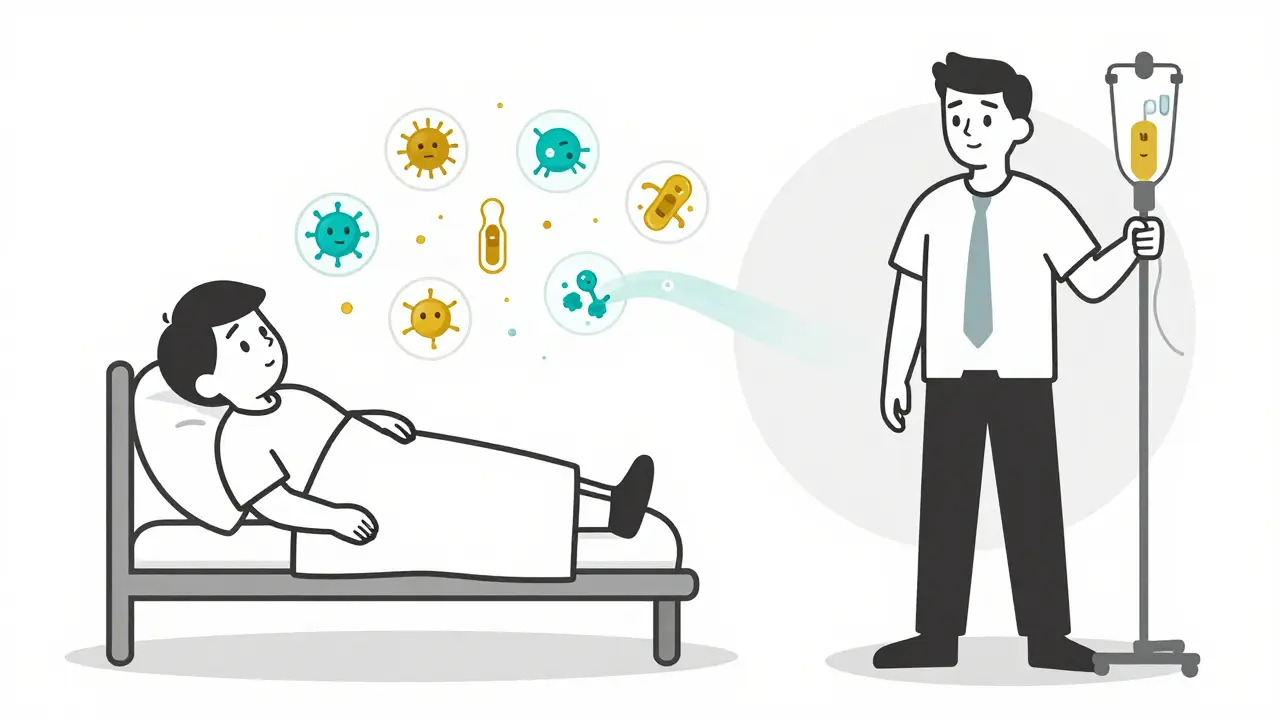
How Often Do You Need It?
IVIG doesn’t last. Your body breaks it down over weeks. For most autoimmune conditions, you’ll need repeat treatments every 2 to 8 weeks. That’s a big commitment. A 2023 Neurology survey found that 35% of CIDP patients stopped IVIG because they couldn’t keep up with the schedule. Each session takes half a day. Traveling to a clinic every month adds up - especially if you’re already fatigued from the disease. Some people get better and can space treatments out. Others need lifelong therapy. It depends on the disease, how well you respond, and your body’s ability to clear the antibodies.IVIG vs. Other Treatments
What makes IVIG stand out?- Speed: Most drugs like methotrexate or mycophenolate take 6-12 weeks to work. IVIG can help in days.
- Safety: Unlike steroids, it doesn’t cause weight gain, bone loss, or mood swings. Unlike biologics, it doesn’t increase infection risk as much.
- Convenience: Compared to plasma exchange (PLEX), IVIG doesn’t need complex machines or special centers. You just need an IV line.
- Cost: One treatment cycle can cost $5,000 to $10,000 in the U.S. Insurance often covers it, but prior authorization is common.
- Supply: IVIG comes from human blood. Global demand has grown 300% in the last decade. Shortages happen.
- Temporary relief: It doesn’t fix the root cause. It buys time - which is often exactly what patients need.
Who Shouldn’t Get IVIG?
Not everyone is a candidate. You should avoid IVIG if you:- Have a history of severe allergic reactions to immunoglobulin products.
- Have IgA deficiency and antibodies against IgA (rare, but can cause anaphylaxis).
- Have severe heart failure or kidney disease - the fluid load can be dangerous.
- Are dehydrated or have very high blood viscosity.

What’s New in IVIG?
Science is moving fast. Researchers at Rockefeller University have created a lab-made version that’s 10 to 100 times more potent than current IVIG. It uses far less antibody material and could cut costs and side effects dramatically. It’s still in animal testing, but the results are promising. Another breakthrough: adding specific sugar molecules (sialylated glycans) to IVIG boosts its anti-inflammatory power. This could mean lower doses - and fewer side effects. Combination therapy is also gaining ground. A 2024 review found that pairing IVIG with rituximab (a drug that targets B-cells) worked in 92% of patients with severe, treatment-resistant autoimmune conditions. And yes - IVIG is now being studied for long COVID autoimmune symptoms. Early data suggests it may help fatigue and brain fog in some patients.Real Patient Outcomes
A woman in her 50s with CIDP couldn’t walk without a cane. After three IVIG cycles over 8 weeks, she could climb stairs again. She still gets treatments every 5 weeks - but she’s working part-time and playing with her grandchildren. A child with Kawasaki disease got IVIG on day 7 of fever. His heart scan came back normal. He’s now 10, healthy, and plays soccer. But not everyone responds. Older patients with GBS tend to do worse. Some kids with Kawasaki disease don’t improve - and need a second dose or other treatments. The key? Early treatment. Waiting too long reduces IVIG’s effectiveness.Where to Get Support
Managing IVIG therapy isn’t just medical - it’s logistical. You need to coordinate infusions, insurance, and side effect management. The American Autoimmune Related Diseases Association (AARDA) offers free guides used by 78% of IVIG centers. They help patients understand what to expect, how to advocate for themselves, and where to find financial aid. Many clinics now offer home infusion services. A nurse comes to your house with the equipment. It’s more comfortable - and saves travel time. But it’s not available everywhere.Final Thoughts
IVIG therapy isn’t glamorous. It’s expensive. It’s time-consuming. But for people with autoimmune diseases who’ve run out of options, it’s often the difference between being bedridden and being able to live. It doesn’t cure. But it restores. And in autoimmune disorders, that’s everything.How long does IVIG take to work for autoimmune conditions?
Most patients see improvement within 3 to 14 days after the first infusion. For conditions like immune thrombocytopenia, platelet counts can rise in as little as 24 hours. In neurological conditions like CIDP or GBS, muscle strength and nerve function may improve over 1 to 4 weeks. The speed depends on the disease, how advanced it is, and individual biology.
Is IVIG therapy safe for pregnant women?
Yes, IVIG is one of the safest options for autoimmune conditions during pregnancy. Unlike steroids or biologics, it doesn’t cross the placenta in large amounts and doesn’t harm fetal development. It’s commonly used to treat conditions like immune thrombocytopenia or myositis in pregnant patients when other drugs are too risky.
Can you take IVIG at home?
Yes, but only with subcutaneous immunoglobulin (SCIG), which is a different formulation given under the skin weekly. Standard IVIG requires intravenous infusion and is usually done in clinics or hospitals. Home IVIG is possible in some regions with trained nurses, but it’s less common than SCIG due to higher volume and longer infusion times.
Does IVIG weaken your immune system?
No, IVIG doesn’t suppress your immune system like chemotherapy or steroids. Instead, it modulates it - calming harmful activity without making you more prone to infections. In fact, many patients on long-term IVIG have fewer infections because their immune system becomes more balanced.
Why is IVIG so expensive?
IVIG is made from human plasma, which requires collecting blood from thousands of donors, then purifying, testing, and sterilizing it to remove viruses. The process is complex, time-consuming, and heavily regulated. Only four companies control most of the global supply, and demand keeps rising. A single treatment cycle can cost $5,000-$10,000, though insurance often covers it for approved conditions.
Are there alternatives to IVIG for autoimmune diseases?
Yes, depending on the condition. Plasma exchange (PLEX) is similar in effectiveness for GBS and CIDP but requires specialized equipment. Steroids, rituximab, and immunosuppressants like mycophenolate are common alternatives. For ITP, drugs like romiplostim offer longer-lasting effects. But IVIG remains unique for its speed, safety in pregnancy, and low infection risk - making it irreplaceable in many cases.
How do you know if IVIG is working for you?
It depends on your condition. For ITP, your doctor checks your platelet count. For CIDP or GBS, they measure muscle strength, nerve conduction, and your ability to walk or grip. In myositis, improved ability to climb stairs or lift objects is a key sign. Most patients report less fatigue, less pain, and better daily function within weeks. If no improvement is seen after two cycles, your doctor may consider other options.

13 Comments
suhani mathur
December 24 2025
Okay but let’s be real - IVIG is basically magic juice made from thousands of strangers’ blood. And yet, it works faster than my coffee kicks in. I’ve seen CIDP patients go from wheelchairs to walking within weeks. The cost? Insane. The relief? Priceless. I’d take a monthly infusion over another steroid-induced meltdown any day.
Diana Alime
December 24 2025
ivig is sooo expensive like whyyyyyy?? i mean i get it’s from blood but like… can’t we just make it in a lab?? my cousin got it for gbs and now she’s got debt for life. also i cried during the infusion bc the nurse said ‘this is gonna save you’ and i was like… okay but i’m 23??
Adarsh Dubey
December 26 2025
There is a significant body of clinical evidence supporting IVIG’s mechanism of action in autoimmune modulation, particularly through Fc receptor blockade and cytokine regulation. The data on ITP response rates above 80% is consistent across multiple randomized trials. It’s not a cure, but it is one of the few therapies that offers rapid, reversible immunomodulation without broad immunosuppression.
Bartholomew Henry Allen
December 27 2025
USA makes the best IVIG. Other countries don’t have the donor infrastructure or the regulatory rigor. We export this life-saving product to the world and get nothing but complaints. We fund the research. We pay the costs. We supply the blood. Don’t act like you can just copy it. This is American science.
Andrea Di Candia
December 27 2025
It’s wild how something so simple - pouring antibodies from donors into a vein - can quietly reset a broken immune system. We’re not fixing the root cause, but we’re giving people back their lives. That’s not medicine. That’s grace. And the fact that it works in pregnancy? That’s the kind of science that makes me believe in humanity again.
claire davies
December 28 2025
Oh my goodness, I just had to share this - my sister in London got SCIG at home last year after years of clinic visits. The nurse came every Sunday with a little cooler, set up the pump, and we watched Netflix while the antibodies dripped in. She said it felt like getting a hug from science. Now she’s gardening again, and her grandkids call her ‘Super Gran’. IVIG isn’t glamorous, but it’s the quiet hero of autoimmune care. 🌿❤️
Raja P
December 29 2025
My uncle got IVIG for CIDP and it saved his legs. He’s still on it every 6 weeks, but he drives now. The side effects? Yeah, headaches suck. But compared to being stuck in bed? No contest. I wish more people knew about this. It’s not magic, but it’s close.
Joseph Manuel
December 30 2025
While IVIG demonstrates efficacy in certain autoimmune conditions, its cost-benefit ratio is unsustainable. The reliance on human plasma introduces significant supply chain vulnerabilities. Moreover, the temporary nature of therapeutic effect necessitates chronic administration, which is both economically and logistically inefficient. Alternative modalities such as monoclonal antibodies offer superior specificity and durability. IVIG should be reserved for refractory cases only.
Spencer Garcia
December 30 2025
First infusion? Nausea. Second? Headache. Third? I could hold my grandbaby. Worth every minute. Don’t let the cost scare you - insurance usually covers it if you fight for it. And yeah, it’s a chore… but so is being paralyzed.
Lindsey Kidd
January 1 2026
IVIG is the MVP of autoimmune care 🙌 I know people who were in wheelchairs and now hike. I know moms who got it during pregnancy and their babies are healthy. It’s not perfect, but it’s a miracle in a bag. Also - home infusion = life changed. 🏡💉 #IVIGWarrior
Rachel Cericola
January 3 2026
Let’s stop pretending IVIG is a gentle treatment. It’s expensive, it’s invasive, it’s a time-suck, and it comes with real risks - kidney damage, thrombosis, anaphylaxis. Yes, it works. But we’re treating symptoms like they’re the enemy, not the signal. We need to stop celebrating IVIG as if it’s a cure and start demanding better science. We owe patients more than temporary fixes wrapped in placebo-level hope.
Blow Job
January 4 2026
I used to think IVIG was just a bandaid. Then my brother got it for GBS after the hospital said he might never walk again. Three cycles later, he stood up. Not perfect. Not cured. But alive. And that’s more than most treatments give you. I don’t care how much it costs - if it gives someone back their life, it’s worth every penny. Thanks to the donors. Seriously. Those people are heroes.
Christine Détraz
January 5 2026
My mom’s on IVIG for lupus nephritis. She’s 72. Last year she couldn’t get out of the chair. This year? She’s baking pies. The infusions are rough - she hates the chills, the headaches, the waiting. But she says, ‘I’d rather feel like crap for a day than not be here to see my grandkids graduate.’ I don’t know what’s more powerful - the science or the will. Maybe both.