
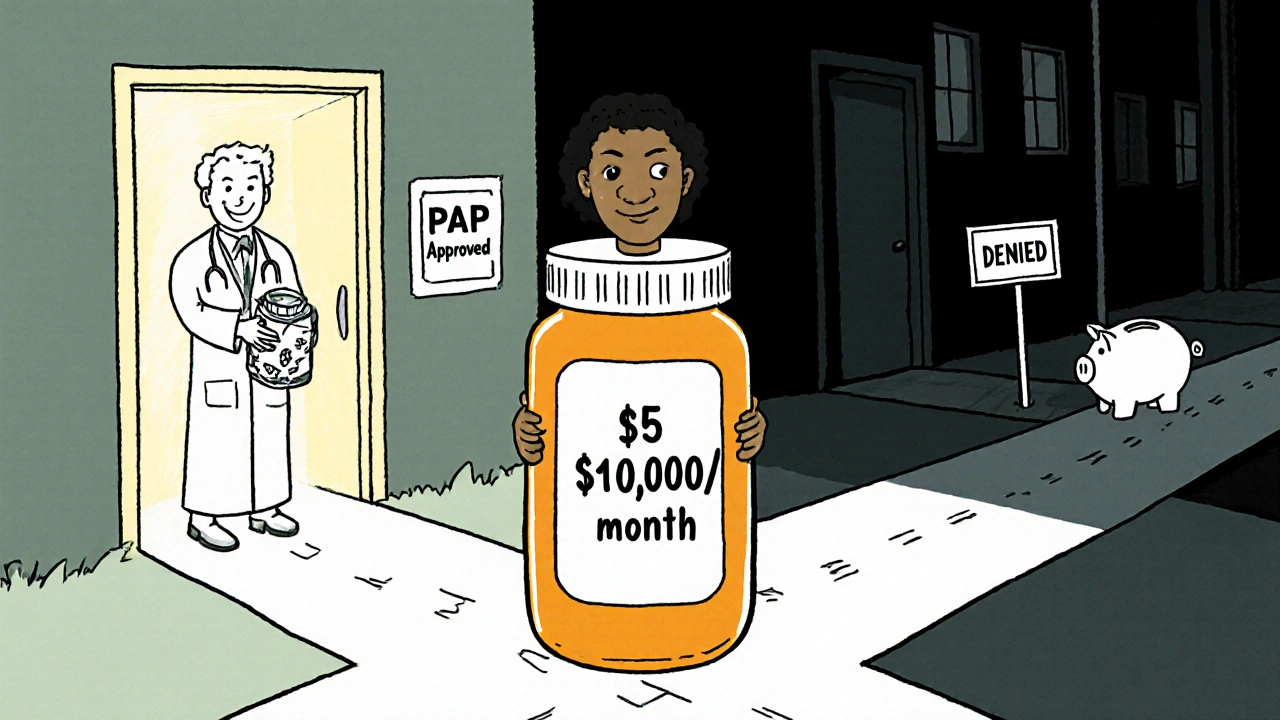
When a life-saving medication has no generic version, the price can be devastating. Some drugs cost over $10,000 a month. If you’re uninsured, underinsured, or stuck with a high-deductible plan, paying that bill isn’t just hard-it’s impossible. But there’s a lifeline: patient assistance programs (PAPs). These are free or low-cost drug programs run by drug makers, nonprofits, and sometimes states. They’re designed exactly for this situation: when there’s no cheaper alternative, and you still need the medicine.
Why PAPs Matter When There’s No Generic
Generic drugs cut costs by 80% or more. But for many serious conditions-like rare diseases, certain cancers, or autoimmune disorders-no generic exists. Drugs like Soliris, Tasigna, or Eylea can cost $500,000 a year. Without a generic, your only real option is the brand-name version. That’s where PAPs step in. In 2022, patient assistance programs gave out $4.7 billion in free or discounted drugs. Over 78% of that went to medications with no generic equivalent. These programs aren’t charity-they’re structured, regulated, and often required by law to exist. Pharmaceutical companies run 85% of them, not out of kindness, but because they’re legally allowed to offer financial help as long as it doesn’t violate anti-kickback rules. The real win? Patients using PAPs for expensive brand-name drugs are 37% less likely to skip doses or stop treatment because they can’t afford it. That’s not just about money-it’s about survival.How PAPs Actually Work
Not all PAPs are the same. There are three main types:- Manufacturer programs (65% of all PAPs): Run by the drug company itself. Examples: Gilead’s Advancing Access, Novartis’s Patient Assistance Program, Eli Lilly’s Simple Bridge.
- Foundation programs (25%): Run by nonprofits like the Patient Access Network Foundation or the Chronic Disease Fund. These often help people with insurance who still can’t afford copays.
- State programs (10%): Like Pennsylvania’s PACE program. These usually only help seniors or low-income residents within that state.
- Proof of income (tax return, W-2, pay stubs)
- A prescription from your doctor
- Proof of U.S. residency
- A signed form from your doctor confirming you need the drug
The Hidden Trap: Accumulator Adjustment Programs
Here’s the brutal truth: even if you get approved for a PAP, your insurance might still make you pay. Many insurance companies use something called an “accumulator adjustment.” This means the money your PAP pays toward your drug doesn’t count toward your deductible or out-of-pocket maximum. So if your drug costs $12,000 a month and your PAP covers it, your insurance still treats you like you paid $12,000. You’re still responsible for hitting your $8,000 deductible next year-on top of everything else. This affects 78% of major pharmacy benefit managers like Express Scripts and Optum. It’s legal. And it’s devastating. One patient in Michigan paid $20,700 out-of-pocket in one year-even though her PAP covered the full cost of her cancer drug-because her insurer refused to count the assistance. If you have commercial insurance, always ask: “Does my plan have an accumulator adjustment policy?” If yes, you need to find a foundation-based PAP instead. Those don’t get caught in this trap.Medicare Patients: You Can’t Use Manufacturer PAPs
If you’re on Medicare Part D, you’re out of luck with drug maker PAPs. Since January 1, 2020, federal law bans pharmaceutical companies from giving copay assistance to Medicare beneficiaries. It’s called the “Medicare Secondary Payer” rule. That doesn’t mean you’re out of options. Foundation programs like PAN Foundation and HealthWell Foundation still help Medicare patients. But they have stricter limits: usually $5,000-$7,000 per year per drug. You’ll need to reapply every year. And if your drug costs $15,000 a year, you’ll still pay the rest. Some Medicare Advantage plans have their own assistance programs. Call your plan and ask. Don’t assume you’re stuck.
How to Find the Right Program
Start with RxHope.org. It’s a free, nonprofit tool that checks over 90% of manufacturer PAPs in seconds. Just enter your drug name, income, and insurance status. It tells you which programs you qualify for, what documents you need, and even links to the application. If RxHope doesn’t find anything, go to NeedyMeds.org. It has a database of over 1,500 PAPs, including foundations and state programs. You can search by drug name, condition, or income level. Don’t skip the drug manufacturer’s website. Go directly to the company that makes your medication. Look for “Patient Assistance,” “Support Programs,” or “Help with Costs.” Many companies have their own portals now, with faster applications. Pro tip: If you’re on a brand-name drug with no generic, your doctor’s office probably has a medication access specialist. Ask for them. These are the people who file PAP applications all day. They know the shortcuts, the forms, and the hidden rules. Let them help. It saves you hours.What to Do If Your Application Gets Denied
Denials happen. 38% of applications are rejected at first-usually because a document is missing or the income proof isn’t clear enough. Don’t give up. You can appeal. The Patient Advocate Foundation says 41% of approved PAPs come after an appeal. Here’s how:- Get the denial letter. It should say why you were rejected.
- Call the program. Ask for a detailed explanation. Sometimes it’s just a typo.
- Resubmit with corrected documents. If they asked for a tax return and you sent a pay stub, send the tax return.
- Ask your doctor to write a letter explaining why you need the drug and how you can’t afford it.
PAPs vs. Other Options: What Really Saves Money?
You’ve probably heard of GoodRx. It’s a discount card. It’s great for generics. But for brand-name drugs with no generic? It barely helps. GoodRx saves you about 8.3% on average for these drugs. That’s $1,000 off a $12,000 monthly bill. Not enough. PAPs? They save you 92% or more. For many, it’s $0. State programs like PACE help seniors, but they cap assistance at $400 a month. That’s still $11,600 left to pay. PAPs are the only option that can fully cover the cost of a $500,000-a-year drug. But they’re not easy. They require work. You have to fight. You have to follow up. But if you don’t, you risk losing your health.
Real Stories: What Happens When People Use PAPs
One Reddit user, u/CancerWarrior2022, shared: “My HIV drug costs $15,000 a month. Without Gilead’s PAP, I would have chosen homelessness over bankruptcy. My $0 copay kept me in my apartment.” Another patient with chronic myeloid leukemia spent 11 hours over three weeks filling out paperwork for Novartis’s program. When she finally got approved, her monthly cost dropped from $1,400 to $0. She said: “It didn’t just save me money. It saved my life.” But there’s also the flip side. A Medicare patient on Patients Rising forum wrote: “After 3 months of fighting UnitedHealthcare’s accumulator policy, I paid $20,700 out-of-pocket-even though my PAP covered everything.” The difference? One person understood the system. The other didn’t.What’s Changing in 2025
The Inflation Reduction Act is changing the game. As of January 1, 2025, Medicare Part D beneficiaries will no longer be allowed to receive any manufacturer copay assistance-even if they’re not on a PAP. This pushes even more pressure onto foundation programs. Meanwhile, drug makers are making things easier. Eli Lilly’s “Simple Bridge” program cuts a 17-step application down to 5 steps. Approval time? Under 48 hours. Epic, the biggest electronic health record system, is now building PAP tools directly into doctors’ software. Soon, your doctor might click one button and automatically check your eligibility. But the big question remains: Why do we need PAPs at all? Why are drugs so expensive that the only way people can afford them is through charity? Experts like Dr. Kao-Ping Chua say PAPs are a band-aid. They fix the symptom-high costs-but not the disease: the pricing system itself. Still, right now, for millions of people, PAPs are the only thing standing between them and death.Your Action Plan: 5 Steps to Get Help
If you’re on a brand-name drug with no generic, here’s what to do:- Find your drug on RxHope.org or NeedyMeds.org. Don’t guess-check both.
- Check your insurance. Call your insurer and ask: “Do you have an accumulator adjustment policy?” If yes, skip manufacturer PAPs. Go straight to a foundation program.
- Ask your doctor for the medication access specialist. Let them handle the paperwork.
- Gather documents before you start: tax return, prescription, ID, insurance card.
- Follow up. If you don’t hear back in 10 days, call. Applications get lost. Don’t wait.
Can I use a patient assistance program if I have insurance?
Yes, but only if your insurance doesn’t cover the drug or your copay is still too high. Many manufacturer PAPs require you to be uninsured. But foundation programs like PAN or HealthWell specifically help people with insurance who still can’t afford their out-of-pocket costs. Always check the program’s rules before applying.
Do patient assistance programs cover all my medication costs?
Most manufacturer programs cover 100% of the drug cost if you qualify based on income. Foundation programs usually cap assistance at $5,000-$7,000 per year per drug. You’ll still pay the rest. Always confirm the exact benefit before applying.
How long does it take to get approved for a PAP?
Manufacturer programs typically approve applications in 7-10 business days. Foundation programs take longer-14-21 days-because they review more paperwork. Some new programs like Eli Lilly’s Simple Bridge approve in under 48 hours. Always follow up if you haven’t heard back after 10 days.
Why do some PAPs not work with my insurance?
Many insurers use “accumulator adjustment” policies, which mean the money from your PAP doesn’t count toward your deductible or out-of-pocket maximum. So even if your drug is free, you still have to pay thousands more before your insurance kicks in. That’s why Medicare patients and those with commercial insurance need to use foundation-based PAPs instead.
Can I apply for PAPs for multiple drugs at once?
Yes. Many patients need help with more than one expensive medication. You’ll need to apply separately for each drug and each program, but you can do it at the same time. Use RxHope.org to see which programs cover all your drugs. Some foundations offer multi-drug assistance.
What if I make too much money for a PAP?
If you earn above 400% of the Federal Poverty Level, you won’t qualify for most manufacturer programs. But some foundation programs have higher income limits or offer sliding-scale help. Check NeedyMeds.org and talk to your pharmacy-they may know of local resources or charitable grants you haven’t heard of.
Can I get help if I’m not a U.S. citizen?
Most PAPs require proof of U.S. residency, but not citizenship. Legal permanent residents, refugees, and asylum seekers often qualify. Some programs don’t ask for citizenship at all-only proof you live in the U.S. Always check the program’s eligibility page carefully.

13 Comments
Yvonne Franklin
November 24 2025
Just got approved for my cancer drug through RxHope. Took 3 days. Doctor’s assistant did the paperwork. Zero copay now. Life changed.
Don’t overthink it. Just apply.
Bartholemy Tuite
November 26 2025
Man I’ve been down this road. My mate in Cork got his rare disease med through a US PAP even though he’s Irish. Turns out some programs don’t care where you live as long as you’re not in a country with state-run healthcare. Weird loophole. Took him six months, three calls to the drug company’s Irish rep, and a signed letter from his GP saying he’d die without it. But he’s alive. So yeah. Fight for it. Don’t let bureaucracy win. Also - check NeedyMeds. It’s like the Reddit of patient help. Real people, real stories. Not corporate fluff.
Neoma Geoghegan
November 28 2025
Accumulator trap is real. My insurer said my PAP payment counted as ‘coverage’ so my deductible didn’t move. I paid $18k out of pocket last year even though my drug was free. Foundation programs are the only way. PAN saved me. Don’t trust commercial insurance. They’ll use your help to make you pay more.
Nikki C
November 28 2025
Why do we let corporations decide who lives and who dies? PAPs aren’t charity. They’re a symptom of a broken system. Drugs cost $500k a year because they can. Not because they have to. But hey - at least we have these patches. For now. I just hope the next generation doesn’t have to beg for their own medicine.
Also - doctors: please, for the love of god, train your staff to help with this. It’s not rocket science. It’s basic human decency.
Alex Dubrovin
November 29 2025
I applied for 3 PAPs at once. Got rejected on two. Called the third one. Told them my wife lost her job. They approved me same day. No forms. Just a conversation. Don’t be afraid to talk to a human. They’re not robots. They want you to get help.
Also - save every email. They lose stuff. Always.
Jacob McConaghy
November 30 2025
My sister’s on Eylea. $12k a month. Manufacturer PAP said no because she has Medicare. Foundation program gave her $5k. She pays $7k. Still too much. But better than $12k. She’s 68. No kids. No savings. Just a pension and grit.
What’s wrong with us when a senior has to choose between medicine and heat in winter? PAPs aren’t the solution. They’re the bandage on a bullet wound.
Vineeta Puri
December 2 2025
It is imperative to recognize that patient assistance programs serve as a critical bridge for individuals facing financial hardship due to unaffordable pharmaceuticals. While these programs are commendable, they are not a substitute for systemic reform in drug pricing policy. I urge all stakeholders to advocate for equitable access to essential medications through legislative action rather than reliance on charitable interventions.
Victoria Stanley
December 3 2025
Just want to say - if you’re reading this and you’re scared or overwhelmed, you’re not alone.
I’ve helped 12 people apply for PAPs this year. Every single one cried when they got approved. Not because they got free drugs. Because someone finally saw them.
Call your doctor’s office. Ask for the access specialist. They’re your secret weapon.
You got this.
Andy Louis-Charles
December 3 2025
✅ Got my HIV med through Gilead’s program. $0.
⚠️ But my insurance didn’t count it toward my deductible. Still paid $14k.
💡 Switched to PAN Foundation. Now I’m covered. No traps.
📌 Pro tip: Use RxHope. It’s free. No ads. Just facts.
🙏 Thank you to the people who built this system. You’re saving lives.
Douglas cardoza
December 5 2025
My cousin applied for a PAP for her MS drug. Got denied because her tax return had a typo. She was so broken. Then she called the program and said ‘I’m not asking for charity. I’m asking for my life.’ They reprocessed it in 2 days. Moral? Be loud. Be clear. Don’t be polite when your life’s on the line.
Adam Hainsfurther
December 5 2025
Interesting how PAPs are legal but accumulate to a form of de facto rationing. The fact that we rely on corporate goodwill to determine access to essential medicine speaks volumes about our healthcare priorities. I wonder if this model would be acceptable if the same companies were providing insulin or antibiotics in the same way. The ethical tension here is profound. Yet people are surviving because of it. That’s the tragedy.
Rachael Gallagher
December 7 2025
Why do Americans let drug companies charge this much? We’re the only country that lets them do this. Canada pays $500 for the same drug. Europe pays $300. We’re being robbed. And we sit here thanking them for the crumbs.
Stop being grateful for survival. Demand justice.
steven patiño palacio
December 8 2025
Just wanted to add - if you're on Medicare and you're struggling, call HealthWell Foundation. They have a dedicated line for Part D patients. They helped me get $6,500 toward my rheumatoid arthritis drug. I had to reapply every year, but it was worth the paperwork. Also, your pharmacist might know about local grants you didn't even know existed. Don't stop until you've checked every option.