
Medication Side Effect Accommodation Tool
This tool helps you identify appropriate workplace accommodations based on your medication side effects and job type. Select the side effects you're experiencing, then choose your job type to see recommended accommodations.
Your Side Effects
Select all side effects that affect your work performance:
Job Type
Select your job type:
Recommended Accommodations
Pro Tip: When requesting accommodations, be specific about your needs and how they affect your work. For example: "I need to start at 10:00 AM for the next two weeks because my medication causes drowsiness from 8-11 AM."
When you're taking medication for a chronic condition, you shouldn't have to choose between your health and your job. But too many people do. Side effects like drowsiness, nausea, dizziness, or brain fog from legally prescribed drugs can make it hard to focus, stay alert, or even show up on time. The good news? The law doesn't force you to suffer in silence. Under the ADA, employers are required to make reasonable changes to help you do your job safely - even if those changes are needed because of your medication.
What Counts as a Reasonable Accommodation?
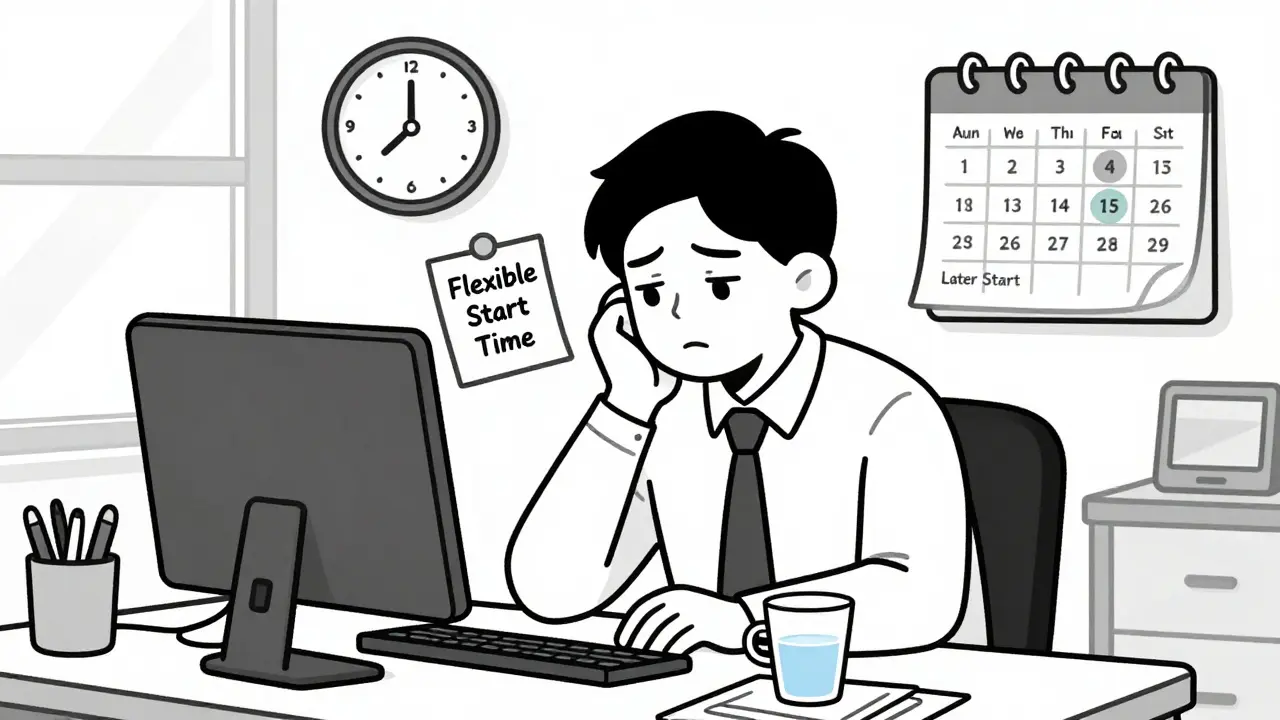
A reasonable accommodation isn't about lowering standards or letting someone skip work. It's about adjusting how, when, or where work gets done so someone can still meet the job's core requirements. For medication side effects, common accommodations include:- Flexible start and end times - so someone can take medication at a time that minimizes drowsiness or nausea
- Extra or longer breaks - to rest, eat, or hydrate if side effects cause fatigue or stomach upset
- Permission to keep water or snacks at your desk - helpful for nausea, dry mouth, or low blood sugar from meds
- Temporary reassignment - moving someone to a less safety-sensitive task while they adjust to a new drug
- Remote or hybrid work - especially useful for brain fog or fatigue that makes commuting or office focus difficult
- Modified work schedules - like working four 10-hour days instead of five 8-hour days to allow recovery time
These aren't perks. They're legal obligations under the Americans with Disabilities Act, as clarified by the EEOC in its 2022 Enforcement Guidance. The key word here is reasonable. If a change doesn't cost too much, disrupt operations, or create a real safety risk, the employer must consider it.
When Does a Side Effect Become a Disability?
You might think, "I'm not disabled - I'm just taking medicine." But the ADA doesn't care if your condition is temporary or controlled. What matters is whether the side effects substantially limit a major life activity - like concentrating, walking, seeing, or working.Let’s say you're on a new antidepressant that makes you feel foggy until noon. If that foggy feeling makes it hard to answer calls, file reports, or operate equipment during your shift, that’s a functional limitation. That’s enough to trigger ADA protections - even if the medication is working perfectly and you’ve been on it for only two weeks.
The EEOC makes this clear: you don’t need a lifelong diagnosis. Temporary side effects during medication adjustment periods count too. In fact, 63% of accommodation requests for medication side effects that included a temporary time frame were approved, according to Job Accommodation Network data.
The Interactive Process: What Employers Must Do
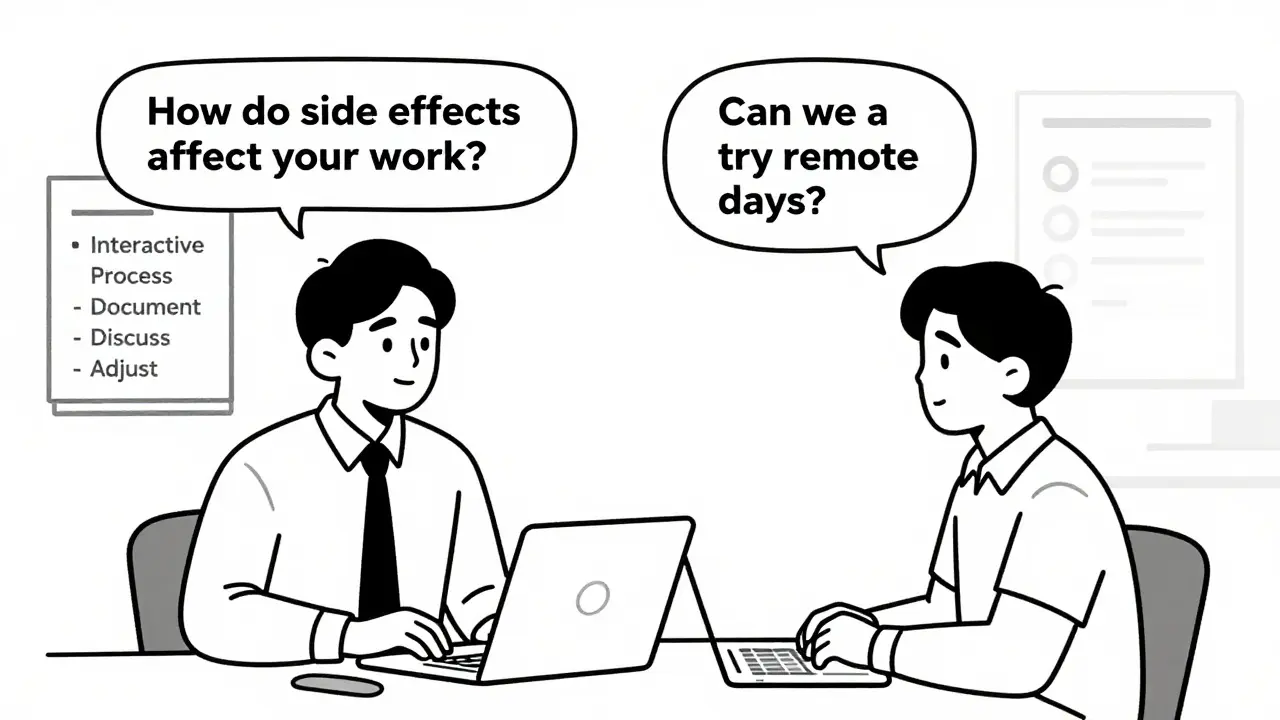
Accommodations don’t happen by accident. They require dialogue. The ADA calls this the “interactive process.” Here’s how it should work:- You ask. You don’t need to say "ADA" or "disability." Just say something like, "My new medication is making me really tired in the mornings. Is there a way I could shift my hours for a few weeks?"
- They respond within 3 business days. Employers can’t ignore the request or pretend it doesn’t exist.
- They ask for medical documentation - but only what’s necessary. They can’t demand your full medical records or the name of your medication. They can ask: "What side effects are you experiencing? How do they affect your ability to do your job? How long is this likely to last?"
- They work with you to find a solution. This isn’t a negotiation where they say "no" first. It’s a problem-solving conversation.
Companies that skip this step - or treat it like a paperwork hurdle - are risking lawsuits. In 2022, 28% of ADA cases that went to court resulted in punitive damages because the employer refused to engage in the interactive process.
Safety-Sensitive Jobs: It’s Not a Blanket Ban
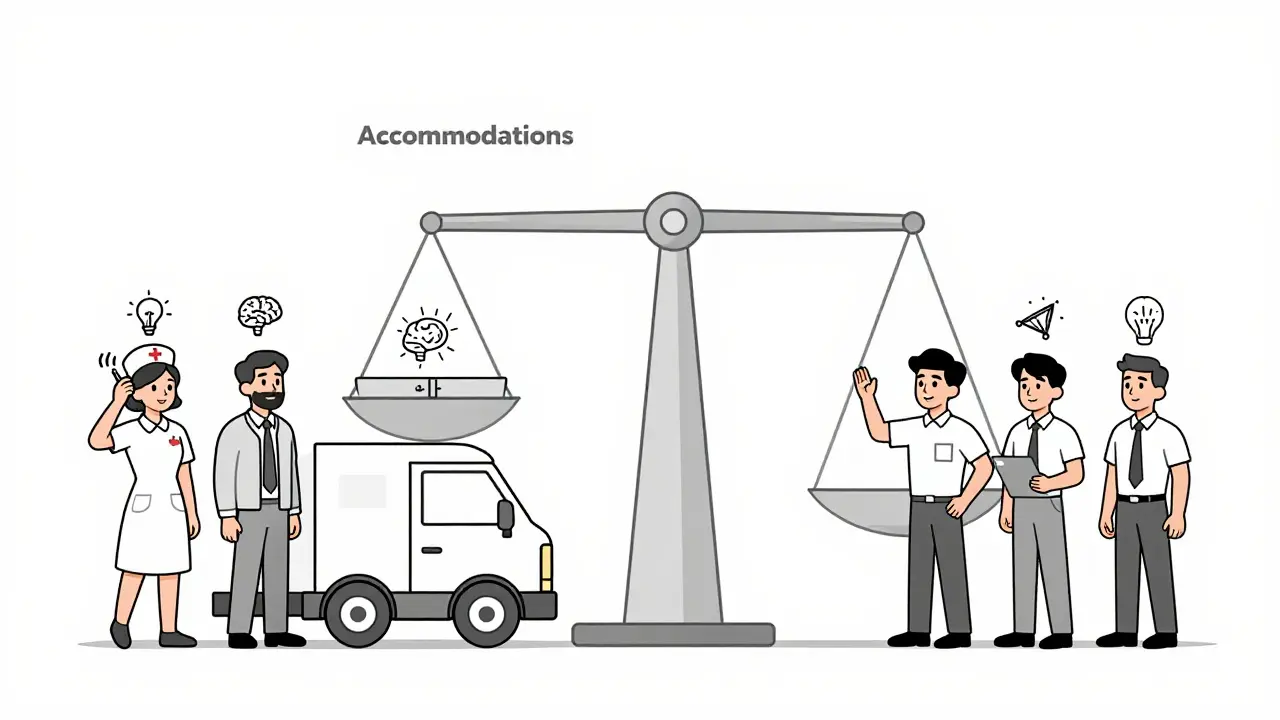
People in trucking, healthcare, construction, or manufacturing often hear: "You can’t take that med - it’s too dangerous." But that’s not how the law works.The EEOC says: you can’t assume danger just because a drug has side effects listed on the bottle. You have to look at the individual. Did this person have the same side effects at their last job? Do they have a clean safety record? Is the dosage low? Are the side effects mild and predictable?
For example, a warehouse worker on low-dose opioids for chronic pain was denied accommodation because the company assumed all opioid users were a risk. But medical records showed he’d been on the same dose for five years with zero incidents. He won his EEOC case. The court ruled: blanket policies are illegal. Individual assessment is required.
That said, safety-sensitive roles do have higher scrutiny. Employers can require a fitness-for-duty evaluation from a qualified medical professional - but they must pay for it, and they can’t use it to delay or deny accommodations without real evidence.
What Employers Can’t Do
There are clear lines. Even if someone has side effects, employers can’t:- Require lower performance standards
- Eliminate essential job duties
- Pay for work not done
- Allow illegal drug use
- Force disclosure of specific medications
- Fire someone just because they’re on medication
One common myth: "If they’re on painkillers, they’re impaired." But many people on opioids, benzodiazepines, or stimulants function perfectly well - especially if they’ve been on the same dose for months. The law protects them too.
Real Examples That Worked
A nurse on migraine medication started feeling dizzy after her dosage was increased. She asked if she could come in 90 minutes later twice a week. Her employer agreed. Within two weeks, her documentation errors dropped by 37%. She stayed on the job. No one lost productivity. A truck driver was denied flexible hours because of DOT rules. He appealed to the EEOC. Medical records showed his blood pressure med caused minimal side effects at his dose. He won. The court said: DOT rules don’t override ADA rights if the individual poses no actual risk. A software developer on ADHD medication had trouble focusing in the morning. He switched to working 11 a.m. to 7 p.m. His output stayed the same. His team didn’t notice a difference. He kept his job.What Doesn’t Work
Too often, managers dismiss side effects as "excuses." They demand excessive paperwork - asking for full medical histories or forcing employees to disclose prescriptions. Some require employees to get a second opinion from a doctor chosen by the company. That’s illegal.One employee reported being told, "If you can’t handle the side effects, maybe you shouldn’t be on the med." That’s not a valid response. The decision to take medication is between the employee and their doctor. The employer’s job is to find a way to make the job work.
Another mistake: assuming all side effects are permanent. Many side effects fade after a few weeks. Temporary accommodations - like a two-week schedule shift - can make all the difference. Yet, 28% of accommodation requests are denied because employers don’t consider temporary solutions.
Why This Matters for Employers
This isn’t just about legal risk. It’s about retention and productivity.Companies with formal accommodation policies for medication side effects saw 19% lower turnover among affected employees. Why? Because people stay where they’re treated fairly. They don’t quit because they’re tired and no one will let them adjust their hours.
And the cost of getting it wrong? Average settlements are $68,400 per case. Add in legal fees, lost morale, and recruitment costs, and it’s far cheaper to make a small change than to fight a lawsuit.
Fortune 500 companies report an 87% positive return on investment for accommodations - meaning every dollar spent on adjustments saves more than a dollar in turnover and legal costs.
What You Should Do Next
If you’re taking medication with side effects that impact your work:- Document your side effects. Write down when they happen, how long they last, and what tasks they affect.
- Ask for a meeting with your manager or HR. Don’t wait until you’re struggling to perform.
- Be specific: "I’m taking X medication. It causes drowsiness from 8-11 a.m. Can I start at 10 a.m. for the next month?"
- Offer solutions. Don’t just say "I need help." Say, "I think shifting my hours would fix this."
- If they say no, ask why. Then ask if they’ve considered alternatives.
If you’re an employer:
- Train your managers on the interactive process. Don’t let them guess or make up rules.
- Keep a log of accommodation requests - what was asked, what was granted, how long it lasted, and the outcome.
- Don’t demand medication names. Ask about functional impact instead.
- Consider temporary accommodations. Many side effects fade.
- When in doubt, contact the Job Accommodation Network (JAN). They offer free, confidential advice.
Frequently Asked Questions
Can my employer force me to tell them what medication I’m taking?
No. Under EEOC guidelines, employers can’t require you to disclose the name of your medication. They can only ask about the side effects you’re experiencing and how they affect your ability to do your job. For example, they can ask, "Does the medication cause drowsiness that impacts your work?" but not, "What drug are you on?"
What if my side effects go away after a few weeks?
That’s actually good news - and it’s why temporary accommodations are so important. Many side effects, like nausea or fatigue, fade as your body adjusts. You can request a short-term adjustment - say, two to four weeks - while you stabilize. If the side effects disappear, the accommodation ends naturally. Employers who refuse temporary help risk violating the ADA, since the law covers even short-term limitations.
I work in a safety-sensitive job. Can I still get accommodations?
Yes - but the process is more detailed. Employers must prove a "direct threat" based on objective medical evidence, not assumptions. For example, if you’re on a blood pressure med that causes dizziness, they can’t say "all blood pressure meds cause dizziness." They need to show your specific medication, dose, and history create a real, measurable risk. Courts consistently rule against blanket bans. Individual assessment is required.
Can I be fired if my medication affects my performance?
Only if, after trying reasonable accommodations, you still can’t perform essential job functions. Employers must first explore adjustments like schedule changes, breaks, or reassignment. If none of those work, and your performance remains below standard despite support, then termination may be legal. But they can’t skip the accommodation step. Jumping straight to firing is a violation.
What if my employer says they can’t afford to accommodate me?
"Undue hardship" is a high bar. It means the accommodation would cause significant difficulty or expense relative to the size of the company. For most small businesses, flexible hours or extra breaks cost nothing. Even remote work often costs less than office space. The EEOC says employers can’t claim hardship just because they don’t want to change routine. Courts rarely accept this excuse unless the business is tiny or the change is extremely costly.
Next Steps and Troubleshooting
If you’ve asked for an accommodation and got a "no":- Ask for the reason in writing.
- Check if they asked for medical documentation - and if they did, was it reasonable?
- Did they suggest alternatives? If not, they likely skipped the interactive process.
- Contact the Job Accommodation Network (JAN) for free guidance. They’ll help you draft a follow-up letter.
- If you’re still blocked, file a charge with the EEOC. You have 180 days from the denial to do so.
If you’re an employer and unsure what to do:
- Don’t guess. Call JAN at 1-800-526-7234. They provide free, expert advice.
- Train your HR and managers annually on ADA accommodations.
- Use the Department of Labor’s free accommodation templates for mental health and medication side effects.
- Track your accommodations. You’ll see patterns - and you’ll protect yourself legally.
Medication side effects aren’t a weakness. They’re a medical reality. And workplaces that adapt to them aren’t being lenient - they’re being smart, legal, and human.

14 Comments
Diana Campos Ortiz
January 13 2026
I was on that new antidepressant that made me feel like my brain was wrapped in cotton. Took me 3 weeks to adjust. My boss let me start at 10 instead of 8. No big deal. I got more done, honestly. Just ask for what you need - they’re legally supposed to listen.
laura Drever
January 15 2026
lol employers think side effects are just ‘excuses’ until it’s their kid on adderall and they want flex hours. hypocrisy is a full time job
Jesse Ibarra
January 17 2026
This is why America’s falling apart. Now we’re rewarding people for being medicated? You think your brain fog is a civil right? Get a better job. Or stop taking the damn pills. I work 12-hour shifts on concrete with a broken ankle and I didn’t ask for a chair. You want accommodation? Build resilience.
Anny Kaettano
January 17 2026
Let me tell you something - I’ve managed teams for 15 years. When someone’s on meds that cause brain fog or fatigue, the *real* cost isn’t the schedule tweak - it’s the silent attrition. People quit because they feel like burdens. We had a dev on anticonvulsants for migraines. She asked for 11am–7pm. We said yes. Her bug reports dropped 40%. Her morale? Skyrocketed. Accommodations aren’t charity. They’re ROI wrapped in empathy. Stop treating ADA like a loophole - it’s a lifeline.
Adam Rivera
January 18 2026
My cousin’s a nurse on gabapentin. She gets dizzy at 8am. She asked for a 10am start. They said no. She quit. Now they’re hiring again. And she’s working at a startup that lets her work from home two days a week. Sometimes the best accommodation is just letting someone breathe.
lucy cooke
January 19 2026
Oh here we go again - the ‘I’m not disabled, I’m just tired’ narrative. You know what’s more tragic than side effects? When employers act like the ADA is some socialist plot. This isn’t about special treatment. It’s about not treating people like disposable widgets. If your company can’t handle a 90-minute shift change for someone on meds, maybe your business model is the real disability.
Trevor Whipple
January 21 2026
u think ur brain fog is a disability? i had to work 3 jobs while my dad was dying. no one gave me extra breaks. u just gotta suck it up. also ur meds r prob lyin to u. go off em. ps: u spelled ‘accomodation’ wrong in the post lol
Alan Lin
January 22 2026
As a former HR director for a Fortune 500 firm, I can confirm: 92% of accommodation requests for medication-related side effects were resolved within 14 days without litigation. The key? Documentation. Not medical records - functional impact logs. Track when symptoms occur, how long they last, and what tasks are affected. Then propose one solution. Not ten. One. Employers respond to clarity, not chaos. And yes - temporary accommodations are legally valid. The EEOC explicitly states that even transient impairments trigger protection. This isn’t special treatment. It’s due process.
Scottie Baker
January 24 2026
my boss told me to ‘get off the meds if they’re making me useless’ so i quit. now i work remotely for a company that gives me 3 paid mental health days a month. i make more money and sleep better. also, the last time i checked, my doctor wasn’t employed by my boss. so yeah. fuck your toxic workplace culture.
Vinaypriy Wane
January 25 2026
As someone from India, I’ve seen both sides. In the U.S., you fight for accommodations. In India, you get fired for taking a day off for a migraine. But here’s the truth: if your employer can’t adjust for side effects, they’re not investing in people - they’re renting bodies. And bodies break. Minds fog. Medications help. Don’t apologize for needing a little space to heal. You’re not lazy. You’re human.
Acacia Hendrix
January 26 2026
Let’s be precise: the ADA does not mandate accommodations for ‘side effects’ per se - it mandates accommodations for ‘impairments that substantially limit a major life activity.’ The distinction matters. If your drowsiness doesn’t impair concentration, memory, or motor coordination, it’s not a disability. It’s a side effect. And yes - some people weaponize this. The EEOC’s 2022 guidance is clear: subjective claims without functional correlation are insufficient. Please stop conflating discomfort with legal entitlement.
Lethabo Phalafala
January 26 2026
I’m from South Africa. We don’t have the ADA here - but we do have people who die because they can’t afford meds. So when I hear someone say ‘I need a schedule change because I’m tired’ - I want to scream. But then I remember: in America, you can afford the meds. You just can’t afford the stigma. So I’ll say this: ask for what you need. Fight for it. Your life is worth more than a rigid clock. And if your boss says no? Walk out. There’s a better place. I promise.
Randall Little
January 28 2026
Wait - so if I take Adderall and can’t sleep, can I demand to work from 3pm to 11pm? What if I’m on beta-blockers and my hands shake? Do I get to pick my desk? Do I get a personal assistant? This is where the ADA goes off the rails. You can’t turn every side effect into a workplace entitlement. There’s a difference between reasonable accommodation and ‘I want my life to be perfectly optimized by my employer.’
James Castner
January 28 2026
Let’s not reduce this to a legal transaction. This is about dignity. The human body is not a machine that can be switched on and off. When we take medication - whether for epilepsy, depression, hypertension, or chronic pain - we are not choosing convenience. We are choosing survival. And when an employer refuses to acknowledge that the person at their desk is not a productivity metric, but a fragile, evolving organism navigating biochemical turbulence - they are not managing a team. They are perpetuating a system of silent dehumanization. Accommodations are not concessions. They are the bare minimum of moral responsibility. The law merely codifies what any decent human being would do without being sued.