
When your kidneys aren't working well, what you eat becomes just as important as any medication. A renal diet isn't about losing weight or eating "healthy" in the usual sense-it's about protecting your kidneys from further damage by carefully controlling three key minerals: sodium, potassium, and phosphorus. For people with stage 3 to 5 chronic kidney disease (CKD), getting these numbers right can mean the difference between staying off dialysis and needing it sooner. And yet, most people don’t realize how sneaky these minerals are in everyday foods.
Why Sodium Matters More Than You Think
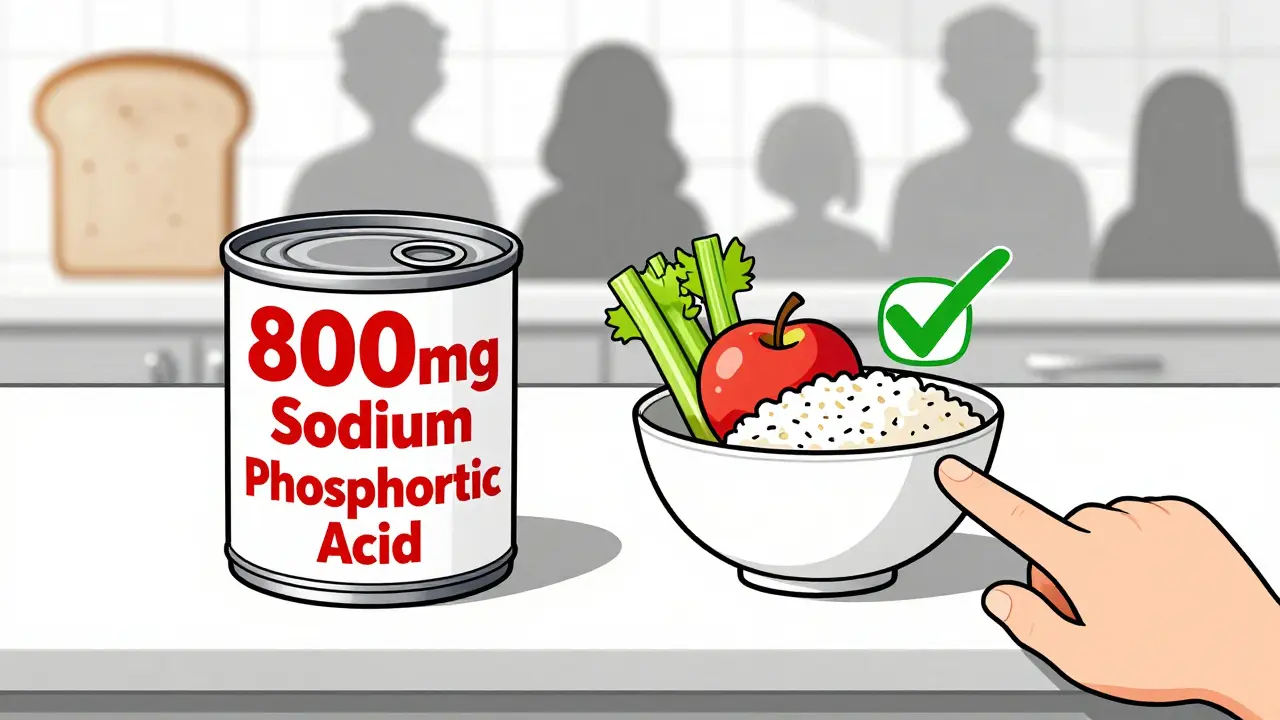
Sodium isn’t just about salty chips or fast food. It’s hiding in bread, canned soups, frozen meals, and even breakfast cereals. The Kidney Disease: Improving Global Outcomes (KDIGO) 2023 guidelines recommend limiting sodium to 2,000-2,300 milligrams per day for non-dialysis CKD patients. That’s less than one teaspoon of table salt. But the average American eats over 3,400 mg daily-nearly double the limit.High sodium doesn’t just raise blood pressure-it causes your body to hold onto fluid. That extra fluid puts pressure on your heart and lungs, especially when your kidneys can’t filter it out. One study from the Cleveland Clinic found that 75% of sodium intake comes from processed foods, not what you add at the table. A single serving of canned soup can have 800-1,200 mg of sodium. One slice of deli meat? Up to 500 mg. Even "low-sodium" labels can be misleading-some still contain 140 mg or more per serving.
The fix? Cook more at home. Use herbs like rosemary, thyme, or garlic powder instead of salt. Brands like Mrs. Dash offer salt-free seasoning blends that work well without triggering fluid retention. Read labels every time. Look for "no salt added," "unsalted," or "low sodium"-and check the milligrams per serving. Reducing sodium by just 1,000 mg a day can lower systolic blood pressure by 5-6 mmHg, according to the CDC (Centers for Disease Control and Prevention).
Managing Potassium: The Silent Threat
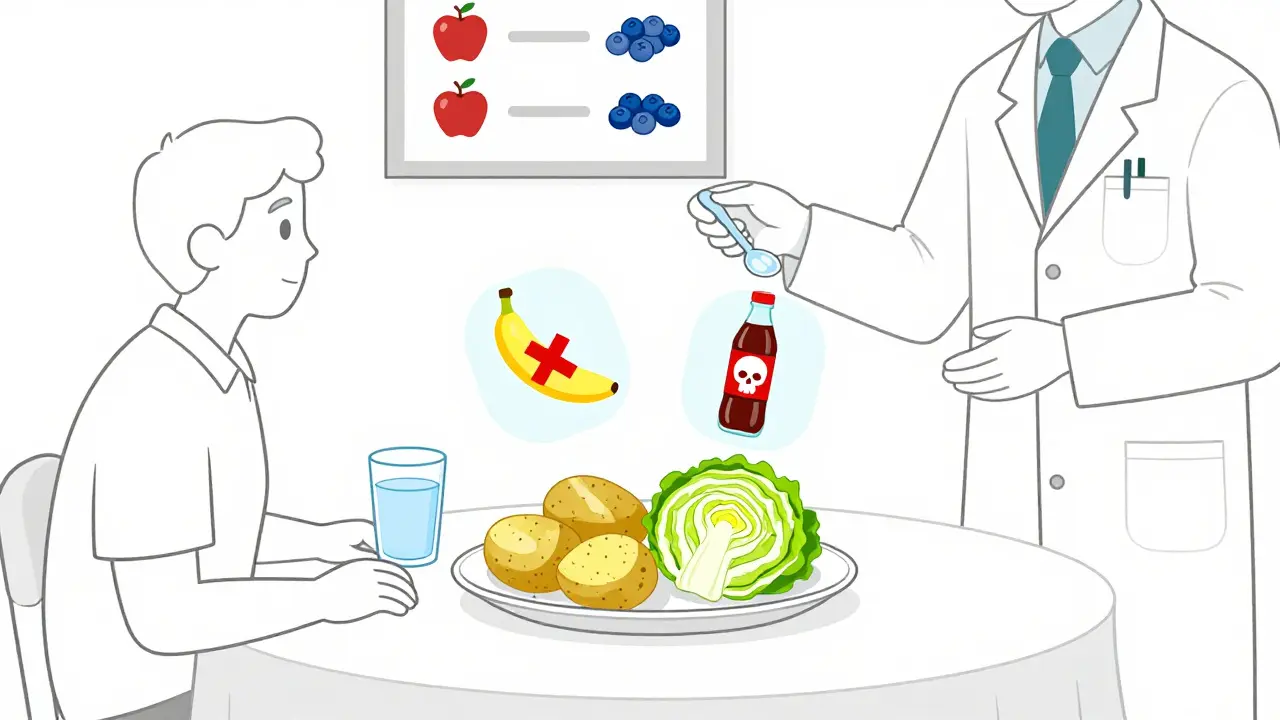
Potassium is essential for heart and muscle function-but when your kidneys fail, it builds up. Levels above 5.5 mEq/L can cause dangerous heart rhythms or even cardiac arrest. The National Kidney Foundation recommends keeping daily potassium intake between 2,000 and 3,000 mg for most CKD patients, but your doctor may adjust this based on your blood test results.Here’s the problem: fruits and vegetables, which are usually considered healthy, are packed with potassium. A banana has 422 mg. An orange? 237 mg. A baked potato? Over 900 mg. Even spinach, tomatoes, and avocados-foods praised in many diets-are high-risk for kidney patients.
On the flip side, you can still enjoy low-potassium options. Apples (150 mg per medium fruit), blueberries (65 mg per ½ cup), cabbage (12 mg per ½ cup cooked), and cauliflower are safe choices. Portion control matters. Eating half a pear instead of a whole one cuts potassium in half.
One powerful trick taught by renal dietitians is leaching (soaking vegetables like potatoes or carrots in warm water for 2-4 hours, then boiling them in plenty of water). This can reduce potassium by up to 50%, according to the DaVita Kidney Care 2023 nutrition guide. It’s time-consuming, but for many patients, it’s the only way to enjoy favorite foods safely.
Phosphorus: The Hidden Killer in Processed Foods
Phosphorus is one of the most misunderstood parts of the renal diet. Your body needs it for bones and energy-but when kidneys fail, phosphorus builds up and pulls calcium out of your bones, making them weak. It also causes dangerous calcification in your blood vessels and heart.The Kidney Disease Outcomes Quality Initiative (KDOQI) recommends limiting phosphorus to 800-1,000 mg per day for non-dialysis CKD patients. But here’s the twist: not all phosphorus is the same. Natural phosphorus in foods like meat, dairy, and beans is only 40-60% absorbed. But phosphorus additives-used in processed foods to enhance color, texture, and shelf life-are absorbed at 90-100%.
That’s why a cola (12 oz) has 450 mg of phosphorus, while a glass of milk (8 oz) has only 125 mg. A slice of processed cheese? 250 mg. A packaged chicken nugget? Up to 180 mg. These numbers add up fast. Research in the Clinical Journal of the American Society of Nephrology shows that processed foods increase phosphorus absorption by 30-50% compared to whole foods.
So what can you eat? Choose fresh meats over deli meats. Swap white bread (60 mg phosphorus per slice) for whole-grain (150 mg). Pick plain yogurt over flavored. Avoid anything with "phos" in the ingredient list-phosphoric acid, sodium phosphate, calcium phosphate. These are red flags.
What About Protein? The New Guidelines
For years, people with CKD were told to eat as little protein as possible. That’s changed. The KDOQI 2020 guidelines now recommend 0.55-0.8 grams of high-quality protein per kilogram of body weight per day. Too little protein can lead to muscle loss and malnutrition, especially in older adults. One study found that excessive restriction increased malnutrition risk by 34% in elderly CKD patients.Good protein sources include eggs, chicken, fish, and lean cuts of beef. Salmon (3 oz) has moderate potassium and phosphorus but is rich in omega-3s. Cod and halibut are lower in phosphorus than other fish. Aim for 2-3 servings per week, each about the size of your palm.
Real-Life Adjustments: What Works
Adapting to this diet takes time. Most patients say the first 3-6 months are the hardest. Flavor changes are tough. You miss salt. You crave bananas. You feel confused about what’s allowed.Here’s what helps:
- Use a food tracking app like Kidney Kitchen (downloaded over 250,000 times) to log meals and check nutrient totals.
- Plan meals ahead. Cook in batches using low-sodium, low-potassium ingredients.
- Work with a registered dietitian who specializes in kidney care. Medicare now covers 3-6 sessions per year for stage 4 CKD patients.
- Keep a food diary. Write down everything you eat, even snacks. You’ll spot hidden sources of sodium and phosphorus.
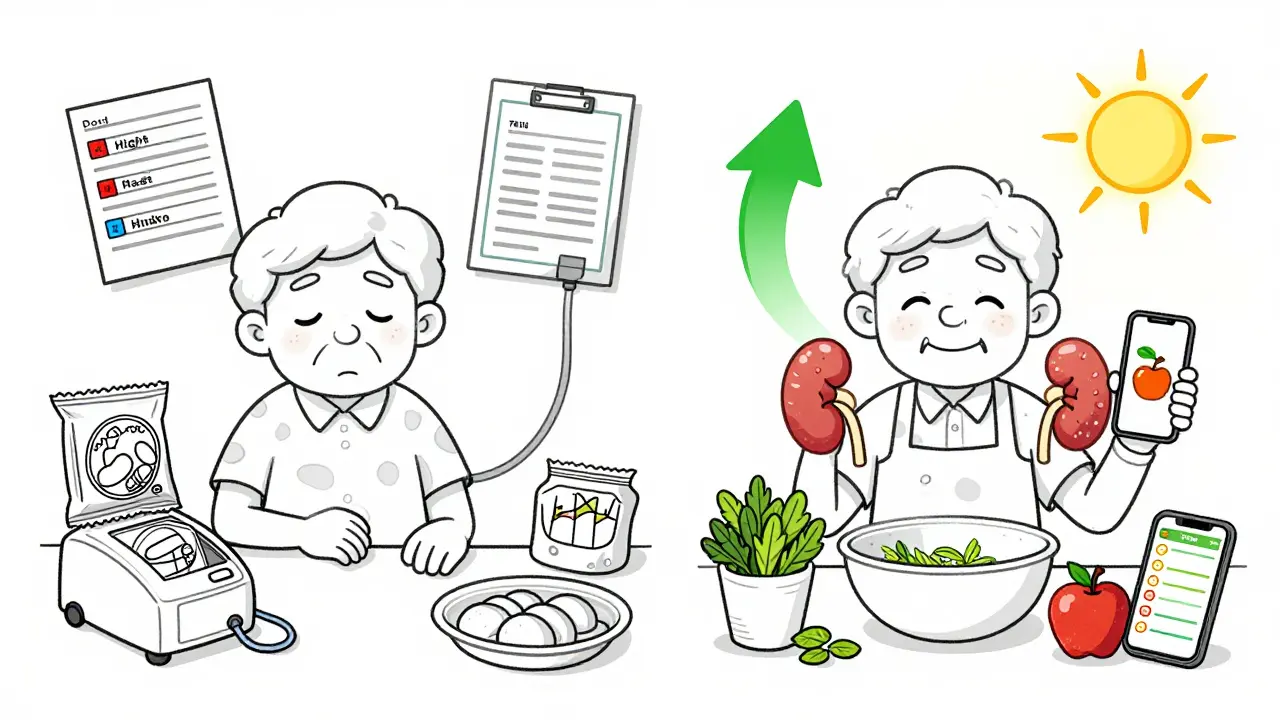
One patient from Ohio, 62, started dialysis in 2022 after ignoring her diet. After working with a renal dietitian, she switched to white rice instead of brown, used lemon juice instead of salt, and swapped oranges for apples. In 18 months, her potassium levels dropped from 6.1 to 4.8, and she avoided dialysis. "It wasn’t easy," she said. "But it was worth it. I’m still here."
What’s Changing in 2026?
The field of renal nutrition is evolving. The National Institutes of Health launched the PRIORITY study in January 2024 to test whether genetic testing can predict how someone responds to potassium or phosphorus intake. The Food and Drug Administration approved Keto-1 in September 2023-the first medical food designed specifically for CKD patients, low in phosphorus and potassium but high in essential amino acids.There’s also growing evidence that gut health affects phosphorus absorption. Prebiotic fibers like inulin (found in chicory root or supplements) may reduce phosphorus absorption by 15-20%, according to 2023 clinical trials. And AI-powered apps are being piloted at Mayo Clinic that adjust dietary advice based on real-time lab results.
But the biggest shift? Moving away from extreme restriction. Dr. Sankar Navaneethan’s 2023 review in JAMA Internal Medicine argues that focusing on food quality-choosing whole foods over processed ones-is more sustainable and effective than strict limits. You don’t need to eliminate all high-potassium foods. You need to learn portion sizes, preparation methods, and how to balance meals.
Common Mistakes to Avoid
- Assuming "natural" means safe. Fresh fruits and veggies can be high in potassium and phosphorus.
- Using salt substitutes. Many contain potassium chloride, which can be dangerous for kidney patients.
- Drinking too much fluid. If you produce less than 1 liter of urine per day, limit fluids to 32 oz (1 liter) daily, including soups, ice, and yogurt.
- Skipping meals or eating too little. Malnutrition is a real risk. Protein is still essential.
- Believing "I feel fine, so I don’t need to follow the diet." Kidney damage often happens silently.
The goal isn’t perfection. It’s progress. One meal at a time.
Can I still eat fruits and vegetables on a renal diet?
Yes-but you need to choose wisely and control portions. Low-potassium options include apples, berries, cabbage, cauliflower, and green beans. Avoid bananas, oranges, potatoes, tomatoes, and spinach unless they’re leached. Cooking methods matter: boiling and soaking can reduce potassium by up to 50%. Always check serving sizes.
Is dairy allowed on a renal diet?
Dairy is high in phosphorus and potassium, so it’s limited. One-half cup of milk has about 125 mg of phosphorus and 170 mg of potassium. Plain yogurt and cottage cheese are better choices than flavored or sweetened versions. Some patients can have small amounts (1/4-1/2 cup) a few times a week. Non-dairy alternatives like rice milk or almond milk (unsweetened, no added phosphorus) can be substitutes-but always check labels.
Do I need to take phosphate binders?
Phosphate binders are medications taken with meals to block phosphorus absorption. They’re often prescribed for people with high blood phosphorus levels, especially those on dialysis. If your lab tests show phosphorus above 5.5 mg/dL, your doctor may recommend them. But they don’t replace dietary changes-they work with them. Never skip meals to avoid taking binders. Always take them as directed with food.
Can a renal diet help me avoid dialysis?
Yes, for many people. Following a renal diet can delay the need for dialysis by 6-12 months or longer, especially in stage 4 CKD. One study showed that patients who stuck to sodium, potassium, and phosphorus limits had slower decline in kidney function. It’s not a cure, but it gives your kidneys breathing room. The earlier you start, the better the results.
What if I have diabetes too?
Managing both diabetes and CKD is challenging because many heart-healthy foods for diabetics-like whole grains, beans, and fruit-are high in potassium or phosphorus. The key is balance. Choose low-potassium fruits like apples or berries instead of oranges or melons. Use white bread instead of whole grain. Work with a dietitian who understands both conditions. Blood sugar control protects your kidneys, so don’t abandon it-but adjust food choices to fit both needs.
Next Steps: What to Do Today
If you or someone you care for has chronic kidney disease, start here:- Get your latest blood work: Check potassium, phosphorus, sodium, and creatinine levels.
- Ask your nephrologist for a referral to a renal dietitian. Many insurance plans, including Medicare, cover this.
- Start reading food labels. Focus on sodium, potassium, and phosphorus per serving.
- Replace one high-potassium food this week-swap a banana for an apple.
- Try one leached vegetable this week-boil potatoes or carrots with plenty of water.
Small changes add up. You don’t need to overhaul your life overnight. Just make one better choice today.

14 Comments
Divya Mallick
March 1 2026
The sodium myth is literally killing people. You think you're being smart by using "low-sodium" labels? Bro, that's just corporate gaslighting. 140mg per serving? That's not low-it's a trap. I saw a patient in Delhi with stage 4 CKD who died because he trusted "no salt added" on a frozen curry pack. The phosphorus additives? They're not even listed as phosphorus. They're "calcium phosphate"-sounds like a vitamin, right? It's not. It's a stealth bomb. And don't get me started on potassium. People think "natural" = safe. A banana is a potassium grenade. You need to leach, boil, double-boil. If you're not doing that, you're just gambling with your heart.
Pankaj Gupta
March 1 2026
The information presented here is both accurate and clinically relevant. The KDIGO 2023 guidelines on sodium restriction are unequivocal, and the data regarding phosphorus bioavailability from additives is well-supported by peer-reviewed literature. The distinction between organic and inorganic phosphorus is critical and often misunderstood. Furthermore, the emphasis on leaching vegetables as a practical intervention is evidence-based and should be more widely disseminated. The inclusion of specific nutrient values per serving enhances clinical utility. One minor clarification: the term "low-sodium" is regulated by the FDA as ≤140mg per serving, which, while technically compliant, remains clinically significant in cumulative intake. Precision in labeling and patient education remains paramount.
Alex Brad
March 3 2026
Start with one change. Swap the banana for an apple. That's it. Just one. Do it today.
Renee Jackson
March 3 2026
I want to commend the author for this comprehensive, compassionate, and meticulously researched guide. The emphasis on progress over perfection is not just practical-it's lifesaving. Too often, patients are overwhelmed by rigid rules and give up before they begin. Your mention of Medicare-covered dietitian visits is vital information that many don’t know exists. For anyone reading this and feeling defeated: you are not alone. Small steps build resilience. One meal. One label. One substitution. You are doing better than you think. Keep going. Your kidneys are fighting with you.
Shivam Pawa
March 4 2026
Phosphorus additives are the real enemy. No one talks about it. People focus on salt and potassium but miss the phosphoric acid in cola and the sodium phosphate in frozen chicken. It's not about what you add. It's about what's already in the package. Leaching works. I do it with potatoes every Sunday. Boil twice. Drain. Repeat. Takes time but saves you from the binder nightmare. And protein? Yeah, you need it. Don't starve yourself. Just pick lean. Chicken breast. Eggs. Cod. Simple.
Diane Croft
March 5 2026
This is the kind of guide that changes lives. I’ve seen friends go from confused to in control just by reading this. The part about leaching vegetables? Game changer. I started doing it with carrots and now I actually enjoy them. And the apple swap? Brilliant. It’s not about giving up flavor-it’s about finding smarter ways to keep it. You don’t need to be perfect. Just consistent. One day at a time.
Mariah Carle
March 6 2026
Isn't it ironic? We live in a world where we're told to eat clean, whole foods, yet the cleanest foods-fresh fruits, vegetables, legumes-are the most dangerous for us? The system is designed to make us sick. We're told to avoid processed food, but processed food is the only safe option. It's a paradox wrapped in a medical guideline. The real disease isn't CKD-it's capitalism. We're forced to choose between poison and starvation. And the solution? More labels. More apps. More bureaucracy. We need systemic change, not just better leaching techniques.
Justin Rodriguez
March 8 2026
Just wanted to add that the 2023 DaVita leaching guide is spot-on. I've been doing it for 3 years. Soak potatoes in 4L of warm water for 3 hours, then boil in 5L fresh water. Reduces potassium by 55-60%. Works for carrots, beets, even spinach if you're desperate. Also-avoid flavored yogurt. Plain is fine. Add a drop of honey if you need sweetness. And yes, cod is better than salmon for phosphorus. Salmon has omega-3s but also more phosphorus. Trade-offs. Always trade-offs.
Raman Kapri
March 9 2026
Let me be clear: this entire guide is dangerously oversimplified. You mention KDOQI guidelines but ignore the fact that individual variability in phosphorus absorption is not accounted for. A 62-year-old woman from Ohio is not representative. What about patients with diabetic nephropathy and hyperkalemia? What about those on ACE inhibitors? You promote leaching but omit that it also removes beneficial micronutrients. This is nutritional dogma masquerading as science. The real issue? Inadequate nephrology access. Not your banana.
Megan Nayak
March 10 2026
Oh wow. A 2,000mg sodium limit? How quaint. I bet you also think the sun revolves around the Earth. The real problem? We're not talking about sodium-we're talking about corporate control of the food supply. The FDA allows 140mg per serving? That’s not a limit. That’s an invitation to binge. And phosphorus additives? They’re not even labeled as phosphorus. They’re disguised as "calcium phosphate" and "sodium tripolyphosphate"-like they’re vitamins. This isn’t a diet. It’s a surveillance system disguised as nutrition. The only way to win? Stop eating food. Just stop. Eat nothing. That’s the only renal diet that works.
Tildi Fletes
March 12 2026
As a registered dietitian specializing in renal nutrition, I can confirm the accuracy of the guidelines cited. The emphasis on whole-food substitution, portion control, and preparation techniques such as leaching is clinically sound. I routinely recommend the use of the Kidney Kitchen app to patients-it has been validated in multiple outpatient studies. Furthermore, the distinction between naturally occurring and additive phosphorus is critical and often overlooked in primary care. I urge all clinicians to refer patients to a renal dietitian early in stage 3 CKD. Early intervention reduces hospitalization rates by up to 40%. This guide is a valuable tool for both patients and providers.
Siri Elena
March 13 2026
Oh honey. You're telling people to leach potatoes? That's adorable. Like scrubbing your soul with a loofah. Did you know that in 2023, the FDA approved a medical food called Keto-1? It's literally designed for this. You don't need to boil vegetables. You need to buy the right $49.99 tub of science. And yes, I know you're proud of your apple swap. But darling, if you're still eating "whole grains," you're already losing. Try rice milk. It's not "natural." But it's not poisoning you either. Progress, not perfection? Honey, perfection is a myth. Survival is the goal. And you? You're doing better than most. But still… try the Keto-1. It's got a flavor. It's got texture. It's got a patent. You're welcome.
Chris Beckman
March 14 2026
yo so i read this whole thing and like… i think the real issue is that people just dont care. i mean, i got ckD stage 3 and i still eat pizza and soda. who cares if my potassium is 5.8? i feel fine. also, i used salt substitute and now my heart is weird. but like, whatever. maybe the real solution is just… stop being so serious. life’s short. eat the banana. drink the cola. your kidneys will handle it. or they wont. either way, chill.
Divya Mallick
March 16 2026
^ This. Exactly. You think your kidneys are tough? They're not. They're silently screaming. I had a cousin who ate like this-pizza every night, cola with every meal. Died at 51. Dialysis for 14 months. No transplant. Just… gone. You don't get to "feel fine." That's the disease talking. Phosphorus doesn't hurt until it's too late. Sodium doesn't burn. It just swells. Your heart. Your lungs. Your brain. One day you wake up and you can't breathe. And then? You're on a machine. And your kids are watching. And you didn't even try. Don't be that person.