
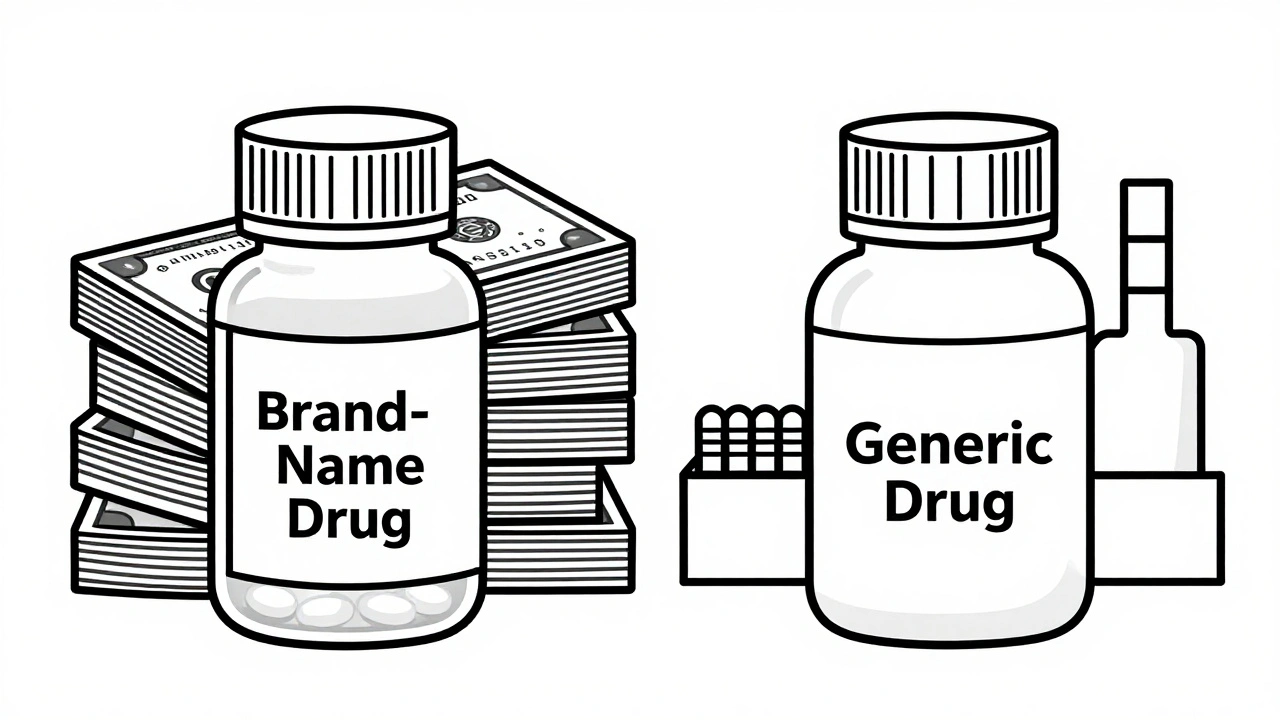
Why does a bottle of generic ibuprofen cost $2 while the brand-name version costs $15? It’s not because one is better than the other. It’s because of how they’re made, regulated, and sold. Generic drugs aren’t cheaper because they’re low quality - they’re cheaper because their entire production model is built around efficiency, scale, and avoiding the massive upfront costs that branded drugs carry.
They Don’t Pay for Research and Development
The biggest reason generic drugs cost so much less is simple: they don’t have to pay for the original research. When a company like Pfizer or Merck creates a new drug, they spend 10 to 15 years and around $2.6 billion on clinical trials, lab testing, safety studies, and regulatory filings just to get approval. That’s not a guess - it’s from the Tufts Center for the Study of Drug Development. That cost gets baked into the price of every pill. Generic manufacturers don’t do any of that. All they need to prove is that their version works the same way as the original. The FDA calls this “bioequivalence.” That means the active ingredient is identical, and it gets into your bloodstream at the same rate and amount. No need for new clinical trials on thousands of patients. No need to prove safety from scratch. Just a few hundred volunteers and a few million dollars in testing. The Office of Health Economics found that approval costs for generics are about 90% lower than for brand-name drugs.Production Gets Cheaper the More You Make
Once a generic drug is approved, production is where the real savings kick in. Generic manufacturers don’t make one or two products. They make dozens, sometimes hundreds. And they make them in huge volumes. There’s a direct link between how many pills you produce and how much each one costs. For every time you double your total production volume, your per-unit cost drops by about 18%. If you double the number of pills made for a single drug - say, 100 million to 200 million - your cost per pill can fall by 45%. That’s not theory. It’s from Boston Consulting Group’s analysis of 15 major generic drugmakers. That’s why companies like Teva and Sandoz run massive factories in India, China, and Eastern Europe. They produce billions of tablets a year. When you’re making 50 billion pills of a single drug, the cost of raw materials, labor, and packaging becomes almost negligible per unit. The FDA’s 2020 data shows that when six or more companies make the same generic drug, prices drop by more than 95% compared to the original brand.Marketing? Almost None
Branded drugs spend billions on TV ads, doctor visits, and patient campaigns. In 2022, pharmaceutical companies spent over $6 billion just on direct-to-consumer advertising in the U.S. alone. Generic manufacturers? They don’t do that. Why? Because doctors already know the drug. Pharmacies already stock it. Patients already ask for it by name. The only marketing generics do is price competition. They compete on cost, not branding. If your generic version of metformin is 10 cents cheaper than the next guy’s, you win the contract with the pharmacy benefit manager. No billboards. No sales reps handing out pens. No glossy brochures. Just lower prices and reliable supply.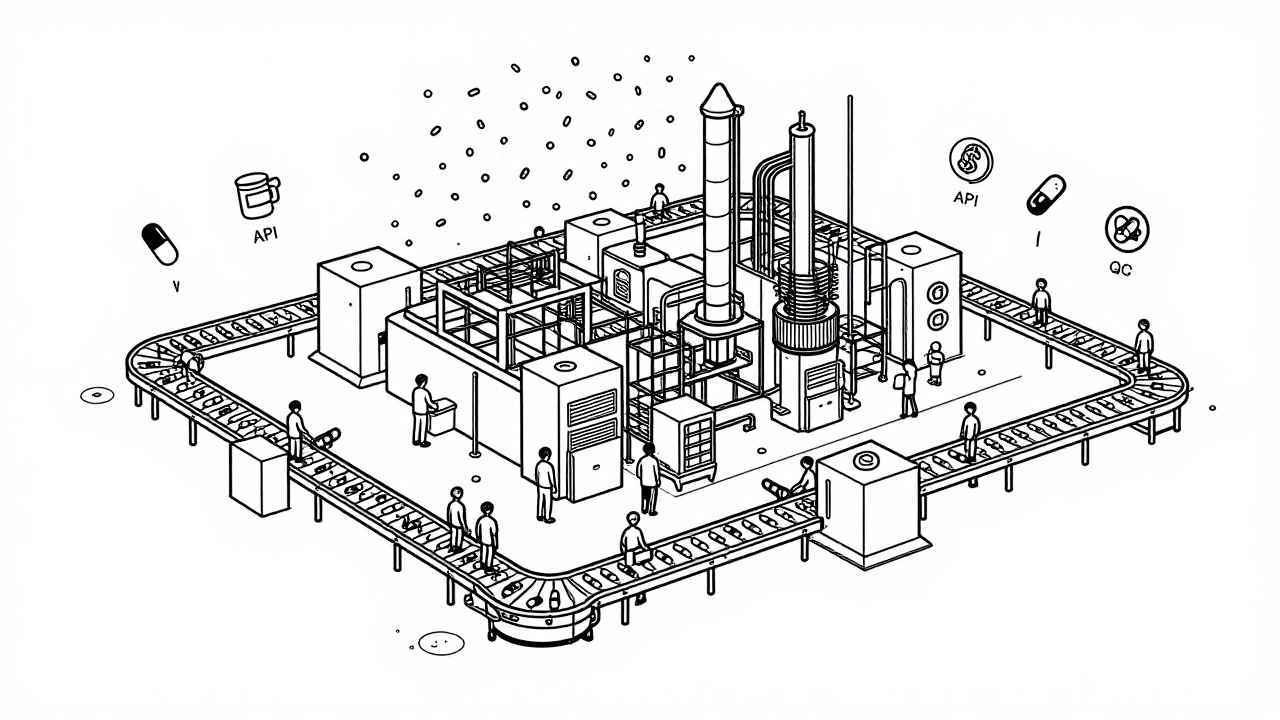
What’s Actually in the Cost of a Generic Pill?
Let’s break down what you’re paying for when you buy a generic drug. According to BCG’s 2019 analysis of 15 major generic producers:- Active Pharmaceutical Ingredient (API): 30-50% of total cost. This is the actual medicine - the chemical that treats your condition. Prices for API can swing 20-30% a year based on global supply chains, weather affecting crops, or geopolitical issues.
- Excipients: 5-10%. These are the fillers, binders, and coatings that make the pill hold together and be easy to swallow. Things like starch, cellulose, or magnesium stearate.
- Quality Control: 10-15%. Every batch must be tested to meet FDA or EMA standards. This includes purity checks, dissolution rates, and stability testing.
- Packaging: 5-8%. Blister packs, bottles, labels, cartons. Even this gets cheaper at scale.
- Supply Chain & Logistics: 4%. Shipping from India to the U.S., customs, warehousing.
- Overhead & Administration: 3-5%. Salaries, compliance, regulatory filings.
Why Do Generics Still Make Up 90% of Prescriptions?
Even though generics make up 90.1% of all prescriptions filled in the U.S. (IQVIA, 2023), they only account for 15.8% of total drug spending. That’s because they’re so cheap. In 2023, Americans filled 8.9 billion generic prescriptions but spent only $443 billion on them, compared to $2.8 trillion total on all drugs. This isn’t just a U.S. thing. In India, 80% of prescriptions are for generics. In China, it’s 65%. The World Health Organization says this is how low- and middle-income countries keep healthcare affordable. The system works because patients get the same medicine at a fraction of the cost. A generic version of lisinopril (for high blood pressure) costs less than $4 for a 30-day supply. The brand name? $120. Same chemical. Same effect. Same side effects. Just a lot less money.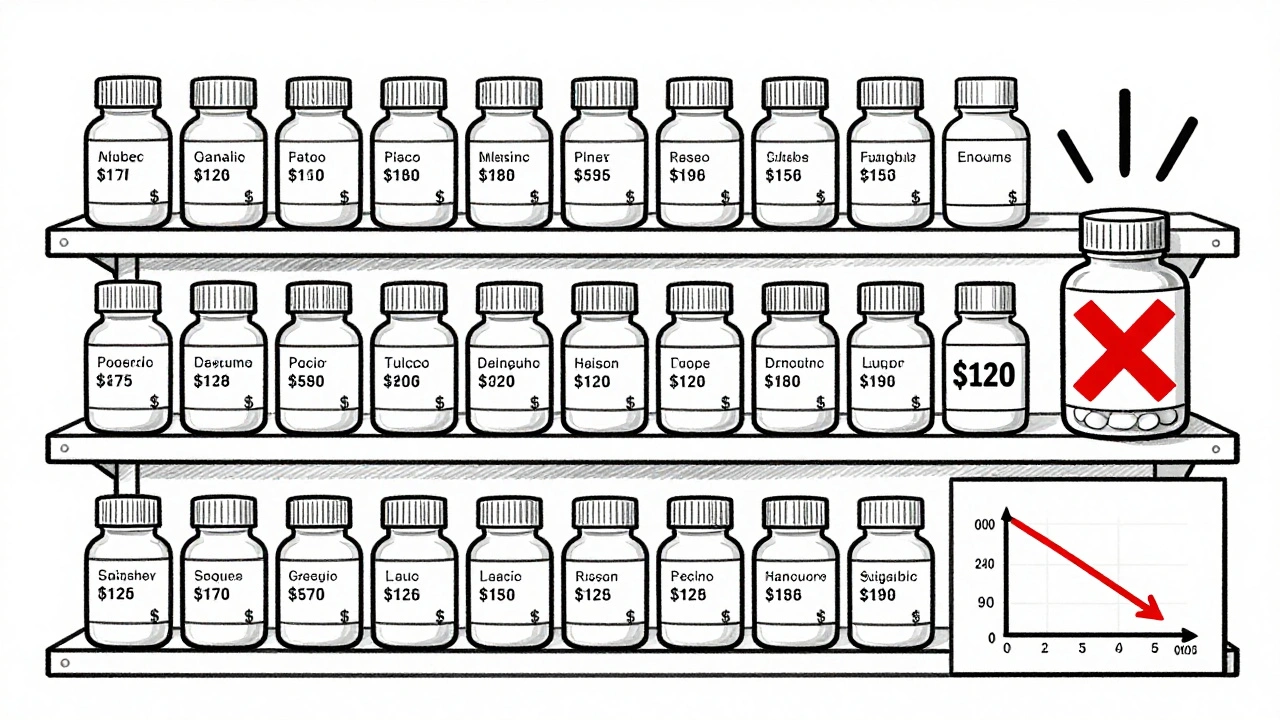
Where Generics Struggle
Not all drugs are easy to copy. Complex generics - like inhalers, injectables, or topical creams - are much harder to manufacture. These require precise delivery systems, sterile environments, and advanced equipment. The FDA calls them “complex drug products.” For example, making a generic version of an asthma inhaler isn’t just about matching the active ingredient. You have to match the propellant, the spray pattern, the particle size, and how the drug sticks to the lungs. That’s why only a handful of companies can make them - and why they cost more than simple pills. Even then, prices still drop dramatically when multiple makers enter the market. The same 18% cost reduction per production doubling applies. It just takes longer to get there.What’s Changing Now?
The landscape is shifting. The FDA’s 2023 Generic Drug User Fee Amendments (GDUFA III) are speeding up approvals - cutting review times from 40 to 24 months. That means more competitors enter the market faster, pushing prices down even more. The Inflation Reduction Act of 2022 lets Medicare negotiate drug prices. While it mostly targets brand-name drugs, it puts pressure on generics too. If Medicare pays less for a brand, pharmacies will demand lower prices for generics too. Automation is also changing things. Companies are investing in continuous manufacturing - machines that run 24/7, producing pills without stopping. The Association for Accessible Medicines predicts this will cut generic production costs by 20-25% by 2027. But there’s a downside. The pressure to cut costs has hurt supply chains. In 2022, there were 350 drug shortages in the U.S., many tied to generic manufacturers shutting down plants because they couldn’t make money. As Dr. Aaron Kesselheim wrote in JAMA Internal Medicine, “Extreme cost pressure has made the system fragile.”Is This Sustainable?
Yes - but only if competition stays strong. When only one or two companies make a generic drug, prices rise. When five or six enter, prices crash. The FDA’s data shows that with two competitors, generics are already 54% cheaper than the brand. With six, they’re over 95% cheaper. The system works because it’s designed to reward volume and efficiency, not innovation. And that’s exactly what we need in healthcare: affordable access to proven medicines. The next time you pick up a generic pill, don’t think of it as “cheap.” Think of it as the result of a well-oiled machine built to save money - not cut corners. It’s not magic. It’s math. And it’s working.Are generic drugs as safe as brand-name drugs?
Yes. The FDA requires generic drugs to have the same active ingredient, strength, dosage form, and route of administration as the brand-name version. They must also meet the same strict manufacturing standards. The only differences are in inactive ingredients like color or flavor, which don’t affect how the drug works. Generics are tested for bioequivalence - meaning they deliver the same amount of medicine into your bloodstream at the same rate.
Why do some people say generics don’t work as well?
This usually comes from confusion or rare cases of sensitivity to inactive ingredients. Some people notice a different shape, color, or taste and assume the drug is different. But unless there’s a documented bioequivalence failure - which is extremely rare - the medicine works the same. In rare cases, people with allergies may react to a dye or filler in one version but not another. That’s not about effectiveness - it’s about personal tolerance.
Why are some generics more expensive than others?
Price differences happen when there’s little competition. If only one or two companies make a generic, they can charge more. Once more manufacturers enter the market, prices drop fast. Also, some generics are harder to make - like injectables or inhalers - so they cost more. Location and distribution costs can also play a role. Always compare prices at your pharmacy; the same generic can vary by $5 or more between stores.
Do generic drugs have the same side effects?
Yes. Since the active ingredient is identical, the side effects are the same. The FDA requires that the safety profile of a generic drug matches the brand-name version. Any differences in side effects are usually due to individual reactions to inactive ingredients, not the medicine itself. If you notice new side effects after switching, talk to your doctor - but it’s rarely because the generic is inferior.
Will generic drugs become even cheaper in the future?
Yes - but with limits. Automation, continuous manufacturing, and more global competition are pushing prices down. The Association for Accessible Medicines expects production costs to drop 20-25% by 2027. However, if supply chains get disrupted - like if API production moves away from China - short-term price bumps are possible. Long-term, the trend is downward as long as competition remains strong.

10 Comments
Donna Anderson
December 12 2025
generic pills are literally the same medicine just without the fancy packaging and ads 😅 my grandma takes them and swears she feels zero difference, and she’s been on the same meds for 20 years
Reshma Sinha
December 13 2025
From the Indian pharma side, this is bread-and-butter stuff. API cost volatility? We feel it daily. One monsoon in Gujarat and suddenly your citric acid spikes 30%. But scale? We’re talking 120 billion tablets/year across our plants. Margins are razor-thin, but automation is finally catching up-continuous manufacturing units are cutting QA bottlenecks by 40%. FDA’s GDUFA III? Huge win. More approvals = more price erosion. And yes, we’re still the backbone of global generics supply.
Lawrence Armstrong
December 14 2025
Just want to clarify one thing-bioequivalence isn’t just ‘close enough.’ The FDA requires 90% CI of AUC and Cmax within 80–125%. That’s tight. And they test multiple batches. So when someone says ‘my generic didn’t work,’ it’s almost always placebo or a sensitivity to a dye. Not the API. 💯
nikki yamashita
December 16 2025
yes yes yes this is why i always pick generics. same pill, 1/10th the price. no brainers. 🙌
Laura Weemering
December 16 2025
But… isn’t this just a neoliberal fantasy? The system ‘works’ only because we’ve externalized the human cost-underpaid labor in Hyderabad, environmental degradation in the Ganges basin, and regulatory capture by multinational conglomerates masquerading as ‘efficient producers.’ The math is clean, but the ethics? Murky. And now, with Medicare negotiating prices, we’re just shifting the burden onto the weakest links in the chain. Is this sustainability-or exploitation dressed as savings?
Robert Webb
December 17 2025
It’s important to recognize that the real innovation in generics isn’t in the drug-it’s in the supply chain logistics. The fact that a tablet made in a factory outside Chennai can be shipped, cleared through customs, warehoused, and delivered to a pharmacy in rural Nebraska for under 12 cents per unit? That’s engineering genius. The real hero here isn’t the chemist-it’s the logistics team that optimized container loads, reduced transit time by 18%, and built redundancy into the API sourcing network. And yes, automation is the next frontier. Continuous manufacturing reduces batch-to-batch variability by 60%, cuts energy use by 30%, and slashes validation cycles from weeks to days. This isn’t just cheaper-it’s more reliable.
Levi Cooper
December 17 2025
Why do we even let foreign countries make our medicine? If this was cars or chips, we’d be in a national emergency. But pills? Nah, let India run the show while our pharmacists sit around. At least in the 80s, we made our own aspirin. Now we’re a drug colony. And don’t even get me started on the quality control…
Adam Everitt
December 18 2025
the real tragedy? when only 1 or 2 players remain in a generic market, prices creep back up like a tide. remember that 2018 ranitidine shortage? one plant shut down, prices tripled overnight. capitalism’s beautiful until it’s not. the system needs constant competition to stay humane. otherwise it’s just monopolies with different labels.
Ashley Skipp
December 19 2025
my pharmacist told me some generics have different fillers so sometimes they dont work right for me but i dont know if shes just trying to sell me the brand
wendy b
December 20 2025
Interesting. But have you considered the epistemological implications of bioequivalence as a proxy for therapeutic equivalence? The FDA’s 80–125% confidence interval is statistically valid, yes-but is it clinically sufficient? When we reduce human physiology to pharmacokinetic curves, we risk conflating measurable outcomes with lived experience. The patient who reports ‘feeling different’ on a generic isn’t irrational-they’re reporting a phenomenological shift that metrics cannot capture. Perhaps the real failure isn’t in the drug-but in our reductionist paradigm of care.