
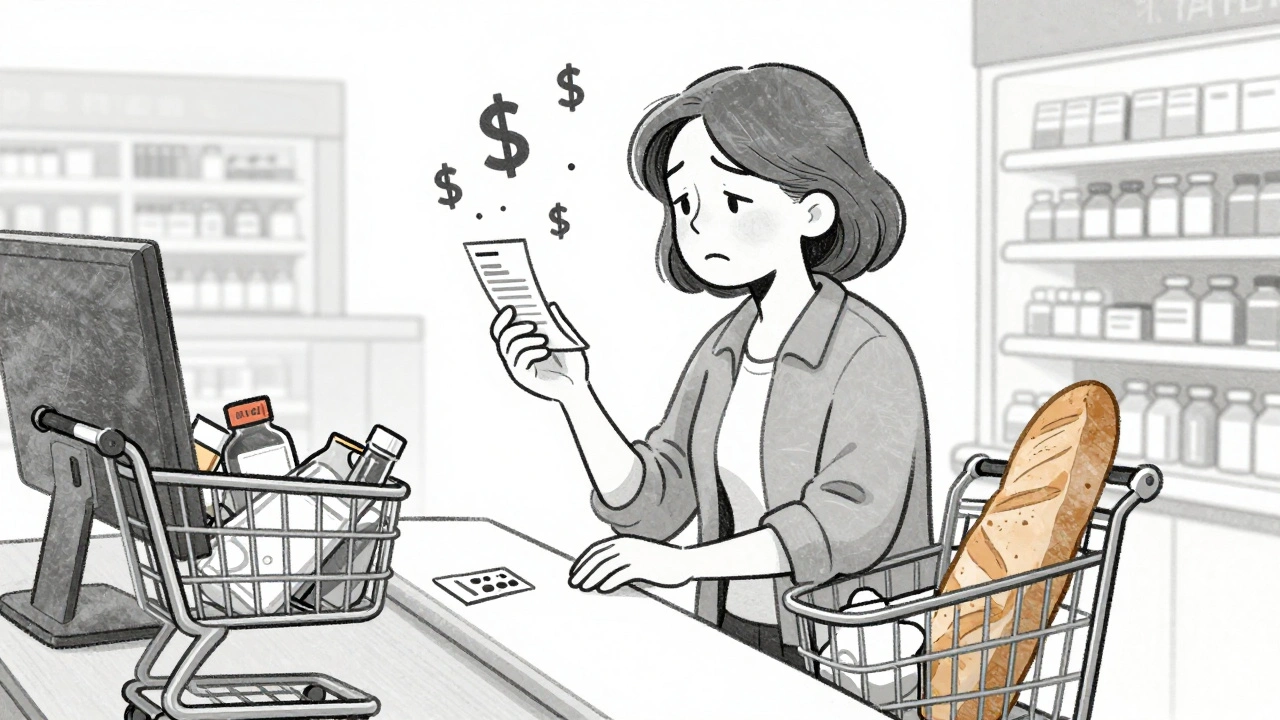
Getting your medicine every month should be simple. But for millions of people, it’s not. It’s not because they forget, or don’t understand their treatment. It’s because they can’t afford it. A 2022 study found that 84% of research linking medication costs to behavior showed that higher out-of-pocket prices directly led to people skipping doses, splitting pills, or skipping refills altogether. This isn’t just about money-it’s about survival. Around 125,000 Americans die each year because they didn’t take their medicines as prescribed. And the cost of that neglect? Between $100 billion and $300 billion in avoidable hospital visits, ER trips, and worsening conditions.
Why Cost Stops People From Taking Their Meds
It’s not just the price tag on the bottle. It’s the whole system. High deductibles mean you pay everything out of pocket until you hit a certain amount. Coinsurance forces you to pay 20%, 30%, or even 50% of the cost after that. And then there are tiered formularies-where your insurer puts drugs into levels, and the higher the tier, the more you pay. A blood pressure pill might cost $10. But a newer version, even if it’s barely better, could cost $150. Many patients don’t know the difference until they get to the pharmacy and see the bill.One study in the American Journal of Managed Care found that when copays jumped from $10 to over $50, adherence dropped by 15% to 20%. That’s not a small dip. That’s people stopping their heart medication, their insulin, their asthma inhalers. And it’s worse for chronic conditions. People with heart disease are especially likely to cut back when prices rise. Not because they’re careless-because they’re choosing between medicine and groceries.
Even people with Medicare aren’t safe. In 2022, 18% of all U.S. adults said they didn’t fill a prescription because of cost. Among older adults, 14.4% reported doing the same. One 62-year-old woman in a Kaiser Health News interview said she pays $350 a month for her meds after Medicare Part D. She’s choosing between pills and food. That’s not a rare story. It’s the norm for too many.
Real People, Real Choices
Reddit threads are full of stories like this: “I pay $800 a month for insulin with insurance.” “I split my 50mg pills in half because I can’t afford the full dose.” “I wait until I’m in pain to take my pain meds-just to make them last.” These aren’t extreme cases. They’re everyday survival tactics.And it’s not just the elderly. Younger people, especially those with low incomes, are hit hardest. A CDC report found that people making under $25,000 a year are more than three times as likely to skip meds than those making over $75,000. Women and people of color are more likely to redirect money from food, rent, or transportation to pay for prescriptions. That’s not responsibility-it’s desperation.
One patient with type 2 diabetes told the American Diabetes Association that her insulin cost $500 a month. She was taking only 60% of her doses. After enrolling in a manufacturer’s patient assistance program, her cost dropped to $25. Her adherence jumped to 95%. That’s the difference between life and complications-amputations, kidney failure, blindness.
How to Get Help: Practical Steps You Can Take Right Now
You don’t have to choose between medicine and meals. There are real, working solutions-but you have to ask for them.- Ask your doctor to check your formulary. The American Medical Association says doctors should know what’s covered before they write a prescription. Ask: “Is there a cheaper drug on my plan that works just as well?” Many times, there is. Generic versions of popular drugs like metformin or lisinopril cost under $5 a month.
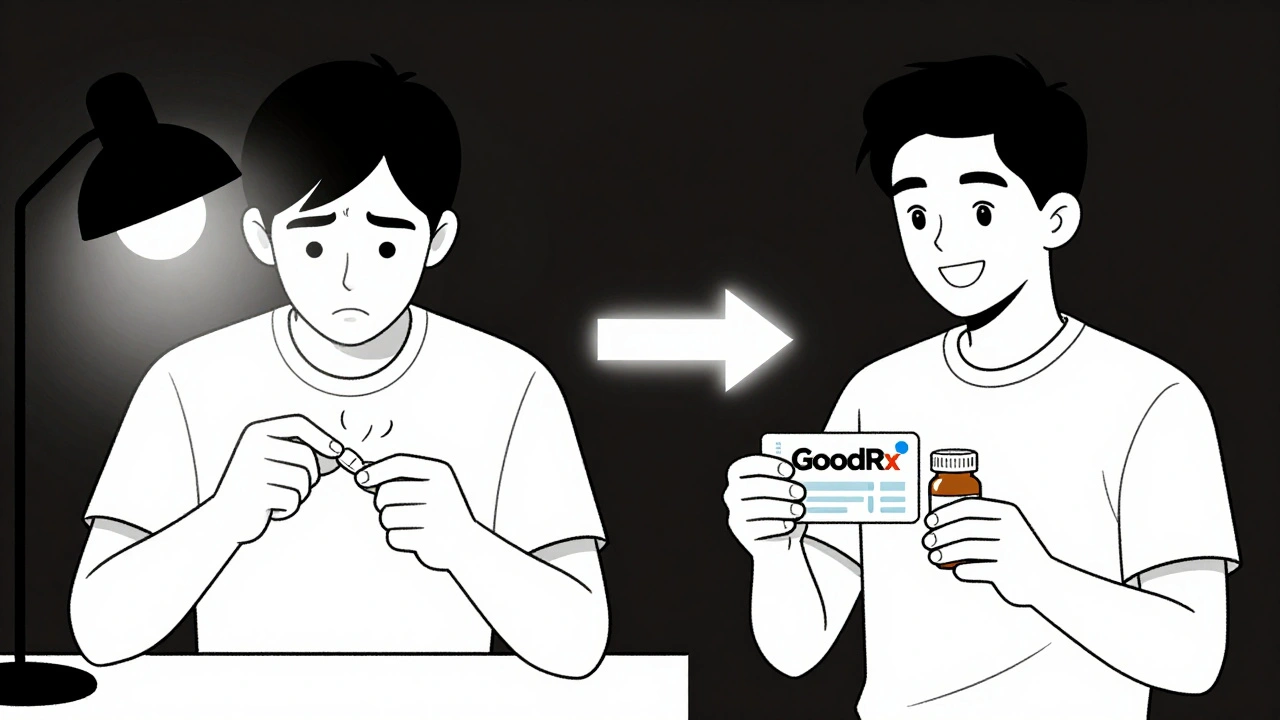
- Use GoodRx or SingleCare. These apps compare prices at pharmacies near you. They’re not insurance. They’re coupons. One user saved $240 on a 30-day supply of atorvastatin. Another saved 80% on their antidepressant. Over 35 million Americans use them every month.
- Ask for a 90-day supply. Many insurers charge the same copay for 90 days as they do for 30. That means you get 3 months of meds for the price of 2. Mail-order pharmacies often offer this too. It saves money and reduces trips to the pharmacy.
- Apply for patient assistance programs. Pharmaceutical companies run these for people who can’t afford their drugs. Eligibility is usually based on income below 400% of the federal poverty level-that’s $55,520 for one person in 2023. In 2022, these programs helped 1.8 million people. The Partnership for Prescription Assistance can help you find the right one. No one has to pay full price for insulin anymore if they qualify.
- Check if you qualify for Medicare Extra Help. If you’re on Medicare and have limited income, this program can cover up to $5,000 a year in drug costs. It’s free to apply. The Social Security Administration can help you sign up.
- Ask for samples. Doctors still have samples. Don’t be shy. A 2022 survey found 32% of patients who worried about cost asked for samples-and got them. It’s a bridge until you find long-term help.
New Laws Are Changing the Game
The Inflation Reduction Act of 2022 brought real changes. Starting in 2025, Medicare beneficiaries will never pay more than $2,000 a year out of pocket for prescription drugs. The “donut hole” is gone. And insulin will cost no more than $35 a month for Medicare users.There’s also a new program called M3P (Medicare Monthly Payment Plan), launching in 2025. It lets you pay high-cost meds in small monthly installments instead of one big bill. That’s huge for people who can’t afford $1,000 upfront but can manage $100 a month.
And the FDA approved over 1,100 generic drugs in 2022 alone. That means more competition, lower prices. You might not know it, but the drug your doctor prescribed last year could now have a generic version that’s 90% cheaper.
What’s Still Broken
Even with all these fixes, the system is still flawed. Real-time benefit tools-software that shows drug prices at the point of prescribing-were supposed to fix the “sticker shock” problem. But a 2022 study found that 37% of the time, the estimated price was off by more than $10. That’s not helpful. That’s misleading.And drug prices? They’re still rising. Insulin list prices jumped 368% between 2007 and 2017, even though the cost to make it barely changed. The Congressional Budget Office predicts prescription drug spending will hit $1.1 trillion by 2031. Without bigger reforms, 1 in 5 Americans will still skip meds because they can’t pay.
But here’s the truth: you don’t need a law to change your situation. You need to speak up. Tell your doctor. Ask your pharmacist. Look up GoodRx. Fill out one form. Call 211 for local help. The system is broken-but you’re not powerless.
What to Do Today
If you’re skipping doses because of cost:- Write down every medication you take and how much you pay for each.
- Call your pharmacy and ask for the cash price-sometimes it’s cheaper than insurance.
- Go to GoodRx.com or download the app. Type in your drug. See the lowest price nearby.
- Call your doctor’s office and say: “I’m having trouble affording my meds. Can we talk about alternatives?”
- Visit NeedyMeds.org or PPA.org. They’ll help you find free or low-cost programs.
It’s not about being lazy. It’s not about forgetting. It’s about a system that makes people choose between their health and their rent. You deserve better. And help is out there-if you know where to look.
Why do people skip doses because of cost?
People skip doses because out-of-pocket costs for prescriptions have risen faster than incomes. High copays, deductibles, and tiered drug lists mean many patients pay hundreds a month just to stay alive. When they can’t afford food, rent, or utilities, medicine becomes a luxury they can’t justify. A CDC study found 8.2% of working-age adults skipped meds due to cost in 2021-and that number is likely higher now.
Can I get my meds for free?
Yes, if you qualify. Pharmaceutical companies offer free or low-cost medication through patient assistance programs. Eligibility is usually based on income-often under 400% of the federal poverty level. For example, insulin manufacturers like Eli Lilly and Novo Nordisk offer free insulin to eligible patients. You can find these programs through NeedyMeds.org or the Partnership for Prescription Assistance.
Does Medicare cover all my drug costs?
No. Medicare Part D has gaps, including a deductible and coinsurance. But starting in 2025, the Inflation Reduction Act caps out-of-pocket drug spending at $2,000 per year for Medicare beneficiaries. Insulin will cost no more than $35 per month. If your income is low, you may qualify for Extra Help, which can cover nearly all your drug costs.
Is GoodRx better than insurance?
Sometimes. GoodRx isn’t insurance-it’s a discount coupon. If your insurance has a high deductible or copay, the GoodRx price may be lower. For example, a $120 brand-name pill might cost $30 with GoodRx, but $100 with insurance after your deductible. Always compare the cash price (via GoodRx) to your insurance price before paying.
What if I can’t afford my meds and I don’t have insurance?
You still have options. Community health centers offer sliding-scale fees based on income. Some pharmacies, like Walmart and Kroger, sell common generic drugs for $4 to $10 a month. Manufacturer assistance programs don’t require insurance. And local charities or religious groups often help with medication costs. Call 211-free and confidential-for help finding resources near you.

15 Comments
Ada Maklagina
December 4 2025
I saw a guy at the grocery store yesterday split his insulin pill in half. Didn't say a word. Just stared at the price tag like it had personally betrayed him. We all know the system's broken. But seeing it in real life? That's the kind of thing that sticks.
sean whitfield
December 5 2025
They say cost is the problem but really its just the government letting big pharma rob us blind. You think this is about medicine? No its about control. They want you dependent. Always buying. Always paying. Always quiet.
William Chin
December 5 2025
It is imperative to acknowledge that the structural inefficiencies within the pharmaceutical distribution model are not merely fiscal in nature but represent a profound failure of public policy. The absence of transparent pricing mechanisms constitutes a violation of patient autonomy and ethical medical practice.
Harry Nguyen
December 7 2025
People complain about drug prices but they still vote for the same politicians who let this happen. You want cheap meds? Stop electing soft liberals who think healthcare is a right. Work harder. Save money. Stop expecting free stuff.
Katie Allan
December 8 2025
There’s so much hope in the solutions listed here. GoodRx, patient programs, 90-day fills - these aren’t magic, but they’re real. I’ve helped three friends navigate this. It takes time, but you don’t have to suffer alone. You’re not broken. The system is.
Deborah Jacobs
December 9 2025
I used to be the person who skipped my meds till I felt like crap. Then I found out my $400 antidepressant was $12 on GoodRx. I cried in the pharmacy aisle. Not because I was weak - because I was finally seen. This isn't just about pills. It's about dignity.
James Moore
December 11 2025
Let’s be clear: the pharmaceutical industry is not evil - it is a capitalist enterprise, and capitalism, by its very nature, commodifies human suffering. The real tragedy is not that drugs are expensive - it’s that we have normalized this as inevitable. We have been conditioned to believe that health is a transaction, not a human right - and that conditioning is the true disease.
Kylee Gregory
December 11 2025
I wonder if we’re overcomplicating this. What if the solution isn’t more programs or apps, but just… listening? To the people who are choosing between insulin and rent. To the ones who whisper their struggles at the pharmacy counter. Maybe the real fix starts with seeing each other as human - not as patients or costs or statistics.
Lucy Kavanagh
December 13 2025
You know what they don’t tell you? That the same companies pushing insulin at $300 are also funding the politicians who block price caps. And the FDA? They approve generics… but only after the brand name has milked every dollar. It’s all connected. Wake up.
Chris Brown
December 13 2025
I find it deeply troubling that this post frames financial hardship as a systemic failure rather than a personal one. Responsibility is not a privilege. It is a moral imperative. If one cannot afford medication, one must seek employment, reduce expenditures, or relocate - not demand others subsidize one’s choices.
Stephanie Fiero
December 14 2025
OMG I JUST FOUND OUT MY BLOOD PRESSURE MED IS $3 ON GOODRX?? IVE BEEN PAYING 80 FOR YEARS. I FEEL SO STUPID. THANK YOU FOR THIS POST. IM TELLING EVERYONE. YOU DIDNT JUST SAVE ME MONEY YOU SAVED MY LIFE.
Laura Saye
December 15 2025
The ontological burden of pharmaceutical accessibility intersects with epistemic injustice in healthcare delivery systems. When patients are rendered invisible through opaque pricing structures, their agency is systematically eroded - a phenomenon that is both quantitatively measurable and qualitatively devastating. The emotional labor required to navigate these barriers is rarely accounted for in policy discourse.
Krishan Patel
December 15 2025
In India, we pay $2 for the same insulin. The U.S. system is a scam. You are being exploited. The government protects corporations, not citizens. You think this is about health? No. It is about profit. And they will keep doing it until you stop being silent.
Carole Nkosi
December 16 2025
They say 'ask your doctor' like it's that easy. What if your doctor doesn't care? What if they're too busy? What if they don't know the alternatives? You think people don't try? We do. We beg. We cry. We get ignored. And then we just stop.
Stephanie Bodde
December 17 2025
You got this 💪 I know it feels overwhelming but you’re not alone. I’ve been there. Start with GoodRx today. Then call your doctor. One step. Just one. You’re stronger than you think. And I’m rooting for you 🌱