
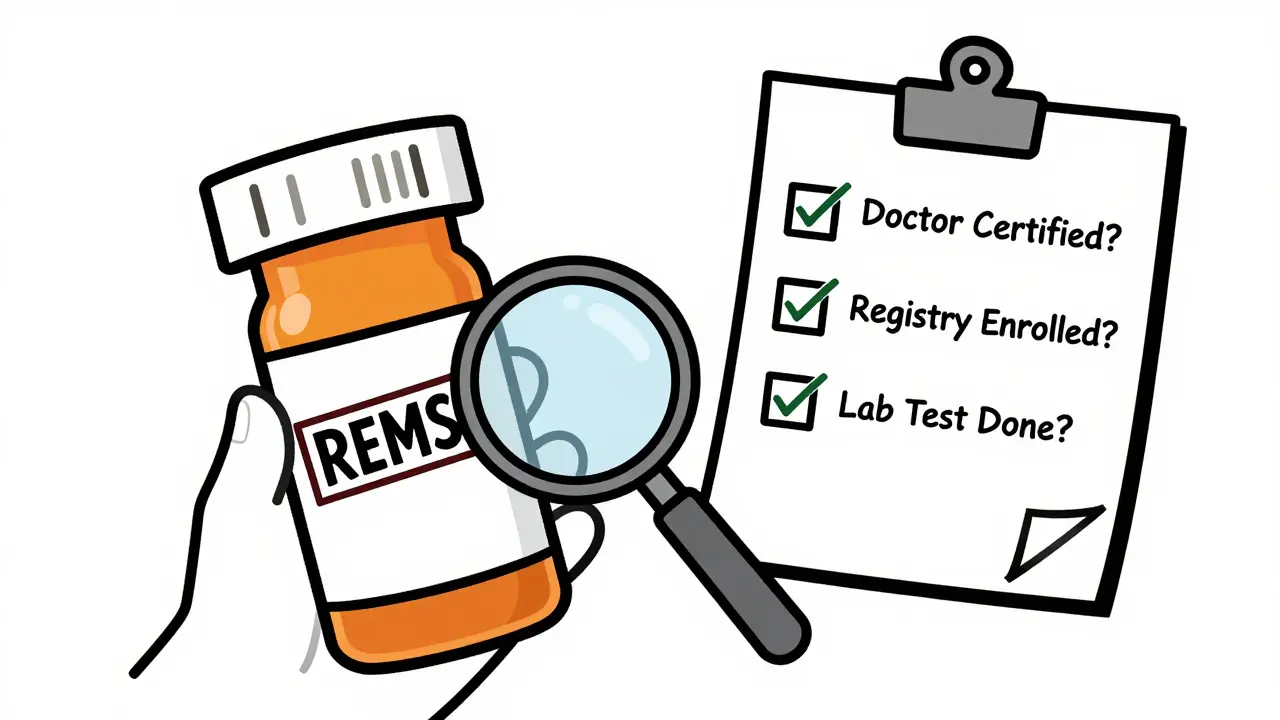
Before you start a new medication, especially one that’s powerful or has serious side effects, there’s one critical step many people skip: checking the REMS requirements. REMS stands for Risk Evaluation and Mitigation Strategies. It’s not a suggestion. It’s a federal rule enforced by the U.S. Food and Drug Administration (FDA) to make sure dangerous drugs are used safely. If you don’t follow these rules, you might not get your prescription filled - or worse, you could put yourself at risk.
What Exactly Is a REMS?
REMS programs exist because some medications are too risky to be sold without strict controls. Think of them like safety locks on a gun: the drug works, but it can cause serious harm if misused. The FDA created REMS in 2007 after several high-profile drug safety failures. Today, there are 76 active REMS programs covering everything from acne pills to opioid painkillers.
Not all REMS are the same. Some just require you to read a patient handout. Others demand that your doctor be certified, you get blood tests every month, or you pick up your medicine at a special clinic. For example, isotretinoin (Accutane) can cause severe birth defects. So the iPLEDGE REMS requires both you and your doctor to register online, complete training, and confirm you’re not pregnant before each refill. Zyprexa Relprevv, an antipsychotic shot, can cause sudden dizziness or fainting after injection - so it must be given in a certified facility where staff can watch you for three hours.
How to Find Out If Your Medication Has a REMS
You can’t assume your doctor or pharmacist knows every REMS rule off the top of their head. You need to verify it yourself. Here’s how:
- Check the prescribing information - The official drug label (also called the package insert) always states if a REMS applies. Look for a section titled “REMS” or “Risk Evaluation and Mitigation Strategy.” It’s usually near the end of the document.
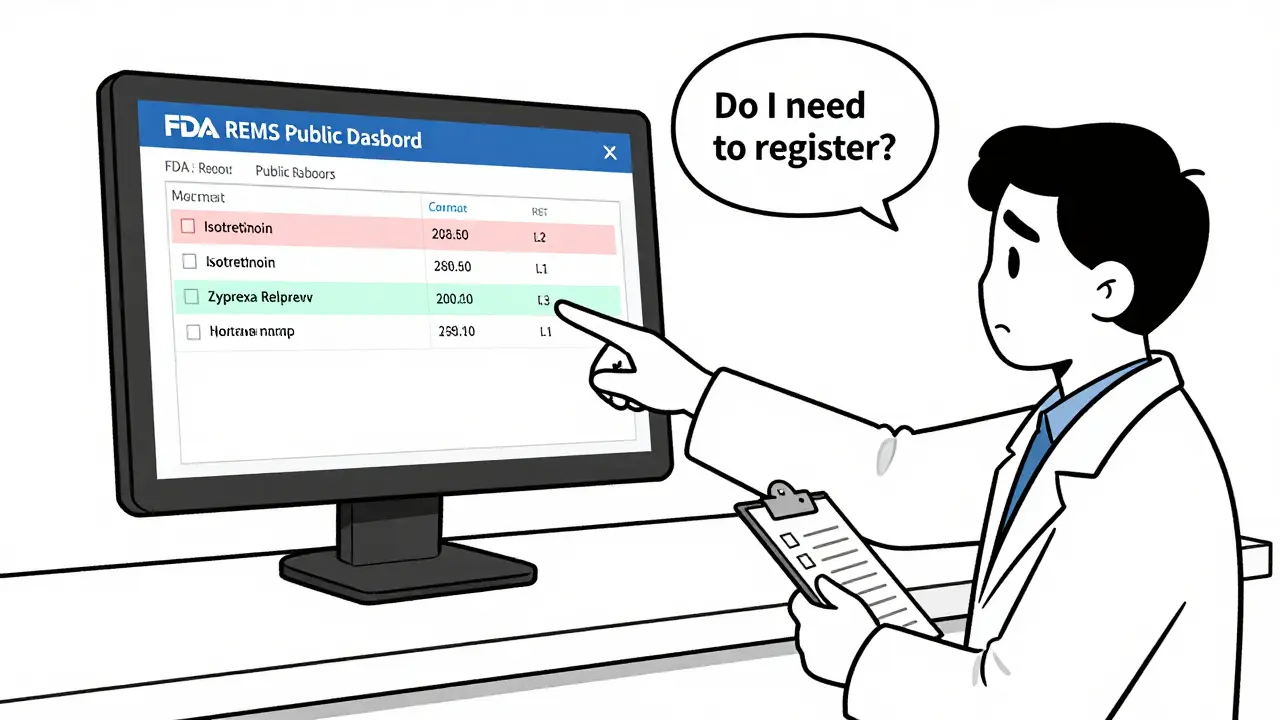
- Use the FDA’s REMS Public Dashboard - Go to fda.gov/drugs/rems. You can search by drug name, manufacturer, or condition. The dashboard shows if the REMS includes prescriber certification, patient registries, or special dispensing rules. The updated version launched in March 2023 includes real-time filters and direct links to each program’s requirements.
- Visit the manufacturer’s REMS website - Most drug companies run their own REMS portals. For example, the iPLEDGE program has its own site: ipleDGEprogram.com. These sites have enrollment forms, training videos, and step-by-step checklists.
- Ask your pharmacy - Pharmacists are on the front lines. If your medication has a REMS, they’ll know. Call ahead and ask: “Does this drug require special certification or registration before I can get it?” The Opioid Analgesic REMS FAQ even recommends this as a first step.
Common REMS Requirements You Might Encounter
REMS programs usually include one or more of these five elements:
- Medication Guides - Paper or digital handouts explaining risks. These must be given to you every time you refill the prescription.
- Communication Plans - Letters or emails sent to doctors to remind them of safety rules. These don’t usually affect patients directly.
- Elements to Assure Safe Use (ETASU) - The strictest part. This can mean:
Prescriber certification: Your doctor must complete training and register online before they can prescribe. For example, thalidomide requires a 65-minute online course and a certified ID number.
Patient enrollment: You must sign up in a national registry. The Mycophenolate REMS (for transplant patients) requires women of childbearing age to confirm they’re using birth control and get monthly pregnancy tests.
Restricted distribution: The drug can only be dispensed by certified pharmacies or given in certified clinics. This applies to drugs like Zyprexa Relprevv and some cancer therapies.
Monitoring requirements: Blood tests, EKGs, or liver function checks every few weeks. The Opioid Analgesic REMS doesn’t require testing, but other programs like those for clozapine do.
What Happens If You Skip REMS Steps?
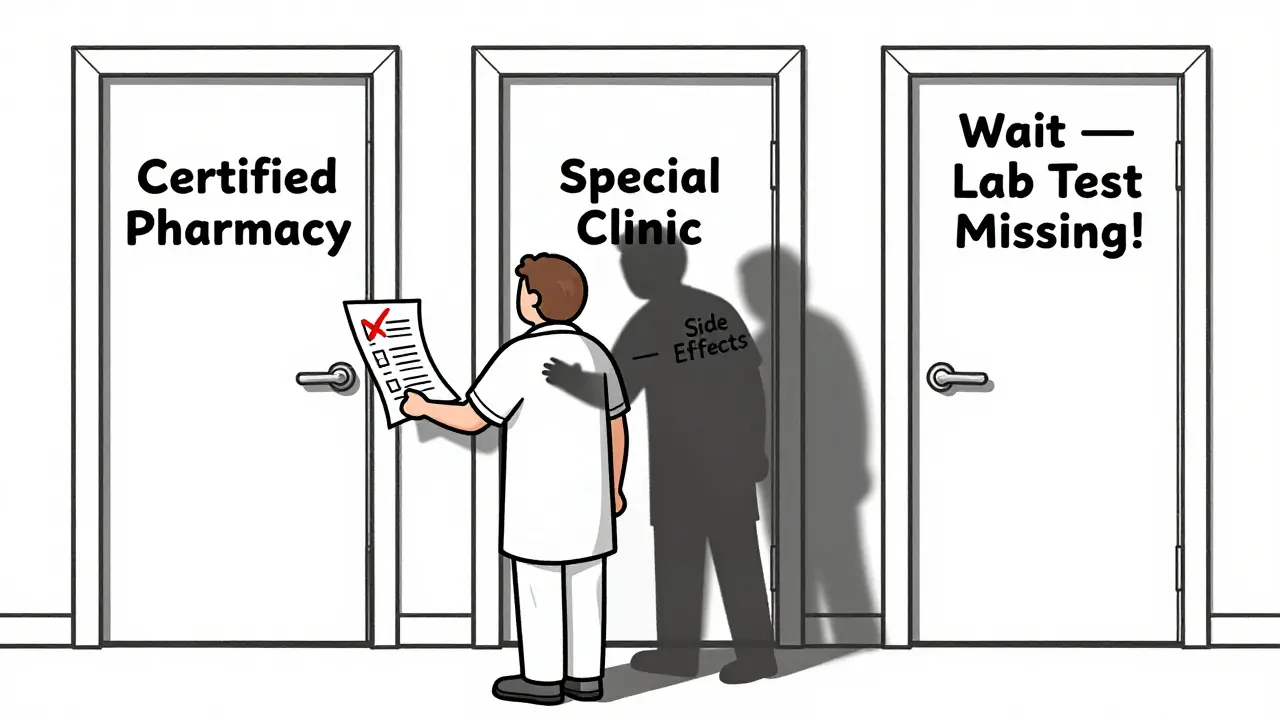
It’s not just a paperwork delay. If you don’t complete the required steps:
- Your pharmacy will refuse to fill the prescription.
- Your doctor’s electronic prescription may be blocked by the system.
- You could be denied insurance coverage.
- You might be exposed to serious side effects you weren’t prepared for.
A 2022 survey by the National Organization for Rare Disorders found that 42% of patients on REMS medications experienced treatment delays - averaging 6.2 business days. One patient waited three weeks because her doctor didn’t know about the Mycophenolate REMS registry. Another couldn’t get his opioid refill because his pharmacy hadn’t updated its REMS verification system.
How to Make REMS Checks Easier
Here’s a simple three-step verification process recommended by the Institute for Safe Medication Practices:
- Check the label - Look for “REMS” on the prescription bottle or the patient handout.
- Search the FDA dashboard - Type your drug name into the FDA’s REMS Public Dashboard. Note the specific requirements.
- Confirm with your pharmacy or doctor - Ask: “Do I need to register? Does my doctor need to be certified? Are there lab tests required?”
Pharmacists in hospital systems have cut processing time for isotretinoin prescriptions from 45 minutes to 15 minutes by using a standardized checklist. You can do the same. Keep a printed or digital list of your REMS-mandated drugs and what you need to do for each. Update it every time you get a new prescription.
What’s Changing in 2026?
REMS programs are evolving. In April 2023, the FDA required all new REMS to include smartphone-friendly tools - meaning you’ll soon be able to complete training, upload test results, or verify enrollment via an app. Eight of the top 10 pharmacy benefit managers now integrate REMS checks directly into e-prescribing systems. By 2026, some experts predict blockchain technology will be used to securely track certifications across clinics and pharmacies.
The FDA is also trying to reduce the burden. Between 2015 and 2020, 37% of REMS programs were modified to remove unnecessary steps. The 21st Century Cures Act pushed for smarter, not stricter, safety rules. Still, about 15-20% of new drugs approved each year require a REMS - and that number is expected to rise, especially for gene therapies and complex biologics.
Final Checklist Before Starting a New Medication
Use this before you take your first dose:
- Is this drug listed on the FDA’s REMS Public Dashboard?
- Does the prescribing info mention REMS?
- Does your doctor need to be certified? If yes, have they completed it?
- Do you need to enroll in a registry? Are you registered?
- Are lab tests required? Have you had them?
- Do you need to pick up the drug at a certified pharmacy or clinic?
- Have you received and read the Medication Guide?
If even one answer is “no,” stop. Call your doctor or pharmacist. Don’t risk your health because of a missed step.
Do all new medications have REMS requirements?
No. Only medications with serious, life-threatening risks require a REMS. About 15-20% of new drugs approved each year have one. Common drugs like antibiotics or blood pressure medications rarely need REMS. High-risk drugs - like those for cancer, severe mental illness, pregnancy-related birth defects, or opioid addiction - are the ones most likely to be covered.
Can I get a REMS medication without seeing a specialist?
Sometimes. For many REMS programs, your regular doctor can prescribe - as long as they complete the required training. For example, the Opioid Analgesic REMS only requires continuing education, not a specialist. But for drugs like Zyprexa Relprevv or thalidomide, you must receive the medication in a certified facility. Always check the specific requirements for your drug.
What if I miss a required lab test for my REMS medication?
Your pharmacy will not refill the prescription until the test is completed and documented. Some programs allow a short grace period - usually 7-14 days - but others block refills immediately. Don’t wait. Schedule your lab work as soon as you’re prescribed the drug. Missing a test doesn’t just delay your medication - it increases your risk of side effects.
Are REMS requirements the same in the UK and other countries?
No. REMS is a U.S.-only program run by the FDA. Other countries have similar systems - like the UK’s Risk Management Plans (RMPs) or the EU’s Risk Management Plans - but they’re not called REMS and have different rules. If you’re traveling or moving abroad, your REMS requirements won’t transfer. Always check the local drug safety rules.
Can I refuse to participate in a REMS program?
Yes - but that means you won’t get the medication. REMS programs are mandatory for distribution. If you don’t complete the steps, the manufacturer won’t supply the drug to pharmacies, and pharmacies won’t dispense it. If the drug is essential for your health, you’ll need to follow the rules. If the risks outweigh the benefits for you, talk to your doctor about alternatives.

12 Comments
Leon Hallal
March 10 2026
Just got prescribed isotretinoin last month. Took me three weeks to get through iPLEDGE. Doctor forgot to certify. Pharmacy said it was on hold. I had to call the manufacturer directly. No one tells you this stuff until you’re already halfway to a breakout.
Don’t skip the checklist. It’s not bureaucracy. It’s your skin on the line.
Judith Manzano
March 10 2026
This is so important. I’m so glad someone laid this out clearly. I had no idea about REMS until my pharmacist stopped me before filling my clozapine script. She said, ‘You’re lucky you asked.’ Turned out I needed a monthly ANC test and my doctor hadn’t told me. Now I keep a sticky note on my fridge with my REMS drugs and deadlines. It’s a pain, but it keeps me alive.
Jazminn Jones
March 10 2026
It is frankly astonishing that patients are expected to navigate this labyrinthine regulatory framework themselves. The FDA’s REMS dashboard, while technically functional, is neither intuitive nor accessible to the average layperson. The burden of compliance is systematically offloaded onto vulnerable populations who lack the health literacy or digital fluency to comply. This is not patient safety-it is institutional negligence disguised as risk mitigation.
Tom Sanders
March 10 2026
Ugh. Another government thing to deal with. Why can’t they just let us take the pill? I mean, I read the handout. I know it’s risky. Do I really need a whole certification process? My doctor says it’s fine. Why does the system hate me?
Stephen Rudd
March 10 2026
REMS is just another way for Big Pharma to control access. They don’t care about safety-they care about liability. That’s why they make you jump through hoops. Meanwhile, the real danger is the drugs they don’t even test. You think isotretinoin is scary? Try the new cancer drugs that get approved with three months of data. REMS is theater. The real risk is the FDA letting them sell poison and calling it ‘care’.
Erica Santos
March 11 2026
Oh wow. So the government now runs a dating app for dangerous drugs. ‘Swipe right if you’ve had a pregnancy test this month.’ I’m starting to think we’re all just beta testers for a dystopian pharmacy AI. Next up: mandatory emotional stability scans before you get ibuprofen.
George Vou
March 12 2026
you know what i think? i think the whole rems thing is a cover for the fda and big pharma to make money. they dont really care if you live or die. they just want you to sign up, pay for tests, go to clinics, and then they sell you more drugs. its all a scheme. my cousin got denied his med because the website was down. they couldve just given him the pills. but nooo. gotta follow the rules. its all fake.
rafeq khlo
March 13 2026
The fundamental flaw in this entire system lies in its assumption of patient agency. The notion that an individual with no medical training can effectively interpret regulatory documentation is not merely naïve-it is dangerously paternalistic. The FDA’s dashboard lacks interoperability with EHRs, rendering compliance a voluntary act of civic duty rather than a systemic safeguard. Furthermore, the absence of standardized digital verification protocols across pharmacy benefit managers introduces critical fragmentation. This is not risk mitigation. This is regulatory entropy.
Scott Easterling
March 14 2026
Why do they make you do so many tests? I mean, I’ve been on this stuff for a year. My liver is fine. My blood pressure is fine. Why do I have to get a blood test every month? It’s not like I’m a drug addict. They treat you like a criminal. And don’t get me started on the pharmacy-last time I went, they said they couldn’t fill it because ‘the system flagged me.’ What system? Who’s watching? I’m starting to think they’re tracking my every move.
Mantooth Lehto
March 14 2026
Thank you for this. I’ve been on Mycophenolate for 3 years. I do my monthly pregnancy test. I fill out the registry. I get my doctor certified. It’s exhausting. But I’m alive. And I have a healthy baby. This isn’t red tape. This is what keeps me from losing everything. Please, if you’re on a REMS drug-don’t half-ass it. I’ve seen what happens when people do.
Melba Miller
March 15 2026
REMS is a joke. We’re in America. We’re supposed to be free. Why should I need permission from the government to take a pill my doctor says I need? I’ve seen people die waiting for their paperwork. Meanwhile, the same companies that push REMS are the ones lobbying to keep drug prices high. This isn’t safety. This is control. And they’re using fear to do it.
Katy Shamitz
March 16 2026
As someone who’s been through 3 different REMS programs, I just want to say-you’re not alone. It feels like a nightmare at first. But once you get the rhythm? It’s just another part of managing your health. I keep a folder. I set calendar alerts. I call my pharmacy every time I get a new script. It’s annoying, sure. But I’d rather be annoyed than dead. You’ve got this. And if you need help, DM me. I’ve got spreadsheets.