
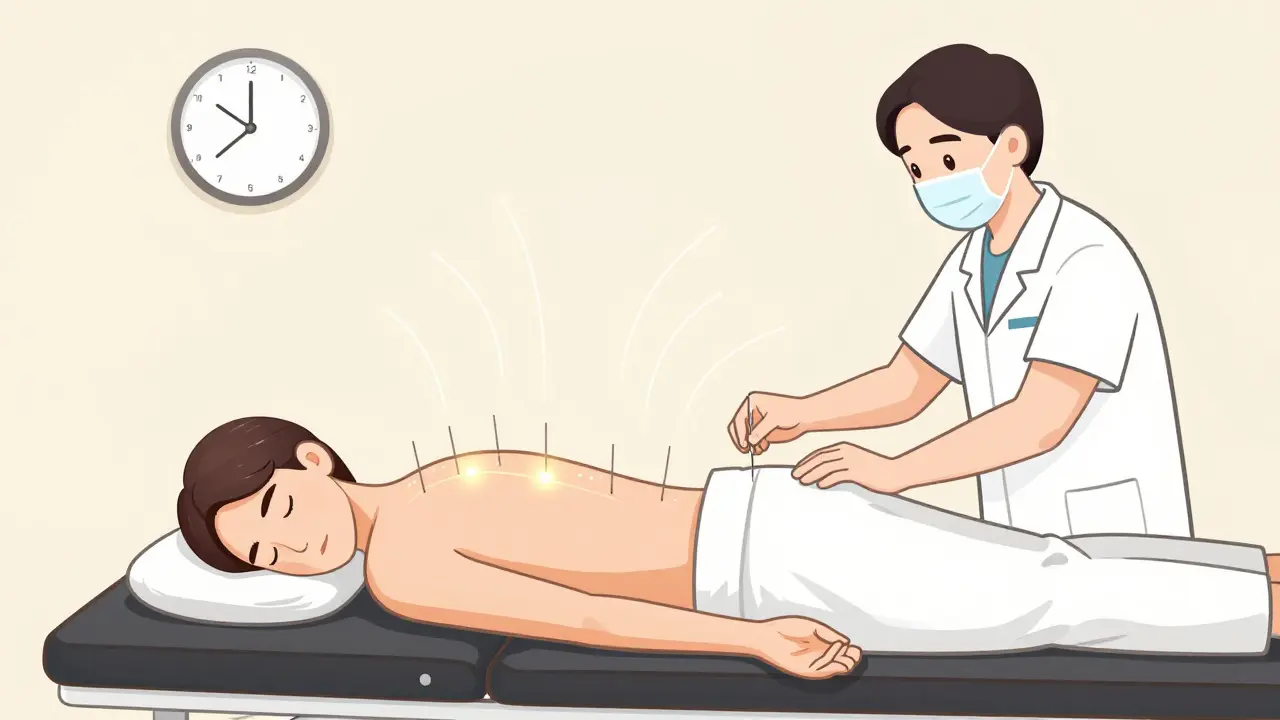
When you’re stuck with chronic pain-backaches that won’t quit, knee arthritis that limits your walk, or headaches that come every other day-you start looking for options beyond pills. Opioids carry risks. NSAIDs can wreck your stomach. And you’re tired of masking symptoms without fixing anything. That’s where acupuncture comes in. Not as a last resort, not as magic, but as a real, research-backed tool that’s been quietly helping millions for decades.
How Acupuncture Works for Pain (It’s Not Just Energy)
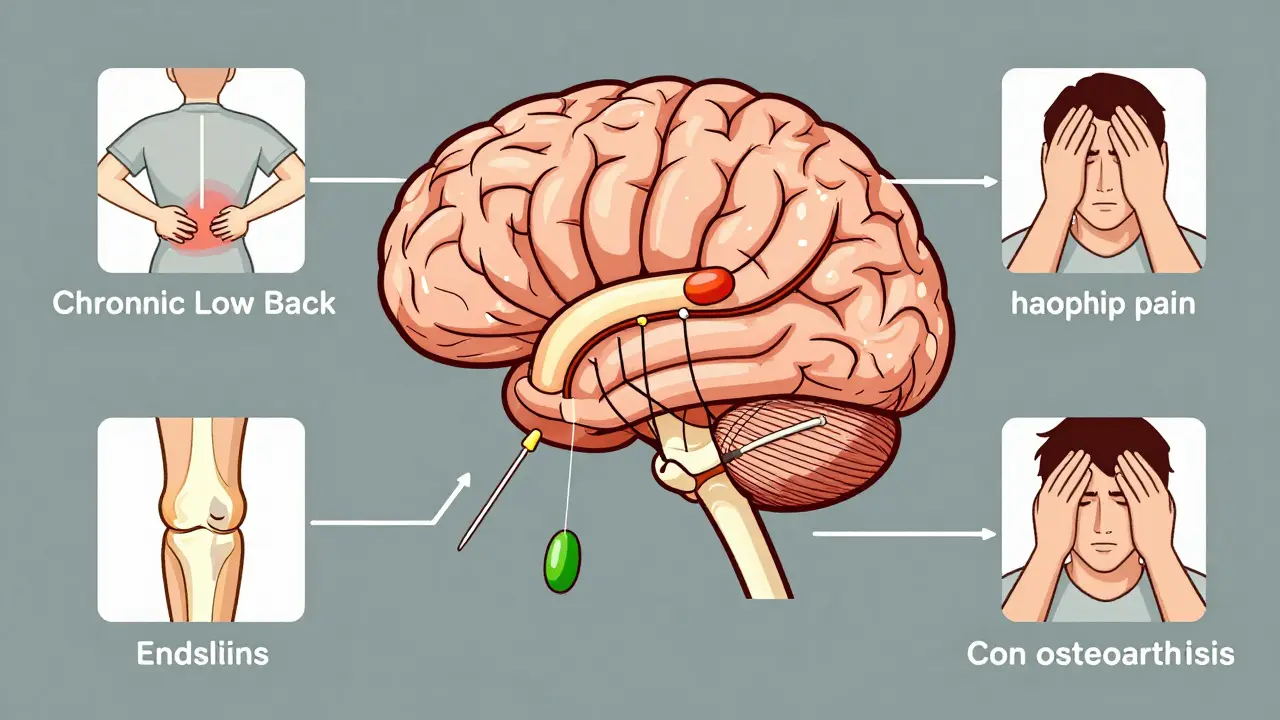
People talk about qi and meridians, and yes, that’s part of traditional Chinese medicine. But modern science doesn’t need those concepts to explain why acupuncture works. Studies show it triggers real biological changes. Needles inserted at specific points send signals to your brain that alter how pain is processed. It boosts natural painkillers like endorphins and serotonin. It reduces inflammation locally where the needle goes. And it calms down overactive nerves in your spinal cord and brain that keep screaming "pain!" even when there’s no injury.
This isn’t theory. A 2018 meta-analysis of nearly 21,000 patients across 39 randomized trials found acupuncture delivered pain relief that lasted at least a year after treatment ended. That’s not placebo. That’s physiology.
What Conditions Does It Actually Help?
Not all pain is the same-and acupuncture doesn’t work equally for all of them. The strongest evidence is for three types:
- Chronic low back pain (lasting more than 12 weeks): Multiple large studies show acupuncture reduces pain intensity and improves movement better than no treatment, and just as well as NSAIDs.
- Knee osteoarthritis: Over 85% of osteoarthritis studies in major reviews focused on knee pain. Results? Consistent, measurable improvement in pain and function, often lasting months after treatment stops.
- Tension-type headaches: If you get headaches from stress, muscle tightness, or poor posture, acupuncture can cut frequency and severity. One study showed patients had half as many headache days after 10 sessions.
For acute pain-like after surgery-acupuncture doesn’t beat painkillers. For sciatica, fibromyalgia, or neck pain, results are mixed but often positive. The pattern is clear: it shines where pain is persistent, not where it’s sudden and severe.
Real Data: How Much Better Is It?
Let’s get numbers. In a 2012 analysis of 29 high-quality trials with over 17,000 people:
- Compared to no treatment: Acupuncture reduced pain by 0.55 standard deviations for back/neck pain, 0.57 for knee OA, and 0.42 for headaches.
- Compared to sham acupuncture (needles that don’t penetrate or go to wrong spots): The difference was smaller, but still real-0.23 for back pain, 0.16 for OA, 0.15 for headaches.
What does that mean? If you rate pain from 0 to 10, acupuncture typically drops it by 2 to 3 points. That’s enough to go from "can’t sleep" to "can sleep," or from "can’t walk the dog" to "can walk the dog."
And here’s the kicker: those benefits stick. A follow-up study found patients still reporting less pain 12 months later. That’s rare in pain management.
How Does It Compare to Other Treatments?
Let’s put acupuncture side by side with what you’re probably already using:
| Treatment | Effectiveness for Chronic Pain | Risk Profile | Duration of Effect |
|---|---|---|---|
| Acupuncture | High for back, knee, headache pain | Extremely low (0.05% serious side effects) | Up to 12+ months |
| NSAIDs (e.g., ibuprofen) | High short-term | High (103,000 US hospitalizations/year for GI issues) | Only while taking |
| Opioids | High, but diminishing returns | Very high (addiction, overdose risk) | Short-term, tolerance builds |
| Sham acupuncture | Moderate (placebo effect) | Negligible | Weeks to months |
Acupuncture doesn’t replace pills. It complements them. Many patients use it to reduce their NSAID or opioid dose-not quit cold turkey, but taper safely. In one study, people getting acupuncture after surgery used 30% fewer opioids in the first 48 hours.
What Does a Real Treatment Look Like?
You’re not getting one needle and calling it a day. A typical course:
- 6 to 12 sessions over 6 to 8 weeks
- 1 to 2 sessions per week
- Each session lasts 20 to 30 minutes
- Needles stay in for 15 to 30 minutes
- Some practitioners use mild electrical stimulation
Practitioners don’t just jab you randomly. They pick points based on your diagnosis. Some use a fixed set of points. Others customize based on your symptoms, pulse, tongue, and energy patterns. Research shows both approaches work, but individualized treatment tends to give slightly better results.
Most people feel a slight pinch, then nothing. Some feel warmth, tingling, or heaviness. That’s normal. If it hurts, speak up. The needles are thin-about the width of a hair-and sterile. Single-use. FDA-regulated since 1996.
Why Do Some People Say It Doesn’t Work?
Because not everyone responds. And because placebo effects are strong in pain care. The difference between real and sham acupuncture is small-about 20% better. That means some of the benefit comes from the ritual, the attention, the relaxation. But that doesn’t make it fake. If a treatment works-even partly through placebo-it still helps people feel better.
Dr. Edzard Ernst, once a skeptic, admitted in 2019 that acupuncture’s benefits are real, even if the mechanism isn’t fully understood. The International Association for the Study of Pain says the same: real acupuncture beats both sham and no treatment. The difference is small, but consistent.
And then there’s the practitioner factor. A 2023 survey of 1,872 reviews on Healthgrades gave acupuncture a 4.2 out of 5. But 41% of negative reviews cited "variable skill." That’s the biggest risk. Find someone certified. In 47 U.S. states, you need NCCAOM certification. Look for it.
Cost, Insurance, and Access
One session averages $60 to $120. A full course? $400 to $1,200. That’s steep if you’re paying out of pocket.
But things are changing. In 2020, Medicare started covering acupuncture for chronic low back pain. That opened doors for 12.5 million seniors. By 2023, 56% of private insurers in the U.S. covered it for pain. The Veterans Health Administration now offers it in 64% of its clinics.
And it’s cost-effective. One 2021 study found acupuncture for chronic back pain saved $1,873 per patient over a year compared to usual care-mostly from fewer doctor visits, fewer pills, and fewer missed workdays.
What You Should Expect
Don’t expect miracles after one session. Most people notice improvement by session 6. Some feel better right away. Others need a few weeks. Patience matters.
Keep a pain journal. Rate your pain before and after each session. Note if you’re using fewer pills, sleeping better, moving easier. That’s the real win.
And if you’re not feeling progress after 8 sessions? It might not be for you. That’s okay. Acupuncture isn’t a cure-all. But for chronic pain that’s resisted other treatments? It’s one of the few options with strong evidence, minimal risk, and lasting results.
Where the Field Is Headed
The National Center for Complementary and Integrative Health (NCCIH) is funding $15.7 million in new research as of 2023. Studies are now looking at how acupuncture affects brain circuits, how to personalize dosing, and whether it can cut opioid use after surgery.
Hospitals are adding it. The Joint Commission now requires pain clinics to offer non-drug options-including acupuncture. It’s no longer fringe. It’s becoming standard.
With over 47,000 opioid deaths in 2022, the need for safe, effective pain relief has never been greater. Acupuncture isn’t the only answer-but it’s one of the most proven tools we have.
Is acupuncture painful?
No, not really. The needles are extremely thin-thinner than a hypodermic needle used for shots. Most people feel a tiny pinch or nothing at all. You might feel a dull ache, warmth, or tingling, which is normal. If you feel sharp pain, tell your practitioner. They’ll adjust it.
How many sessions do I need to see results?
Most people start noticing changes around session 6. A full course usually takes 6 to 12 sessions over 6 to 8 weeks. For chronic conditions, you may need occasional maintenance sessions every 4 to 8 weeks to keep the benefits going.
Can acupuncture replace my pain medication?
It can help reduce your reliance on medication, but don’t stop pills without talking to your doctor. Many patients use acupuncture to lower their NSAID or opioid dose safely. It’s best as part of a broader plan-not a replacement.
Is acupuncture covered by insurance?
It depends. In 2023, about 56% of U.S. private insurance plans covered acupuncture for chronic pain. Medicare covers it for chronic low back pain. Check your plan or call your insurer. Some providers offer sliding scale fees if you’re paying out of pocket.
Are there risks or side effects?
Very few. The most common side effect is minor bruising or soreness at the needle site. Serious complications-like infections or organ injury-are extremely rare (less than 0.05% of treatments). Always choose a licensed practitioner using single-use, sterile needles. Avoid acupuncture if you have a bleeding disorder or are on blood thinners without medical clearance.

10 Comments
Agbogla Bischof
March 21 2026
Acupuncture’s efficacy isn’t just in the needles-it’s in the ritual of stillness. In a world where we’re constantly stimulated, sitting quietly for 30 minutes while someone gently inserts thin filaments into your skin? That’s therapy in itself. The science confirms it: endorphins, neural modulation, anti-inflammatory cascades. But let’s not ignore the psychological reset. You’re not just treating pain-you’re interrupting the stress-pain feedback loop. And that’s priceless.
Stephen Alabi
March 22 2026
While the data appears statistically significant, one must question the methodological integrity of sham-controlled trials. The placebo effect in pain management is notoriously potent, and the distinction between real and sham acupuncture is often within the margin of error. Moreover, the 2018 meta-analysis you cite includes studies with varying degrees of blinding-some practitioners knew which patients received real acupuncture, introducing performance bias. This is not to dismiss the phenomenon entirely, but to insist on higher standards before endorsing it as a first-line intervention.
Jacob Hessler
March 24 2026
look i dont care about all that science stuff. i had back pain for 3 years. tried pills, physical therapy, even chiropractors. then i tried acupunture. after 3 sessions i could lift my kid again. no joke. so dont tell me its placebo when real people are living it.
Caroline Dennis
March 24 2026
Neuroplasticity + endogenous opioid release + autonomic modulation. That’s the triad. The needles are just the trigger. The real intervention is the body’s recalibration. Chronic pain isn’t just a signal-it’s a maladaptive circuit. Acupuncture doesn’t suppress it; it reprograms it. That’s why effects persist long after treatment ends. This isn’t magic. It’s neurobiology.
Chris Farley
March 26 2026
Why are we letting Chinese medicine into our healthcare system? We’ve got real science here in America. Why not just give people better NSAIDs or improve physical therapy? This is just a feel-good fad dressed up as evidence. And don’t get me started on Medicare covering it-taxpayer money for needles?
Darlene Gomez
March 26 2026
Hey, I get why some folks are skeptical. But pain is personal. What works for one person might not for another-and that’s okay. Acupuncture doesn’t have to be the answer for everyone to be a lifeline for someone. I’ve seen patients go from bedridden to walking their dogs again. That’s not placebo. That’s dignity restored. Let’s not dismiss what helps people live better.
Katie Putbrese
March 26 2026
Wait, so you're telling me that sticking needles into my body is safer than taking pills? That's insane. What if they hit a nerve? Or worse-what if they're contaminated? I mean, really? You're telling me a 3,000-year-old practice is better than modern medicine? This is why America is falling behind. We're giving up on science for superstition.
Aaron Sims
March 27 2026
Ohhhhh, so now the ‘science’ says acupuncture works… but only if you ignore the fact that sham acupuncture works almost as well? That’s not evidence-it’s confirmation bias wrapped in a lab coat. And don’t even get me started on the ‘12-month benefit.’ How many of those patients were still getting acupuncture every month? Coincidence? Or just the placebo effect on repeat?
Alex Arcilla
March 27 2026
Y’all are overcomplicating this. I’ve been doing this for 15 years-acupuncture, massage, tai chi. You don’t need to understand the mechanism to feel the shift. It’s like listening to music. You don’t need to know how speakers work to feel the bass. Just try it. Don’t come here with skepticism. Come with curiosity. And if it helps? Cool. If not? You tried. No harm done.
Brandon Shatley
March 28 2026
my mom did it for her arthritis and said it felt like a warm tingle. she stopped taking her naproxen and now walks her dog every day. no side effects. i dont know all the science but i know when something works for someone you love. its worth a shot. cheaper than a co-pay anyway.