
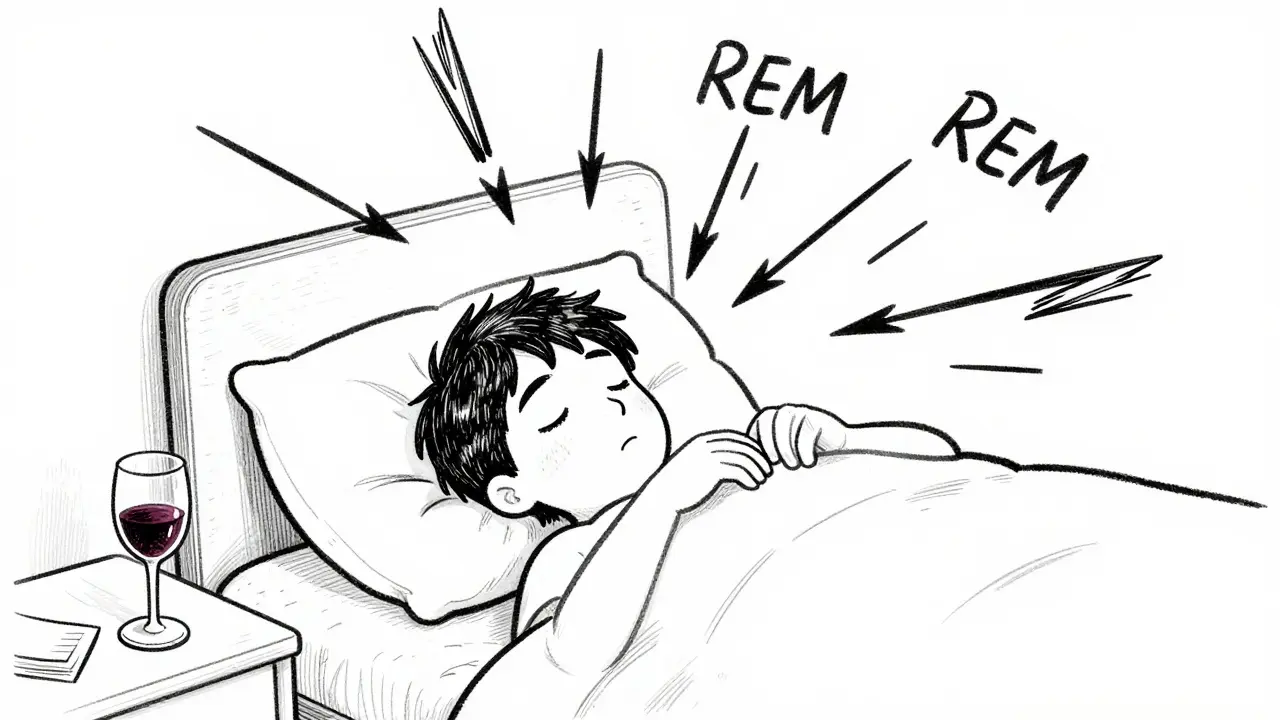
Many people believe that a nightcap helps them fall asleep faster and sleep more soundly. But if you wake up tired, groggy, or with a racing heart-even after eight hours in bed-alcohol might be the real culprit. It’s not helping you sleep. It’s hijacking it.
How Alcohol Tricks Your Brain Into Thinking It’s Sleeping
Alcohol doesn’t improve sleep. It simulates it. At first, it acts like a sedative. If you have one or two drinks before bed, you might drift off quicker than usual. That’s because alcohol boosts adenosine, a chemical in your brain that builds up during the day and naturally makes you sleepy. But here’s the catch: once your body starts breaking down the alcohol-usually within 90 minutes to two hours-adenosine levels crash. That’s when your brain hits rewind. Instead of moving smoothly through sleep stages, it stumbles awake, often without you realizing it.This is called sleep fragmentation. You’re not lying there wide awake. You’re not snoring loudly. But your brain is cycling between light sleep and brief awakenings dozens of times a night. A 2023 study found that people who drank alcohol before bed had 19.2 fewer minutes of total sleep and 4.3% lower sleep efficiency than on nights they didn’t drink. That’s like losing nearly 20 minutes of rest every single night. Over a week, that adds up to more than two hours of lost recovery time.
The REM Sleep Sabotage
The most damaging effect of alcohol on sleep is how it kills REM sleep-the stage where your brain processes emotions, consolidates memories, and sparks creativity. In the first half of the night, alcohol suppresses REM sleep by up to 50%. That sounds good if you hate nightmares, but it’s a disaster for your mental health. REM sleep isn’t just about dreams. It’s when your brain sorts through the day’s emotional baggage. Without it, you’re more likely to feel anxious, irritable, or emotionally raw the next day.Then, as alcohol leaves your system, your brain tries to make up for lost REM. That’s why people often report vivid dreams, nightmares, or even waking up drenched in sweat around 3 a.m. This rebound effect doesn’t fix the damage. It just makes sleep more chaotic. You end up with less restorative sleep overall. A 2021 review by the European Sleep Research Society found that even one standard drink reduces REM sleep by 9.3% and increases sleep fragmentation by 11.7%. There’s no safe dose.
Alcohol Turns Sleep Apnea Into a Medical Emergency
If you snore-or worse, stop breathing briefly during sleep-alcohol makes it worse. It relaxes the muscles in your throat, making your airway collapse more easily. That’s why even one drink before bed can increase your apnea-hypopnea index (AHI) by 20%. For someone with mild sleep apnea, that could push them into moderate or severe territory overnight.The American Thoracic Society says people with sleep apnea should avoid alcohol entirely within three hours of bedtime. Why? Because it doesn’t just increase the number of breathing pauses. It drops your blood oxygen levels by 3 to 5 percentage points during each event. That’s like climbing a mountain without supplemental air. Your heart has to work harder. Your brain gets less oxygen. And your body stays stuck in survival mode instead of repairing itself.
Studies show that drinking 2 to 4 drinks a day increases your risk of moderate-to-severe sleep apnea by 25%. With five or more drinks, that risk jumps to 51%. This isn’t just about snoring. It’s about long-term damage to your heart, brain, and metabolism.
What Happens the Next Morning (And Why You Don’t Notice)
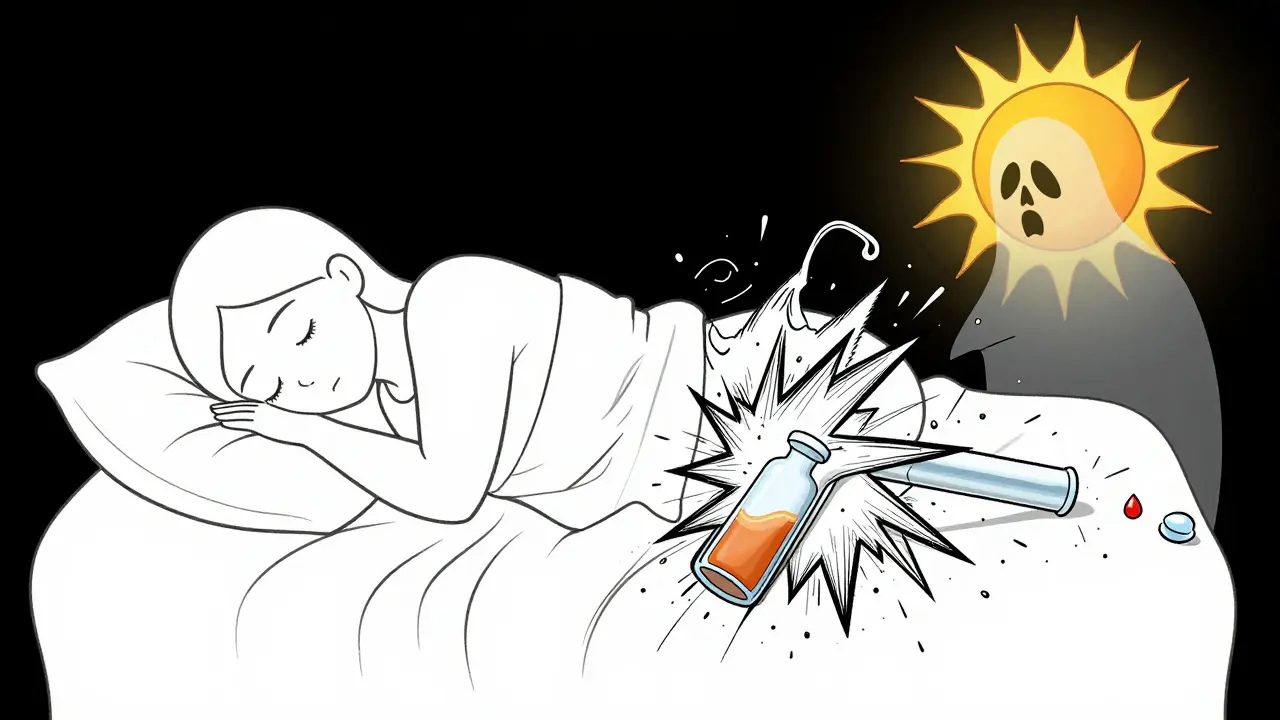
You might think, “I slept fine. I just feel a little sluggish.” But your brain knows the truth. Even if you don’t feel hungover, your cognitive performance takes a hit. A 2023 clinical study found that after drinking alcohol before bed, participants scored 8.7% worse on memory and attention tasks the next day-even though they didn’t report feeling impaired.Slow-wave sleep, the deepest and most restorative stage, drops by 15.3% after alcohol. That’s the stage your body uses to repair muscles, balance hormones, and strengthen your immune system. Without it, your reaction time slows, your focus fades, and your decision-making gets sloppy. One study showed a 12.7% drop in cognitive processing speed and a 9.4% loss in working memory capacity. That’s enough to make you miss details at work, forget appointments, or misjudge traffic.
And then there’s emotion. Alcohol-disrupted sleep makes you more reactive. A 2022 study found that people were 31.2% more likely to overreact to negative stimuli-like a rude comment or a delayed bus-after drinking before bed. Your brain isn’t processing emotions properly. It’s stuck in fight-or-flight mode.
The Cycle That Keeps You Trapped
Here’s the dangerous loop: You drink to fall asleep. You wake up exhausted. You feel tired during the day. So you drink again the next night to help you sleep. And the cycle tightens.Research from the University of Missouri shows that sleep deprivation after binge drinking actually increases the urge to drink more alcohol. Your brain starts associating alcohol with sleep-not because it works, but because it’s the only thing that seems to help. That’s how dependence begins. What starts as a habit can turn into a disorder.
Tolerance builds fast. After just 3 to 7 days of nightly drinking, your body stops responding to alcohol’s sedative effects. But your sleep doesn’t get better. It just gets worse. You need more alcohol to feel the same effect, and your sleep quality keeps declining. A 2022 longitudinal twin study found that heavy drinkers were over three times more likely to report poor sleep quality than non-drinkers.
Long-Term Damage You Can’t See
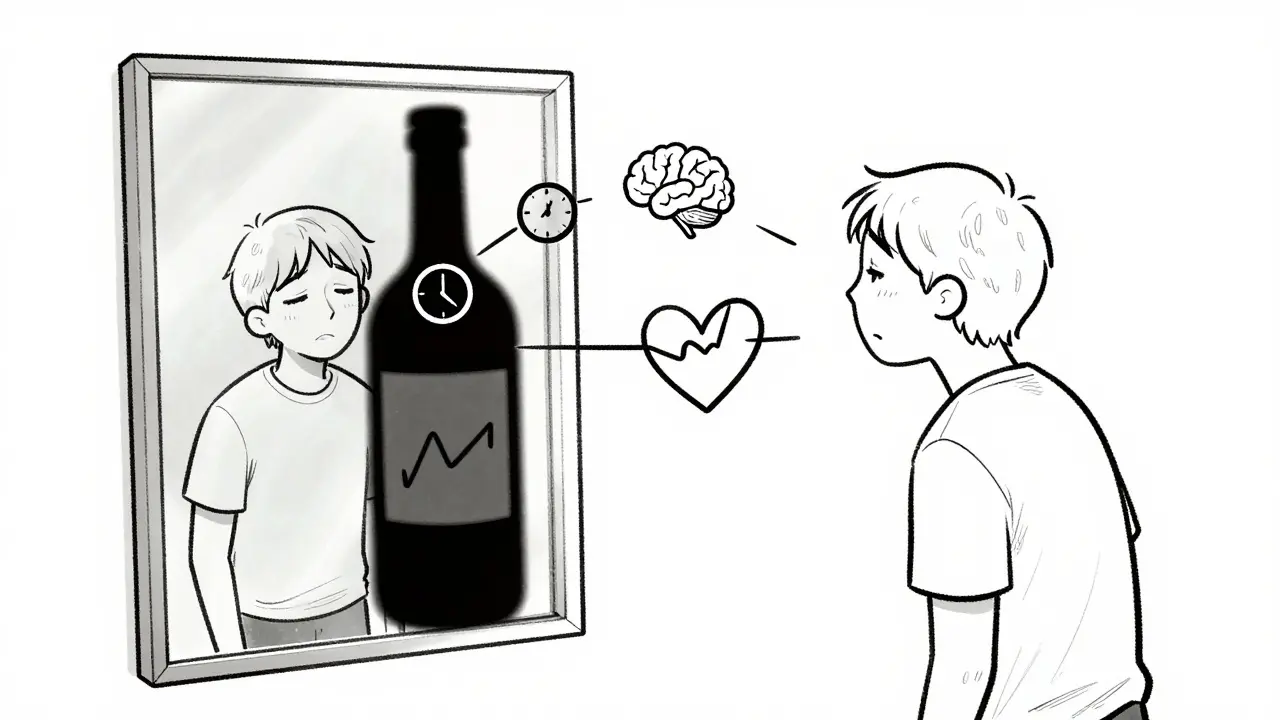
This isn’t just about feeling tired tomorrow. Chronic alcohol-related sleep disruption accelerates brain aging. A 2023 study from the American Academy of Neurology found that people who regularly drank before bed showed a 23% faster rate of cognitive decline over five years compared to non-drinkers. That’s not just memory loss. It’s slower thinking, weaker problem-solving, and earlier risk of dementia.And if you’re trying to quit? Sleep problems are one of the biggest reasons people relapse. The National Institute on Alcohol Abuse and Alcoholism reports that 50 to 70% of people in early recovery struggle with severe insomnia. It can take 3 to 6 months for sleep architecture to normalize after stopping alcohol-even when you’re sober. That’s why recovery programs now treat sleep as a core part of treatment, not an afterthought.
What Should You Do Instead?
If you’re using alcohol to fall asleep, you’re not alone. But you don’t have to keep doing it. Here’s what actually works:- Stop drinking at least 3 hours before bed. That gives your body time to clear half the alcohol.
- Try magnesium-rich foods like almonds, spinach, or bananas. Magnesium helps calm the nervous system.
- Keep your bedroom cool and dark. Temperature matters more than you think.
- Use a white noise machine or earplugs if you’re sensitive to sound.
- Get outside in natural light for at least 15 minutes in the morning. It resets your circadian rhythm.
- If you still can’t sleep after 20 minutes, get up. Do something quiet-read a book, stretch-until you feel sleepy.
There’s no magic pill. But there’s a better way than drinking. Your brain doesn’t need alcohol to sleep. It just needs time, consistency, and a little patience.
Does alcohol help you sleep better?
No. While alcohol may help you fall asleep faster, it disrupts the natural sleep cycle. It reduces REM sleep, increases nighttime awakenings, and lowers sleep quality. Even one drink can reduce REM sleep by 9.3% and increase fragmentation by 11.7%.
Can alcohol cause sleep apnea?
Yes. Alcohol relaxes the muscles in your throat, making your airway more likely to collapse during sleep. Each standard drink consumed before bed increases your apnea-hypopnea index (AHI) by about 20%. For people with existing sleep apnea, even one drink can make symptoms significantly worse.
Why do I wake up at 3 a.m. after drinking?
Alcohol metabolizes in your body about one drink per hour. After 3 to 4 hours, your blood alcohol level drops, triggering a rebound effect. Your brain, which was suppressed earlier, becomes overactive. This causes increased wakefulness, vivid dreams, or nightmares-often around 3 a.m. It’s your body trying to correct the unnatural sleep pattern alcohol created.
Does alcohol affect sleep quality long-term?
Yes. Regular alcohol use before bed increases your risk of chronic insomnia by 38%. Over time, it disrupts your body’s natural sleep-wake cycle, reduces restorative slow-wave sleep, and accelerates cognitive decline. Studies show a 23% faster rate of brain aging in people who drink before bed regularly.
How long does it take for sleep to improve after quitting alcohol?
It can take 3 to 6 months for sleep architecture to fully normalize after stopping alcohol. During the first few weeks, you may experience worse insomnia or vivid dreams as your brain adjusts. But with time, deep sleep and REM sleep gradually return. Consistency is key-avoiding alcohol entirely is the only way to restore natural sleep patterns.
Is it safe to drink one glass of wine before bed?
No. Even one standard drink reduces REM sleep, increases sleep fragmentation, and lowers sleep efficiency. A 2021 review confirmed that no level of alcohol consumption before bedtime improves sleep quality. The sedative effect is temporary and comes at the cost of deeper, restorative sleep stages.

10 Comments
Jasmine Bryant
January 23 2026
I used to drink wine every night to fall asleep and thought I was fine until I started waking up at 3 a.m. drenched in sweat and heart pounding. Didn't realize it was the alcohol until I read this. Cut back to once a week and my sleep's been way more solid. Still wake up once but no more nightmares. My brain feels less foggy too.
Also, the part about REM sleep being sabotaged? That's why I've been so emotionally raw lately. Never connected the dots.
Also, I typo a lot but this felt too important to not share.
Liberty C
January 24 2026
Oh please. Another ‘alcohol is evil’ sermon from the sleep-industrial complex. People have been drinking before bed since the Neolithic era. You think your 2023 study is the first to notice sleep fragmentation? My great-grandmother drank whiskey every night and lived to 98. Your ‘science’ is just modern superstition dressed in lab coats.
And don’t even get me started on ‘no safe dose.’ That’s like saying ‘no safe dose’ of sunlight. Absurd. You’re pathologizing human behavior because you’re terrified of pleasure.
shivani acharya
January 26 2026
Okay so let me get this straight - you’re telling me the government, Big Pharma, and the sleep tech companies are all hiding the truth that alcohol is the real sleep guru? And now they’re selling us magnesium gummies and white noise machines like it’s some kind of spiritual awakening? Lol.
Meanwhile my cousin in Mumbai drinks rum with his chai before bed and wakes up like a goddamn lion. He’s 62, runs a business, and never had a sleep tracker. You think your ‘9.3% REM reduction’ matters when your life isn’t falling apart?
Also - who funded this study? The mattress company? The Fitbit people? I smell a corporate agenda bigger than the moon landing hoax.
Hilary Miller
January 27 2026
Just stopped drinking before bed last month. First week was rough. Second week? I actually woke up feeling rested. No more 3 a.m. panic. No more ‘why am I so angry at my cat?’
Also - try cold showers before bed. Game changer.
Margaret Khaemba
January 27 2026
This was so helpful. I’ve been drinking one glass of wine to ‘wind down’ for years and always blamed my exhaustion on work. Didn’t realize it was the alcohol stealing my deep sleep. I’m going to try the magnesium and morning light thing - I’ve been stuck inside all winter. Also, I never knew sleep apnea could get worse from just one drink. Scary stuff.
Thanks for laying it out so clearly. Feels like I finally understand why I’ve been so off lately.
Malik Ronquillo
January 28 2026
I don't care what the studies say I drink before bed and I sleep like a baby. You people are overthinking this. It's not rocket science. If it works, it works. My body doesn't lie.
Also I'm 42 and I've never felt better. So yeah your science is probably wrong. Or maybe I'm just genetically blessed.
Also I don't care about REM sleep. I care about waking up and not wanting to kill my roommate. And alcohol does that. End of story.
Brenda King
January 30 2026
Just wanted to say thank you for writing this. I’ve been trying to quit drinking for months and the insomnia was killing me. I thought I was broken. Turns out my brain was just detoxing.
It’s been 47 days sober. Last night I slept 7.5 hours straight for the first time in years. No dreams. No sweating. Just… peace.
It’s not easy. But your article reminded me I’m not alone. And that’s worth more than any drink.
Also - try chamomile tea. It’s not magic but it helps.
Chiraghuddin Qureshi
January 30 2026
Bro I used to drink 2 beers before bed every night. Now I do yoga and listen to sitar music. My sleep is like a baby in a hammock 🌿🎶
Also magnesium glycinate is a godsend. My cousin in Kerala swears by it. No more 3 a.m. panic attacks.
Also - why are you all so obsessed with science? My grandma didn’t need studies. She drank warm milk with turmeric. And she lived to 102.
Patrick Roth
February 1 2026
Wait so you’re telling me alcohol doesn’t improve sleep? That’s the most basic misunderstanding of human biology I’ve heard all week. You’re ignoring the fact that alcohol is a GABA agonist - it literally slows down neural activity. That’s why you fall asleep faster. The rebound effect? That’s not sabotage, that’s homeostasis. Your body is trying to correct an imbalance. You’re calling it damage. I call it adaptation.
Also - if your sleep efficiency drops 4.3%, you’re probably just a terrible sleeper to begin with. This isn’t a universal truth. It’s a statistical outlier dressed as gospel.
Oren Prettyman
February 1 2026
While the empirical data presented herein is methodologically sound and corroborated by multiple peer-reviewed longitudinal studies, it remains regrettably insufficient in addressing the socio-cultural dimensions of nocturnal alcohol consumption as a ritualized practice of self-regulation within post-industrial societies. The reduction of REM sleep by 9.3% may be statistically significant, yet it fails to account for the epistemic privilege of subjective experience, wherein individuals may derive non-physiological benefits - such as affective regulation, circadian anchoring, or symbolic closure to the diurnal stressor - that transcend quantifiable metrics of sleep architecture. Furthermore, the prescriptive recommendations offered, while well-intentioned, exhibit a troubling technocratic bias toward biomedical solutions, neglecting the existential dimension of sleeplessness as a manifestation of modern alienation. One cannot simply replace a chemical crutch with a magnesium supplement and expect ontological harmony to ensue. The true remedy lies not in pharmacological substitution, but in the reclamation of narrative coherence through disciplined ritual - a practice abandoned with the demise of the evening pipe and the rise of the smartphone.