
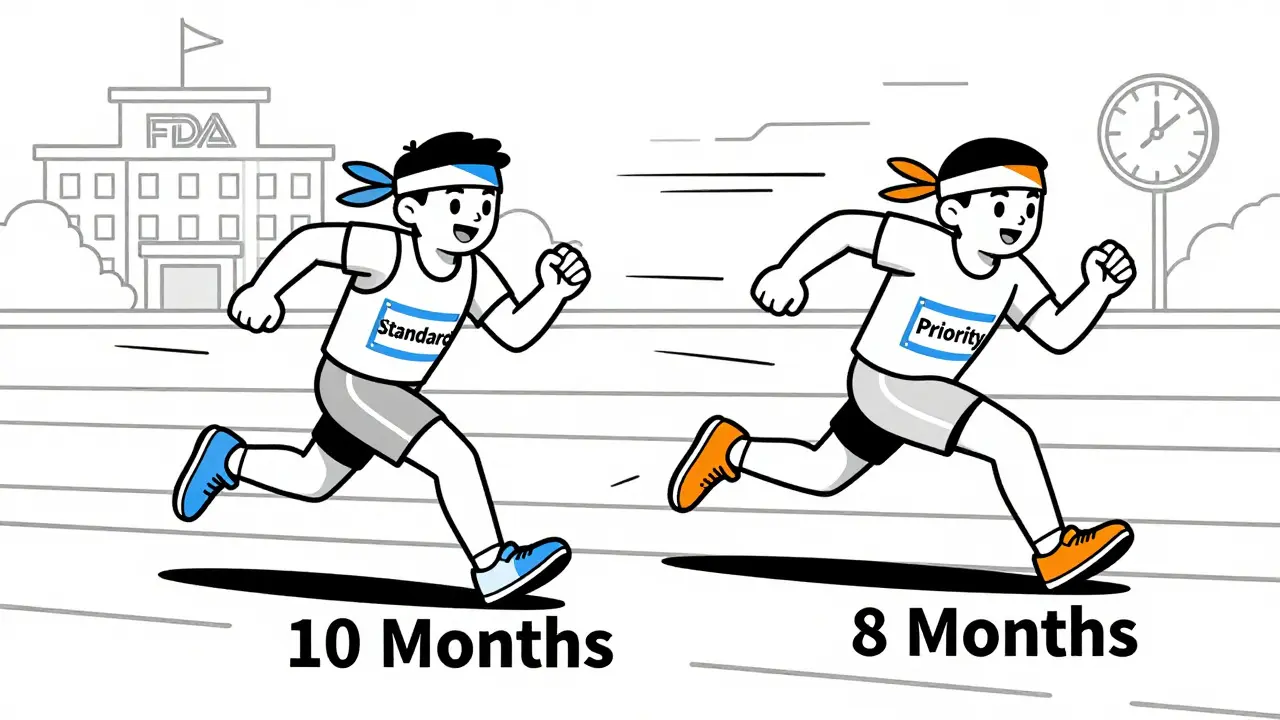
When a brand-name drug loses its patent protection, the race begins. Generic manufacturers scramble to submit their Abbreviated New Drug Applications (ANDAs) to the U.S. Food and Drug Administration (FDA), hoping to be first in line. But not all applications are treated equally. The agency uses two distinct pathways-standard review and priority review-to determine how quickly a generic drug hits the market. Understanding this distinction isn't just regulatory trivia; it can mean hundreds of millions of dollars in revenue for manufacturers and faster access to affordable medications for patients.
The Two Timelines: Standard vs. Priority Review
Under the current framework established by Generic Drug User Fee Amendments III (GDUFA III), which took effect on October 1, 2022, the FDA has set strict targets for reviewing generic drug applications. These timelines are measured from the date the application is officially "filed" by the agency, meaning it has passed initial completeness checks.
Standard Review: This is the default pathway for most generic applications. The Target Action Date (TAD) is 10 months. If an application meets all criteria without significant deficiencies, the FDA aims to complete its scientific evaluation within this window.
Priority Review: For specific categories of drugs deemed critical, the timeline shrinks to 8 months. This two-month acceleration might sound minor, but in the competitive generic market, being first to market often grants 180-day marketing exclusivity. During this period, no other generic competitor can enter the market, allowing the first applicant to capture a significantly larger share of profits before prices drop due to competition.
| Feature | Standard Review | Priority Review |
|---|---|---|
| Target Action Date (TAD) | 10 months | 8 months |
| Eligibility | Most generic applications | First generics, drugs in shortage, complex generics, or U.S.-manufactured products (via pilot) |
| Filing Fee Impact | Standard fee applies | Standard fee applies, but strategic value is higher |
| Market Impact | Competitive entry after exclusivity periods | Potential for 180-day exclusivity and higher early revenues |
Who Qualifies for Priority Review?
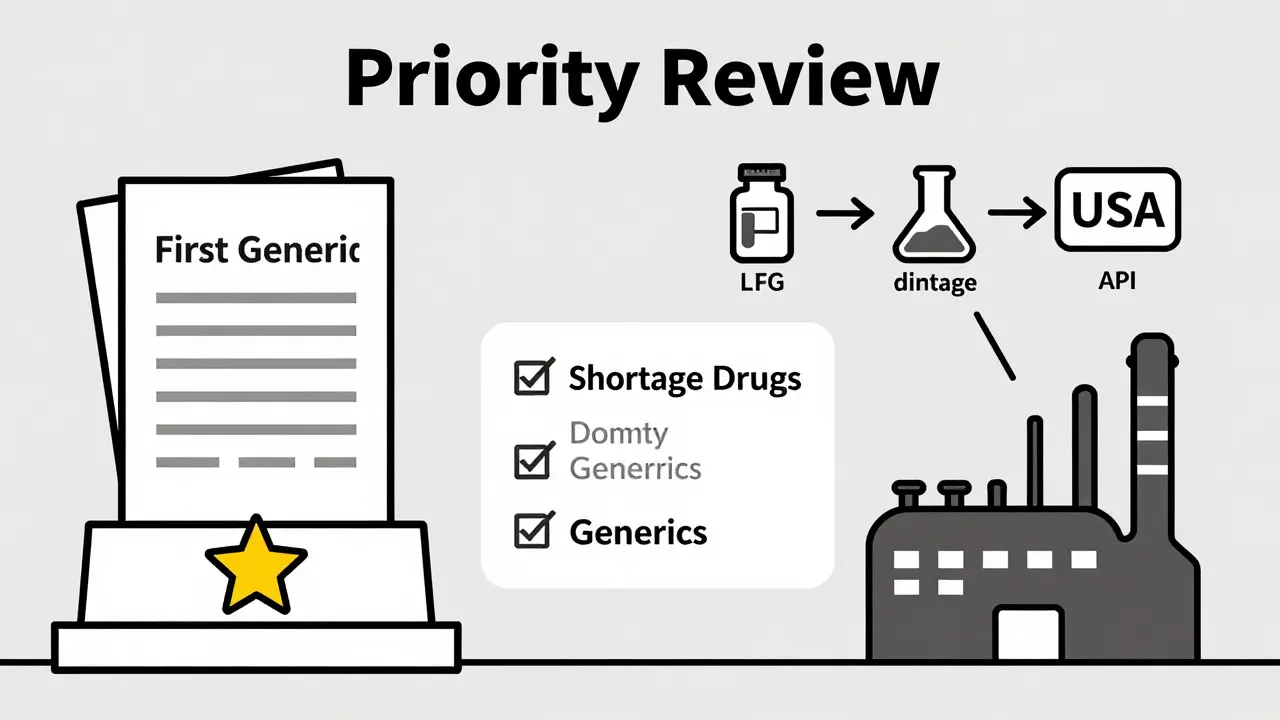
You don’t get priority status simply by asking for it. The FDA’s Office of Generic Drugs (OGD) within the Center for Drug Evaluation and Research (CDER) applies specific criteria outlined in their Manual of Policies and Procedures (MAPP 5240.3). An ANDA typically qualifies for priority review if it falls into one of these categories:
- First Generics: The first substantially complete ANDA submitted for a drug product that has no existing generic competition. This is the most common route to priority status.
- Drugs in Shortage: Applications that address a drug shortage as defined by Section 506C of the Federal Food, Drug, and Cosmetic Act. When hospitals struggle to find essential medications, the FDA fast-tracks approvals to restore supply.
- Complex Generics: Certain complex dosage forms, such as topical products, inhalers, or modified-release formulations, may receive priority consideration due to their technical difficulty and importance.
- Medically Important Advances: Products that offer a significant improvement over existing therapies, though this is less common for simple generics.
According to FDA performance data from Fiscal Year 2022, the system is working as intended: 83.1% of priority review applications met the 8-month goal, compared to 72.3% of standard review applications meeting the 10-month goal. This demonstrates that the accelerated pathway does indeed result in faster approvals when applications are complete and compliant.
The Game Changer: The U.S. Manufacturing Pilot Program
In October 2023, FDA Commissioner Robert M. Califf announced a new initiative that has reshaped how companies approach generic development: the ANDA Prioritization Pilot Program. This program directly links regulatory speed to domestic manufacturing.
To qualify for this specific type of priority review, applicants must prove three things:
- Bioequivalence testing was conducted in the United States.
- The finished dosage form is manufactured at a U.S. facility.
- The active pharmaceutical ingredient (API) is sourced exclusively from U.S. suppliers.
This move addresses a critical vulnerability exposed during the pandemic. Before 2020, approximately 80% of API manufacturing occurred outside the U.S., leaving the country dependent on foreign supply chains for essential medicines. By incentivizing domestic production with faster reviews, the FDA aims to increase the percentage of U.S.-manufactured generic drugs from 28% to 40% within five years.
However, adoption has been challenging. Regulatory attorney James Shehan noted that only 12.3% of ANDA sponsors currently meet all three U.S. manufacturing criteria. Many complex generics rely on specialized excipients or APIs that are still primarily produced in Europe and Asia. As one industry executive put it, shifting production lines is costly and logistically difficult, even with the promise of a two-month review acceleration.
The Hidden Cost: Complete Response Letters
Achieving priority status doesn't guarantee approval within eight months if your application has flaws. The biggest hurdle in the generic approval process is the Complete Response Letter (CRL).
In 2022, 31.7% of original ANDAs received at least one CRL. A CRL means the FDA found significant deficiencies in your application, halting the review clock until you resubmit corrected information. The most common issues fall under Chemistry, Manufacturing, and Controls (CMC), accounting for 47.2% of all review interruptions.
When an application receives a CRL, it enters a new review cycle. Each additional cycle adds approximately 4.2 months to the total timeline. On average, an ANDA requires 1.7 review cycles for approval. This means that while the *target* is 8 or 10 months, the *actual* time to market can stretch to 12-14 months or longer if quality control data is incomplete or bioequivalence studies are flawed.
To mitigate this risk, 63% of generic drug sponsors now engage in pre-submission meetings with the FDA, up from 41% in 2020. These early consultations help identify potential issues before the formal submission, increasing first-cycle approval rates from 24.1% to 38.7% for participating companies.
Strategic Implications for Manufacturers
For generic manufacturers, the choice between aiming for standard or priority review is a major strategic decision. Dr. John Jenkins, a former FDA director and current regulatory consultant, estimates that the two-month acceleration in priority review translates to $200-$500 million in additional revenue for first-to-market products. In a market where margins are thin, this difference can make or break a product launch.
Major players like Teva, Sandoz, and Hikma have responded to the new pilot program by increasing U.S. bioequivalence testing capacity by 22% year-over-year. Contract research organizations (CROs) like PPD and Covance are seeing a 35% surge in U.S.-based studies as companies rush to qualify for the domestic manufacturing incentive.
Yet, the pressure is mounting. With the generic drug market reaching $128.7 billion in U.S. sales in 2022, competition is fierce. The FDA projects a 12.5% increase in ANDA submissions for Fiscal Year 2024, totaling 1,275 applications. With more applicants vying for limited review resources, maintaining high-quality submissions is more important than ever.
Looking Ahead: AI and Future Timelines
The FDA is also looking to technology to streamline reviews. By Q3 2024, the agency plans to implement AI-assisted review tools for ANDAs. Early internal pilots have shown these tools can reduce review times for straightforward applications by 18.7%. While AI won't replace human reviewers, it will likely handle routine checks, allowing scientists to focus on complex safety and efficacy questions.
Industry analysts predict that these optimizations could accelerate generic entry by an average of 4.3 months by 2026, potentially saving the U.S. healthcare system $18.7 billion annually. For patients, this means faster access to affordable alternatives. For manufacturers, it means a more efficient, albeit more demanding, regulatory landscape.
What is the difference between standard and priority review for generic drugs?
The main difference is the target timeline. Standard review has a 10-month Target Action Date (TAD), while priority review has an 8-month TAD. Priority review is reserved for first generics, drugs in shortage, complex generics, or those qualifying under the U.S. manufacturing pilot program.
How do I qualify for priority review under the new pilot program?
To qualify for the ANDA Prioritization Pilot Program, your application must demonstrate that bioequivalence testing was done in the U.S., the finished dosage form is manufactured in the U.S., and the active pharmaceutical ingredient (API) is sourced exclusively from U.S. suppliers.
What happens if my ANDA receives a Complete Response Letter (CRL)?
A CRL pauses the review clock. You must address the deficiencies identified by the FDA and resubmit your application. Each resubmission cycle adds approximately 4.2 months to the total timeline, potentially delaying market entry significantly.
Why is the FDA pushing for U.S. manufacturing?
The FDA aims to strengthen supply chain resilience. During the pandemic, reliance on foreign sources for APIs and ingredients caused shortages. By offering faster reviews for domestically manufactured drugs, the FDA hopes to increase U.S. production from 28% to 40% within five years.
Does priority review guarantee approval within 8 months?
No. Priority review sets a target action date, but actual approval depends on the quality of the submission. If the application has deficiencies requiring a CRL or additional information requests, the timeline will extend beyond the 8-month goal.
What is the financial impact of being first to market with a generic drug?
Being first to market often grants 180 days of marketing exclusivity, preventing competitors from entering during that period. Experts estimate this advantage can translate to $200-$500 million in additional revenue for the manufacturer.

13 Comments
Mollie Louise
May 21 2026
I have been working in regulatory affairs for over a decade and I must say that this breakdown of the FDA's generic review process is absolutely phenomenal and incredibly insightful for anyone trying to navigate the complex landscape of pharmaceutical approvals! The distinction between standard and priority review is not just a bureaucratic detail but rather a critical strategic lever that can determine the financial success or failure of a new product launch in such a highly competitive market environment. It is truly inspiring to see how the agency is attempting to balance speed with rigorous scientific evaluation while also addressing the broader national security concerns related to supply chain resilience through the U.S. manufacturing pilot program. The data presented regarding the 180-day exclusivity period really highlights the immense value at stake for manufacturers who are able to secure that first-to-market advantage, which often translates into hundreds of millions of dollars in additional revenue streams that would otherwise be lost to early competitors. I believe that the push towards domestic manufacturing is a necessary step forward even though it presents significant logistical challenges for companies that have historically relied on established international supply networks for their active pharmaceutical ingredients. We must support these initiatives because they ultimately lead to a more robust healthcare system where patients have reliable access to essential medications without the fear of sudden shortages disrupting their treatment plans. The integration of AI tools into the review process by Q3 2024 sounds like a promising development that could significantly reduce administrative burdens and allow human reviewers to focus on more complex safety questions. This article has provided me with a much clearer understanding of the incentives driving current industry trends and I am eager to see how these policies evolve over the next few years as more data becomes available on their effectiveness.
Kris Wong
May 21 2026
They want you to think this is about patient safety but it is all about controlling the narrative and keeping the big pharma profits flowing while pretending to care about shortages 🤡 The FDA is just another arm of the deep state designed to keep us dependent on their approved drugs while ignoring natural alternatives that actually work without side effects. They claim 80% of API comes from overseas but why do you think they never mention the ones made right here in secret government labs? It is all a conspiracy to monopolize the healing industry and suppress truth seekers who dare to question the official timeline. Do not fall for the hype about AI reviewing your applications because those algorithms are programmed to reject anything that does not fit their predetermined agenda of corporate compliance. You are being played and you do not even know it 😂
Warren Brewer
May 23 2026
This is good info for people who want to understand how things work now. It helps to know what the rules are so we can follow them properly.
charles robert
May 25 2026
The existential dread of waiting ten months for approval is palpable in this text and one cannot help but feel the weight of the bureaucratic machine crushing the spirit of innovation under its cold unfeeling gaze 💀 The concept of priority review is merely a fleeting moment of hope in an otherwise dark abyss of regulatory uncertainty where dreams go to die slowly. Why do we accept this arbitrary timeline imposed upon us by distant authorities who seem disconnected from the urgent needs of humanity suffering in the shadows? The two-month acceleration is a cruel joke played by the elite to keep us striving for a goal that remains perpetually out of reach while they count their gains. We are all actors in a grand theater of absurdity where the script is written by men in suits who have never felt the true pain of waiting for a cure. The irony is thick enough to cut with a knife as we praise the efficiency of a system that inherently values profit over life itself. One wonders if the machines will eventually replace the humans entirely leaving us alone with our thoughts and our unapproved applications drifting into the void. Is there any meaning left in this struggle or are we simply cogs in a vast indifferent mechanism grinding away at the edges of sanity? The silence of the CRL is louder than any scream echoing through the empty halls of bureaucracy. We are trapped in a cycle of submission and rejection that mirrors the futility of Sisyphus pushing his boulder up the hill only to watch it roll back down again and again forevermore 😔
Mark Ronson
May 27 2026
As someone who works closely with regulatory submissions I find this overview quite accurate and helpful for understanding the current landscape. The emphasis on complete response letters is very important because many sponsors underestimate how much time these delays can add to the overall timeline. It is crucial to engage in pre-submission meetings as early as possible to identify potential issues before they become major roadblocks during the formal review process. The shift towards domestic manufacturing is indeed challenging but it offers significant long-term benefits for supply chain stability especially after the disruptions we saw during the pandemic. Companies should carefully evaluate whether they meet the criteria for the pilot program because the two-month acceleration can make a substantial difference in capturing market share. The use of AI tools is an interesting development that may streamline routine checks but human expertise will still be essential for evaluating complex safety data. Overall this provides a solid foundation for understanding the strategic decisions involved in generic drug development.
mardy duffy
May 28 2026
Boring stuff. Just read the summary at the bottom if you cant be bothered to read all this word salad.
Dana Ellington
May 30 2026
OMG this is such a huge deal for everyone in the industry!! I was totally stressed about the timelines but knowing that priority review exists gives me so much hope for faster approvals! The part about the US manufacturing pilot program is super exciting because it means we might get more local jobs and better supply chains which is amazing for our community! I love how they explained the 180 day exclusivity thing because it shows exactly why being first matters so much financially! I hope more companies jump on board with the domestic production idea because it feels like the right thing to do for our country! The stats about CRLs are kinda scary tho but at least we know to prepare better now! Lets go team USA! 🇺🇸💪
victoria catharinaa
May 30 2026
You guys need to stop making excuses for why this takes so long! If the FDA wants to be efficient they should just fix their broken system instead of blaming complex generics or foreign APIs! It is unacceptable that patients have to wait months for affordable drugs when lives are on the line! We demand immediate action and transparency from these regulators who hide behind jargon and timelines! Stop protecting big pharma interests and start prioritizing public health above all else! This article reads like a justification for incompetence and we are not buying it!
Mikey Mann
May 31 2026
There is a profound beauty in the structure of regulation when viewed through the lens of order and predictability. The dichotomy between standard and priority review reflects a deeper philosophical tension between equity and efficiency in our societal frameworks. One might ponder whether the acceleration of eight months truly serves the greater good or merely amplifies the disparities between well-resourced corporations and smaller innovators. Yet there is optimism in the fact that systems evolve and adapt to meet the changing needs of the population they serve. The introduction of AI suggests a future where technology aids human judgment rather than replacing it entirely allowing for a more nuanced approach to evaluation. We must remain hopeful that these changes will lead to improved outcomes for all stakeholders involved in the healthcare ecosystem. The journey towards clarity and speed is ongoing but each step forward brings us closer to a more transparent and effective process.
Christina Moran
June 1 2026
i think the part about the pilot program is really cool but i wonder if small companies can actually afford to move everything to the us? seems like only the big players will benefit from this change. also why does it take so long for bioequivalence testing anyway? isnt that just comparing numbers? maybe there is some cultural bias in how these standards are set too since most guidelines come from western countries. i hope they consider global perspectives more in the future.
Glen Speck
June 2 2026
the reality is that regulations exist to protect consumers from harm and while the process may seem slow it ensures that every drug meets strict safety standards before reaching the market. we should respect the boundaries set by experts who dedicate their lives to understanding chemistry and pharmacology deeply. the cultural shift towards domestic production is a positive step towards self-reliance and reducing vulnerability to external shocks. let us appreciate the complexity of this field rather than demanding instant results that could compromise quality. patience and diligence are virtues that serve us well in both personal and professional endeavors.
Yuvraj Singh
June 4 2026
This is a very comprehensive explanation of the current FDA processes and I appreciate the clear distinction between the two review pathways. As a professional in the Indian pharmaceutical sector dealing with exports to the US market this information is invaluable for strategizing our submission plans. The emphasis on avoiding Complete Response Letters is particularly relevant as we strive to maintain high quality standards in our documentation. We are closely monitoring the developments around the US manufacturing pilot program to see if there are opportunities for collaboration or investment in domestic facilities. The projected increase in ANDA submissions indicates a growing market which is encouraging for our business outlook. Thank you for sharing this detailed analysis.
Desirea Gaona
June 5 2026
It is imperative that we recognize the systemic inequities inherent in the current regulatory framework and advocate for reforms that prioritize equitable access to medication for all individuals regardless of socioeconomic status. The concentration of power within large pharmaceutical entities necessitates a critical examination of how policy decisions impact marginalized communities who often bear the brunt of delayed approvals and inflated costs. We must foster inclusive dialogue among stakeholders including patients advocacy groups and regulatory bodies to ensure that diverse perspectives are represented in the decision-making process. Mentorship programs aimed at supporting underrepresented groups in the pharmaceutical industry can help diversify the talent pool and bring fresh insights to address these complex challenges. By cultivating a culture of empathy and collaboration we can create a more just and sustainable healthcare system that serves the needs of the entire population.