

Imagine taking a medication for high blood pressure, only to find it stops working because you started taking an over-the-counter painkiller. You didn’t change the dose. The lab results show the drug is still in your system at normal levels. So why isn’t it working? This is the puzzle of pharmacodynamic drug interactions, which are interactions where one drug alters the effect of another at the site of action without changing its concentration in the body. Unlike pharmacokinetic interactions, which mess with how your body absorbs or breaks down a drug, these happen right at the finish line: the receptor.
According to data from European teaching hospitals between 2015 and 2017, these types of interactions account for about 40% of all clinically significant drug-drug issues in hospital settings. That’s a huge chunk of medical complications that aren't caused by the wrong dose, but by the wrong combination. Understanding this mechanism is critical for anyone managing multiple medications, especially as we age and polypharmacy becomes more common.
Key Takeaways
- Definition: Pharmacodynamic interactions occur when drugs compete or cooperate at the same biological target (receptor) or physiological pathway.
- Risk Level: They cause 68% of serious adverse events leading to hospitalization, higher than pharmacokinetic interactions.
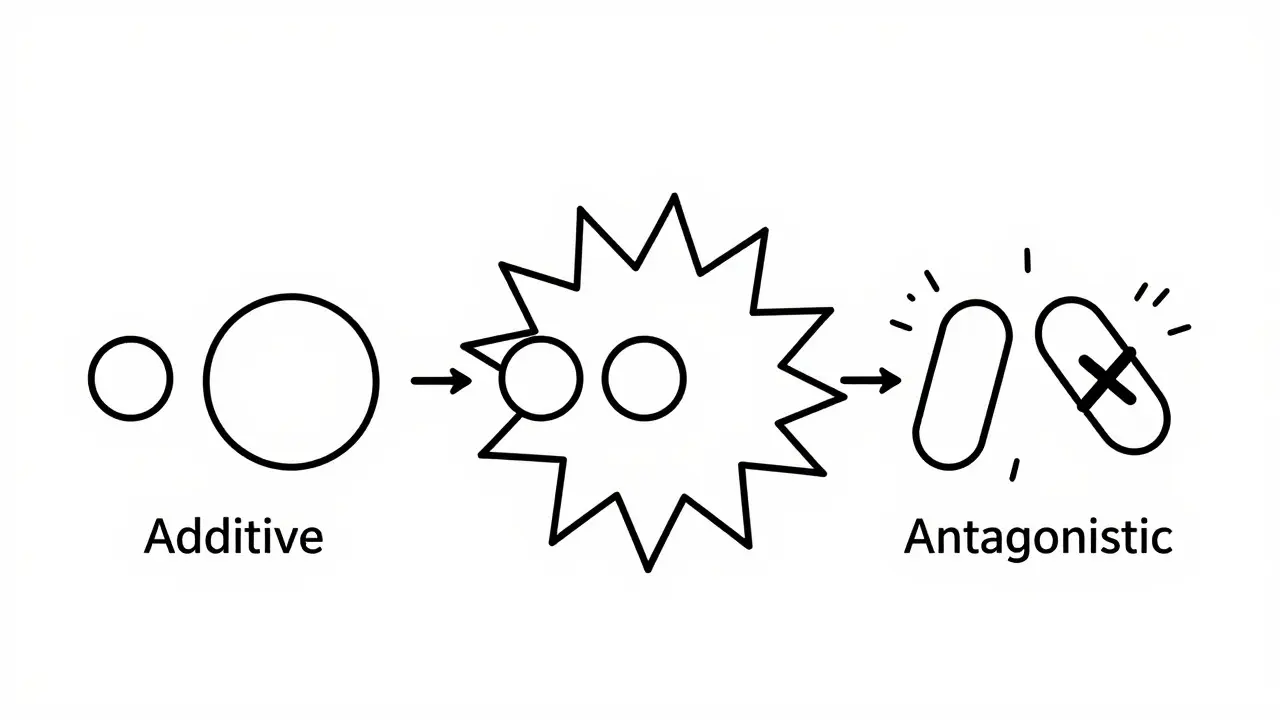
- Main Types: Synergistic (combined effect > sum), Additive (combined effect = sum), and Antagonistic (one blocks the other).
- Dangerous Combos: SSRIs + MAOIs (serotonin syndrome risk increases 24-fold); NSAIDs + ACE inhibitors (reduced blood pressure control).
- Beneficial Combos: Trimethoprim + Sulfamethoxazole (synergistic antibiotic action allows lower doses).
How Pharmacodynamic Interactions Work
To understand what happens when drugs combine, you have to look at the lock-and-key model of biology. Your body has millions of receptors-locks-that specific drugs-keys-fit into. When a drug binds to a receptor, it triggers a response. A pharmacodynamic interaction happens when two keys try to fit into the same lock, or when one key changes the shape of the door so the other can’t get in.
This is distinct from pharmacokinetics. If Drug A stops your liver from breaking down Drug B, Drug B’s concentration spikes. That’s pharmacokinetic. In pharmacodynamics, Drug B’s concentration stays exactly the same, but its *effect* changes because Drug A is interfering with the signal.
The clinical significance here is massive. A 2020 analysis in the Journal of Clinical Pharmacy and Therapeutics found that 68% of serious adverse events involving pharmacodynamic interactions resulted in hospitalization. Compare that to 42% for pharmacokinetic interactions. Why? Because pharmacodynamic clashes often require completely avoiding the combination, whereas pharmacokinetic issues might just need a dose tweak.
The Three Main Types of Interactions
Not all combinations are bad. In fact, some are designed to work together. We categorize these interactions into three buckets based on the math of their combined effects.
- Additive Effects: 1 + 1 = 2. The combined effect is exactly what you’d expect if you added the individual effects together. For example, taking two different sedatives might make you twice as sleepy as either alone.
- Synergistic Effects: 1 + 1 = 3 (or more). The drugs amplify each other. This is powerful in medicine. The classic example is Trimethoprim combined with Sulfamethoxazole. These two antibiotics block sequential steps in bacterial folic acid synthesis. Together, they reduce the required individual doses by 75% compared to using them alone, minimizing side effects while killing bacteria more effectively.
- Antagonistic Effects: 1 + 1 = 0 (or less). One drug cancels out the other. This is dangerous if you’re trying to treat a condition. For instance, if you take a beta-blocker like propranolol for heart rate control, it can completely negate the bronchodilatory effects of albuterol, a rescue inhaler for asthma. The propranolol competes for the same beta-receptors, leaving the albuterol with nowhere to bind.
Clinical Examples: The Dangerous Combinations
Knowing the theory is one thing; recognizing the danger in a prescription list is another. Here are the most critical pharmacodynamic interactions that clinicians watch for, backed by real-world data.
NSAIDs and Blood Pressure Medications
This is perhaps the most common oversight. Non-steroidal anti-inflammatory drugs (NSAIDs) like ibuprofen or naproxen inhibit renal prostaglandin synthesis. Prostaglandins help keep blood vessels in the kidneys dilated. When you block them, renal blood flow drops by approximately 25%, according to a 2019 NIH study of 347 hypertensive patients. This directly interferes with Angiotensin-Converting Enzyme (ACE) inhibitors, which rely on those same pathways to lower blood pressure. The result? Your blood pressure medication stops working, even though you’re taking it correctly.
SSRIs and MAOIs: The Serotonin Storm
Selective Serotonin Reuptake Inhibitors (SSRIs) and Monoamine Oxidase Inhibitors (MAOIs) both increase serotonin levels, but through different mechanisms. When combined, they don’t just add up; they create a synergistic overload. A 2021 meta-analysis of 18 clinical studies showed this combination increases the risk of serotonin syndrome-a potentially fatal condition causing high fever, seizures, and irregular heartbeat-by 24-fold. This is why doctors enforce a "washout period" of several weeks when switching between these classes.
Opioids and Opioid Antagonists
If a patient is dependent on morphine and receives naloxone (an opioid antagonist used for overdoses), the naloxone doesn’t just stop the high; it kicks the morphine off the receptors instantly. This precipitates immediate, severe withdrawal symptoms. It’s a direct receptor competition scenario where the drug with higher affinity (naloxone) dominates.
| Drug Combination | Interaction Type | Mechanism | Clinical Consequence |
|---|---|---|---|
| Ibuprofen + Lisinopril (ACE Inhibitor) | Antagonistic | Inhibition of renal prostaglandins reduces kidney blood flow | Loss of blood pressure control; potential kidney strain |
| Fluoxetine (SSRI) + Phenelzine (MAOI) | Synergistic | Excessive accumulation of serotonin in synaptic clefts | High risk of Serotonin Syndrome (fever, rigidity, confusion) |
| Albuterol + Propranolol | Antagonistic | Propranolol blocks beta-2 receptors needed for bronchodilation | Asthma attack may not respond to rescue inhaler |
| Morphine + Naloxone | Antagonistic | Naloxone displaces morphine from opioid receptors | Precipitated acute withdrawal in dependent patients |
Why Pharmacodynamic Interactions Are Harder to Manage
You might wonder why we can’t just lower the dose to fix these problems. With pharmacokinetic interactions, if Drug A makes Drug B too strong, you cut the dose of Drug B in half. Simple.
With pharmacodynamic interactions, it’s rarely that simple. If Drug A is blocking the receptor that Drug B needs to work, lowering the dose of Drug B won’t help-it will just make the treatment weaker. You often have to choose: drop Drug A, or switch Drug B to a different class entirely. This requires a deeper understanding of physiology, not just arithmetic.
A 2022 survey of 1,247 physicians revealed that 63% encountered at least one potentially dangerous pharmacodynamic interaction monthly. The most common culprits were anticoagulants combined with antiplatelet agents (38% of cases) and multiple central nervous system depressants (29% of cases). The latter is particularly risky in the elderly, where the combination of benzodiazepines, opioids, and antihistamines can lead to fatal respiratory depression or falls.
The Role of Technology and Future Directions
Can software save us? Modern clinical decision support systems (CDSS) have reduced pharmacodynamic interaction errors by 37% in US hospitals, according to a 2020 study. However, they still miss 22% of significant interactions. Why? Because current algorithms are often oversimplified. They flag known pairs but struggle with complex, multi-drug scenarios where the interaction emerges from three or four drugs acting on related pathways.
The future lies in quantitative modeling and machine learning. Dr. Rada Savic’s team at UCSF developed an algorithm in 2022 that achieved 89% accuracy in predicting serotonin syndrome risk from polypharmacy regimens. By integrating pharmacodynamic interaction data with electronic health records, systems like the one piloted by the UK’s National Health Service in 2023 aim to move from reactive alerts to proactive prevention.
Regulatory bodies are catching up too. Since 2017, the FDA has required specific pharmacodynamic interaction studies for new Central Nervous System (CNS) drugs. The European Medicines Agency reported that 34% of new drug applications now include these studies, up from 19% in 2015. As the global population ages-with 1.5 billion people expected to be over 65 by 2050-the stakes for getting these predictions right have never been higher.
Practical Steps for Patients and Clinicians
So, what should you do? If you are a patient, the golden rule is transparency. Never assume an over-the-counter drug is "safe" just because it doesn’t require a prescription. Ibuprofen, melatonin, and St. John’s Wort are all notorious for pharmacodynamic clashes. Keep a single, updated list of all medications and supplements, and review it with your pharmacist every time a new prescription is written.
For clinicians, the focus must be on narrow therapeutic index drugs. Professor David E. Geller noted that 83% of life-threatening pharmacodynamic interactions involve at least one drug with a therapeutic index below 3.0. Drugs like warfarin, lithium, and digoxin leave no room for error. In these cases, pharmacist-led medication reviews are invaluable. A 2021 systematic review in BMJ Quality & Safety found that such reviews reduced adverse events from pharmacodynamic interactions by 58% in elderly patients.
Understanding that drugs don’t just exist in isolation, but in a complex web of biological targets, is the first step toward safer prescribing. It’s not just about what the drug does; it’s about who else is in the room.
What is the difference between pharmacodynamic and pharmacokinetic interactions?
Pharmacokinetic interactions affect how the body processes a drug (absorption, distribution, metabolism, excretion), changing the drug's concentration in the blood. Pharmacodynamic interactions occur at the site of action (the receptor), altering the drug's effect without changing its concentration. Think of pharmacokinetics as controlling how much fuel gets to the engine, and pharmacodynamics as controlling how the engine responds to that fuel.
Are all pharmacodynamic interactions harmful?
No. While many are dangerous, some are therapeutically beneficial. Synergistic interactions, like the combination of trimethoprim and sulfamethoxazole, allow for lower doses of each drug while achieving a stronger effect. This reduces side effects and improves efficacy. The key is whether the interaction was intentional and monitored.
Why are NSAIDs dangerous for people taking blood pressure medication?
NSAIDs inhibit the production of prostaglandins, which help maintain blood flow to the kidneys. Many blood pressure medications, particularly ACE inhibitors and diuretics, rely on healthy kidney function and prostaglandin activity to work. By blocking prostaglandins, NSAIDs can reduce the effectiveness of these drugs by up to 25%, leading to uncontrolled hypertension.
What is serotonin syndrome, and which drugs cause it?
Serotonin syndrome is a potentially life-threatening condition caused by excessive serotonin activity in the brain. It is most commonly triggered by combining SSRIs (like fluoxetine) with MAOIs (like phenelzine) or other serotonergic drugs (like tramadol or triptans). Symptoms include agitation, confusion, rapid heart rate, high blood pressure, dilated pupils, muscle rigidity, and high fever.
How can I check for drug interactions before taking a new medication?
Always consult your pharmacist or doctor. They have access to comprehensive databases like the NHS Specialist Pharmacy Service database or Stockley’s Drug Interactions. Additionally, modern electronic health records often include automated checks. However, technology isn't perfect, so verbal confirmation with a healthcare professional is the safest approach, especially for over-the-counter drugs and supplements.
Do herbal supplements cause pharmacodynamic interactions?
Yes. Herbal supplements are biologically active substances that can interact with prescription drugs. For example, St. John’s Wort can induce enzymes that speed up the metabolism of many drugs (pharmacokinetic), but it also has serotonergic properties that can contribute to serotonin syndrome when combined with antidepressants (pharmacodynamic). Always disclose supplement use to your healthcare provider.
