
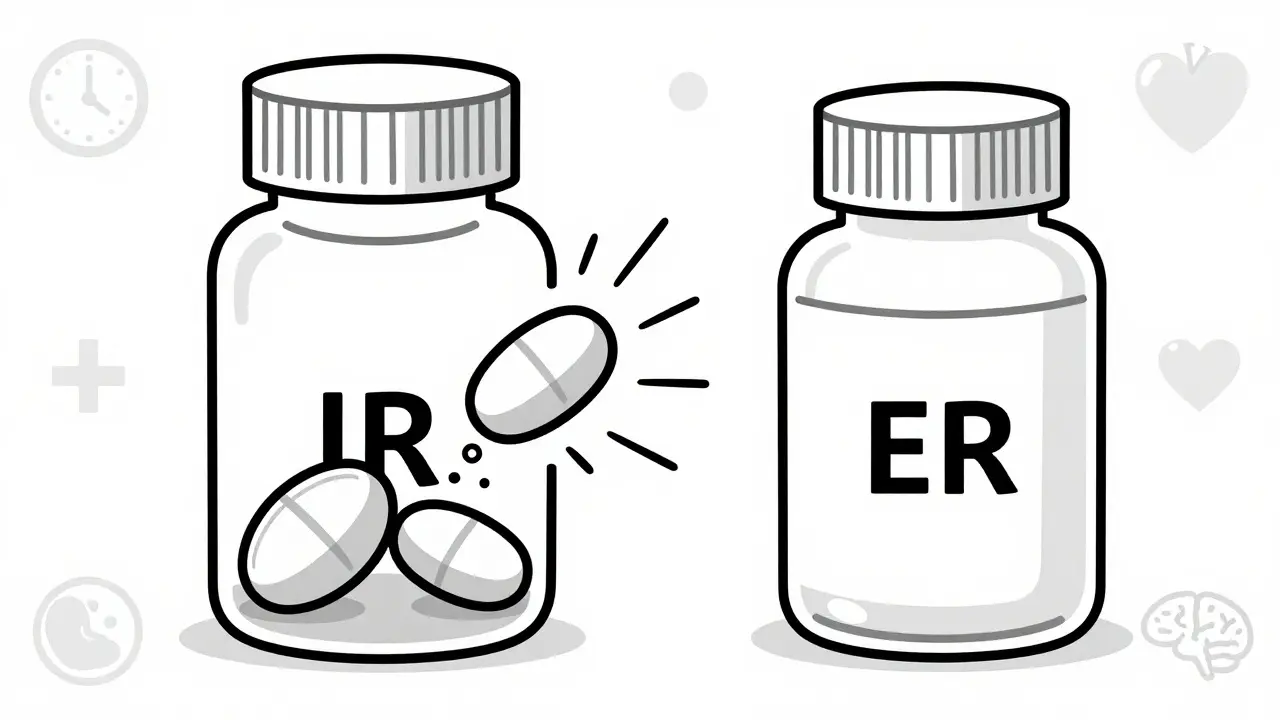
When you take a pill, you might assume it works the same way every time. But the truth is, not all medications behave the same. Some hit you fast and hard. Others creep in slowly, keeping things steady for hours. This difference isn’t just about convenience-it’s about safety, effectiveness, and even your life.
Two main types of medication delivery systems dominate prescriptions today: extended-release (ER) and immediate-release (IR). Choosing between them isn’t just a matter of preference. Mixing them up, misunderstanding how they work, or even crushing a pill can lead to serious harm-or death.
How ER and IR Medications Work
Immediate-release pills are the classic kind. You swallow them, and within 15 to 30 minutes, the drug starts dissolving in your stomach. Peak levels in your bloodstream usually hit within 30 to 90 minutes. That’s why you feel effects quickly-like pain relief from an IR painkiller or a sudden boost in focus from Adderall IR. But it doesn’t last. Most IR drugs wear off in 4 to 8 hours, meaning you might need to take them three or four times a day.
Extended-release medications are engineered differently. They don’t dump all their drug at once. Instead, they use smart systems to release medication slowly over 12 to 24 hours. Some use a gel-like matrix that swells and lets the drug leak out gradually. Others use tiny osmotic pumps, like the ones in Concerta, that push the drug out through a laser-drilled hole. There are even multilayer tablets that release different amounts at different times.
This design keeps drug levels steady. For example, bupropion IR can spike your blood concentration to 600 ng/mL within two hours-then crash below therapeutic levels by afternoon. That spike is why IR bupropion carries a seizure risk at high doses. But bupropion XL holds levels steady between 100 and 200 ng/mL all day, cutting that risk dramatically.
Why Timing Matters
Timing isn’t just about when you feel something-it’s about how your body handles the drug over time.
With IR, you get a sharp peak followed by a steep drop. That’s why people on IR antidepressants often report feeling fine in the morning, then crashing by midday. It’s also why IR opioids are used for breakthrough pain: they act fast when you need them most.
ER medications avoid those peaks and valleys. That’s why they’re preferred for chronic conditions. A 2022 study in JAMA Internal Medicine tracked 15,000 people on blood pressure meds. Those on ER versions had a 22% higher adherence rate. Why? Because they only had to take one pill a day instead of two or three. Fewer doses mean fewer missed pills.
But ER doesn’t work instantly. It takes 2 to 4 hours just to start working. And it can take 7 to 10 days to reach full steady-state levels-compared to 3 to 5 days for IR. That’s why some patients panic. They take their ER medication, feel nothing after an hour, and think it’s not working. So they take another dose. And another. That’s how accidental overdoses happen.
The Hidden Dangers of ER Medications
Extended-release sounds safer because it’s smoother. But it’s actually more dangerous in overdose situations.
If someone swallows too many IR pills, the drug gets absorbed quickly and peaks within hours. Doctors can treat it, and the body clears it out in a day or two.
But with ER? The drug keeps releasing for 24 to 48 hours. A 2021 report from the National Poison Data System found that ER bupropion overdoses required hospital stays 2 to 3 times longer than IR overdoses. Why? Because the body is still getting poison long after the person is admitted.
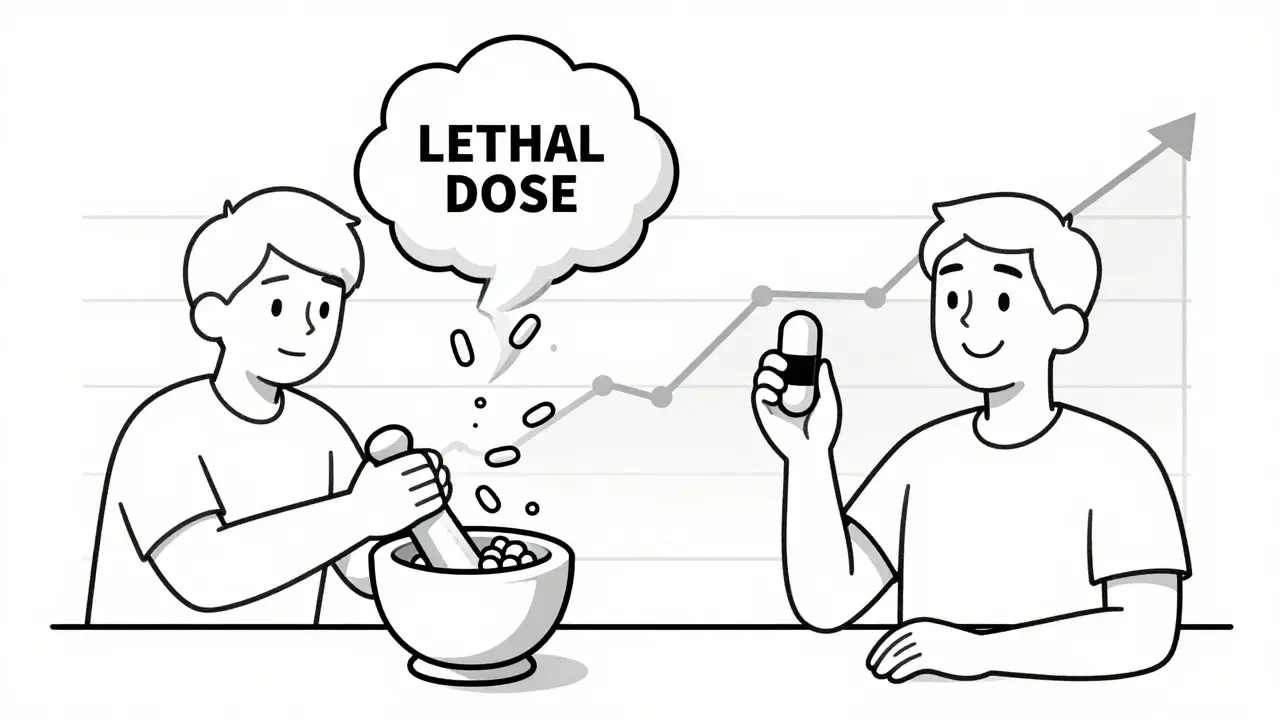
And here’s the scary part: 92% of ER pills are not meant to be crushed, chewed, or split. Yet people do it all the time. They think, “If I crush this, I’ll feel it faster.” That’s a deadly mistake. Crushing an ER tablet turns it into an IR dose all at once. A single 150mg ER bupropion tablet, when crushed, can deliver a lethal 150mg spike-far above the 350 ng/mL seizure threshold.
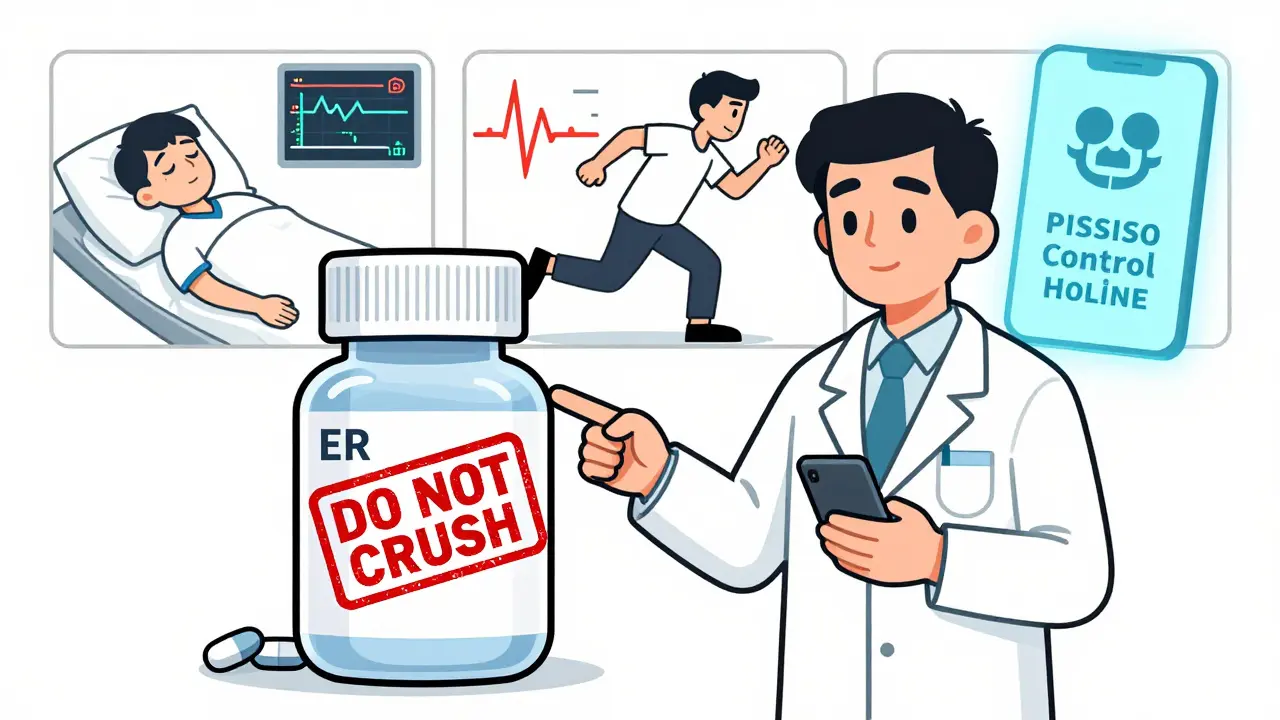
The FDA has issued multiple warnings about this. In 2020, they specifically called out extended-release opioids, where crushing led to fatal overdoses. Today, 100% of osmotic pump systems (like Concerta) and 85% of matrix tablets carry a warning: “Do not crush, chew, or divide.”
When to Choose ER vs. IR
There’s no one-size-fits-all answer. It depends on your condition, your lifestyle, and your goals.
Choose ER if:
- You’re managing a chronic condition like ADHD, depression, high blood pressure, or diabetes.
- You need once-daily dosing to improve adherence.
- You’ve had side effects from IR versions, like insomnia, nausea, or mood swings.
- You’re on a medication where steady levels matter-like quetiapine XR, which causes less sleep disruption than IR.
Choose IR if:
- You need fast relief-like for breakthrough pain, panic attacks, or sudden anxiety.
- You’re starting a new medication and your doctor needs to fine-tune the dose.
- You have a condition that affects absorption, like gastroparesis (delayed stomach emptying), where ER pills can absorb unpredictably and cause dangerous spikes.
For example, many people with ADHD use Adderall XR for daily focus but keep a few 5mg IR tablets on hand for presentations or urgent tasks. One Reddit user put it perfectly: “XR’s smooth ride prevents the 2pm crash I got with IR, but I keep IR tabs for when I need instant focus.”
Cost, Compliance, and Real-World Trade-offs
ER versions usually cost 15% to 25% more than IR. Adderall XR can run $350-$450 for 30 capsules, while IR runs $280-$380 for the same dose. Insurance doesn’t always cover the difference.
But the real cost isn’t just money-it’s hospital visits, missed work, and complications from mistakes.
A 2022 survey of 5,000 chronic medication users found that 41% didn’t understand how ER pills work. Nearly 30% took extra doses because they didn’t feel effects right away. That led to 9% reporting adverse events-dizziness, nausea, rapid heartbeat, even seizures.
On the flip side, patients on ER metoprolol reported 32% fewer dizziness episodes than those on IR. Satisfaction scores were 4.2/5 vs. 3.5/5. But some still complained: “It took too long to work when I was having a panic attack.”
What You Must Never Do
Here are three rules you must follow:
- Never crush, chew, or split an ER pill-unless your pharmacist or doctor specifically says it’s safe. Many ER tablets aren’t scored, and even those that are can release their entire dose at once.
- Don’t assume ER works faster. It doesn’t. If you take it and feel nothing after an hour, wait. The effects are coming, but slowly.
- Never switch between ER and IR without consulting your doctor. The doses aren’t interchangeable. Taking one 30mg ER pill is not the same as taking three 10mg IR pills.
Pharmacists report that 23% of ER medication errors come from people altering the pill form. A 2023 safety alert from the Institute for Safe Medication Practices found that Venlafaxine XR, a commonly prescribed antidepressant, was frequently split-despite being non-scored and clearly labeled “do not crush.”
What’s Next?
The future of medication delivery is getting smarter. Researchers at MIT are testing 3D-printed “polypills” that release different drugs at precise times-some within minutes, others hours later. New abuse-deterrent technologies, like the Aversion® system used in some ADHD meds, turn crushed pills into gummy gels that can’t be snorted or injected.
But for now, the basics still matter most. Understanding how your pills work isn’t optional. It’s essential. Whether you’re managing depression, ADHD, heart disease, or chronic pain, the difference between ER and IR isn’t just science-it’s safety.
Ask your pharmacist: “Is this extended-release?” Then ask: “What happens if I crush it?” If they hesitate, ask again. Your life might depend on it.
Can I switch from immediate-release to extended-release on my own?
No. You should never switch between IR and ER formulations without your doctor’s guidance. The dosing isn’t the same. For example, 30mg of Adderall IR is not equivalent to 30mg of Adderall XR in how it affects your body. ER pills are designed for slower absorption, and switching without adjustment can lead to underdosing or dangerous overdosing. Always consult your prescriber before making any changes.
Why do some ER pills cost more than IR pills?
ER pills cost more because of the complex technology used to control drug release-things like osmotic pumps, hydrophilic matrices, and multilayer tablets. These require advanced manufacturing, more research, and stricter FDA testing. While the active ingredient may be the same, the delivery system is engineered for precision. The higher price also reflects better adherence and fewer hospital visits over time, which saves the healthcare system money in the long run.
Is it safe to take ER medication with food?
It depends on the drug. Some ER medications, like extended-release metformin, work better with food because it slows stomach emptying and helps control absorption. Others, like Concerta, should be taken on an empty stomach for consistent results. Always check the label or ask your pharmacist. Changing how you take it-like taking it with a large meal when you normally take it alone-can alter how much drug enters your bloodstream and cause side effects or reduced effectiveness.
What should I do if I accidentally crush an ER pill?
If you accidentally crush or chew an extended-release pill, treat it like a potential overdose. Stop taking any more doses immediately. Call your doctor or poison control (1-800-222-1222 in the U.S.) right away. Even if you feel fine, the drug may still be releasing slowly into your system. ER formulations can continue to release over 24 to 48 hours, so monitoring is essential. Do not wait for symptoms to appear.
Are there any conditions that make ER pills unsafe?
Yes. People with gastroparesis (delayed stomach emptying), severe Crohn’s disease, or intestinal blockages may absorb ER medications unpredictably. In these cases, the drug can sit in the stomach too long and release all at once, leading to dangerous spikes in blood levels. The FDA issued a warning in July 2023 about this exact risk. If you have a condition that affects digestion, talk to your doctor before starting any ER medication. You may need IR instead.
If you’re on any medication, take a moment today to check: Is it ER or IR? Do you know how it works? And most importantly-have you ever been told not to crush or split it? If not, ask your pharmacist. It’s one of the simplest, most life-saving questions you can ask.

11 Comments
John Smith
February 23 2026
So let me get this straight - we’re paying extra so pills can be fancy and slowly poison us over two days? Brilliant. I’d rather just take my 10mg three times and be done with it. At least then I know when I’m dying.
Also - crushing? Please. I’ve done it. Felt great. Nothing happened. So yeah, I’m not worried.
Natanya Green
February 24 2026
OMG, I just realized I’ve been crushing my ER bupropion for MONTHS??!! I thought it was just ‘slow release’ not ‘slow murder’!!! I’m so scared right now 😭😭😭 My heart is racing and I think I’m gonna faint!! I need to call my doctor RIGHT NOW!! Please tell me I’m not gonna die!!
Steven Pam
February 24 2026
This is actually one of the most important posts I’ve read all year. Seriously. I used to think ER was just ‘chill meds’ - turns out it’s like a slow-burn bomb.
My dad was on ER metoprolol and never missed a dose. He said he felt stable all day - no crashes, no spikes. I switched from IR to XR for my anxiety and honestly? Life changed. No more 3pm panic spiral.
But yeah - DO NOT CRUSH. I know someone who did it with OxyContin. Didn’t survive the night. It’s not a snack. It’s a precision tool.
Timothy Haroutunian
February 25 2026
Let’s be real - this whole ER vs IR thing is just Big Pharma’s way of making you pay more for the same chemical. They slap on a fancy coating, call it ‘innovation,’ and jack up the price 25%. Meanwhile, people are dying because they don’t understand that a pill isn’t a magic bean.
And let’s not forget - 92% of ER pills aren’t meant to be crushed? So what? People crush them anyway. Because they’re human. Because they’re desperate. Because they’re in pain. The real problem isn’t the pill - it’s that we’re expected to manage complex medical regimens without education, support, or affordable access.
Also - ‘do not crush’ is written in 5-point font on the bottom of the bottle. Who reads that? Your pharmacist? Your doctor? Or the 72-year-old with shaky hands and no vision?
Stop blaming patients. Fix the system.
Michael FItzpatrick
February 27 2026
I’ve been prescribing SSRIs for 18 years and let me tell you - ER formulations are game-changers… if people actually follow the rules.
But here’s the dirty secret: most patients don’t know the difference between ‘once daily’ and ‘take with food.’ They think ‘extended-release’ means ‘longer-lasting high.’ I’ve had patients ask me if they can cut their XR tablet in half to get ‘more bang for the buck.’
And yes - I’ve seen the ER bupropion overdoses. One guy took three pills because he ‘didn’t feel anything’ at 10 a.m. By 3 p.m., he was seizing.
Here’s what I tell my patients: ‘If it’s ER, it’s not a sprint. It’s a marathon. You don’t see the finish line until day 7.’
And if you’re wondering whether to crush it - ask yourself: ‘Would I crush a time-release firework?’ No? Then don’t crush your meds.
Nandini Wagh
February 27 2026
I’m from India. We don’t have ER versions of most meds here. Everyone takes IR. Twice a day. Sometimes three.
But you know what? We don’t die. We don’t overdose. We just… live.
Maybe the problem isn’t the pill. Maybe it’s the over-medicalized, over-marketed, over-priced American system.
Just saying.
Holley T
February 28 2026
I read the entire post and I have to say - this is peak medical misinformation.
First - ER doesn’t ‘take 7–10 days to reach steady state’ for most drugs. That’s true for SSRIs, maybe, but not for bupropion or metoprolol. The half-life of bupropion is 12–14 hours. Steady state is 2–3 days. You’re misleading people.
Second - ‘92% of ER pills aren’t meant to be crushed’? That’s not a fact. That’s a marketing slogan. Many ER tablets are scored. Many are designed to be split. The FDA doesn’t ban splitting - it bans splitting when the formulation isn’t designed for it.
Third - you say ‘crushing ER turns it into IR’ - but that’s not true for all. Osmotic pumps? Yes. Matrix tablets? Sometimes. But some use enteric coatings that just delay release - not slow it. Crushing those doesn’t cause a spike - it just makes it absorb faster.
This post reads like a pharmaceutical ad disguised as public safety advice. And that’s dangerous.
Ashley Johnson
February 28 2026
I’ve been following this for years. And I’m telling you - this whole ER thing is a government mind control experiment.
They want you to take one pill a day so they can track you. The slow release? It’s not for your health. It’s so they can pump chemicals into your bloodstream while you sleep.
And the ‘do not crush’ warning? That’s because if you crush it, you’ll see the microchip.
I know someone who crushed a pill and saw a tiny blinking light inside. He disappeared.
Also - your pharmacist? They’re paid by Big Pharma. Don’t trust them.
Take IR. Twice a day. Stay free.
tia novialiswati
February 28 2026
This is so helpful!! 💖 Thank you for breaking this down so clearly!!
I switched from IR to XR for my ADHD last year and I was SO worried at first - felt like nothing was working. But then I waited. And waited. And then BAM - 3 hours later, I was focused like I’ve never been.
Also - I used to crush my pills because I hated swallowing them. Now I just mix the XR with applesauce (pharmacist said it’s fine!) 🍎
You’re not alone if you’re scared. You’re not broken. You’re just learning. And you’re doing great. 💪❤️
Lillian Knezek
March 1 2026
I don’t trust any of this.
What if the ‘slow release’ is actually a delayed trigger? What if the ‘steady levels’ are just a cover for something worse?
I read that 1 in 3 ER pills contain a nano-particle that binds to your DNA.
And the FDA? They’re in on it.
I stopped all my meds. Now I drink lemon water and pray.
My doctor says I’m ‘non-compliant.’ I say I’m awake.
Maranda Najar
March 2 2026
I am absolutely devastated by this post.
After reading this, I wept for hours.
My sister - my beautiful, brilliant sister - died at 28. She took an ER opioid after a car accident. She didn’t know she couldn’t crush it. She thought, ‘It’s just a pill.’
She crushed it.
She died 14 hours later.
They said it was an ‘accidental overdose.’
I say it was a failure of education. A failure of labeling. A failure of humanity.
They told her to ‘follow instructions.’ But who writes those instructions? Who prints them in 3-point font? Who makes the pill so beautiful that it looks like candy?
She didn’t die because she was careless.
She died because the system didn’t care enough to make it impossible for her to make a mistake.
And now - I carry her pill bottle in my purse.
Every time I see someone crushing a pill - I stop them.
I tell them.
And I cry.
And I pray.
And I beg them to listen.