
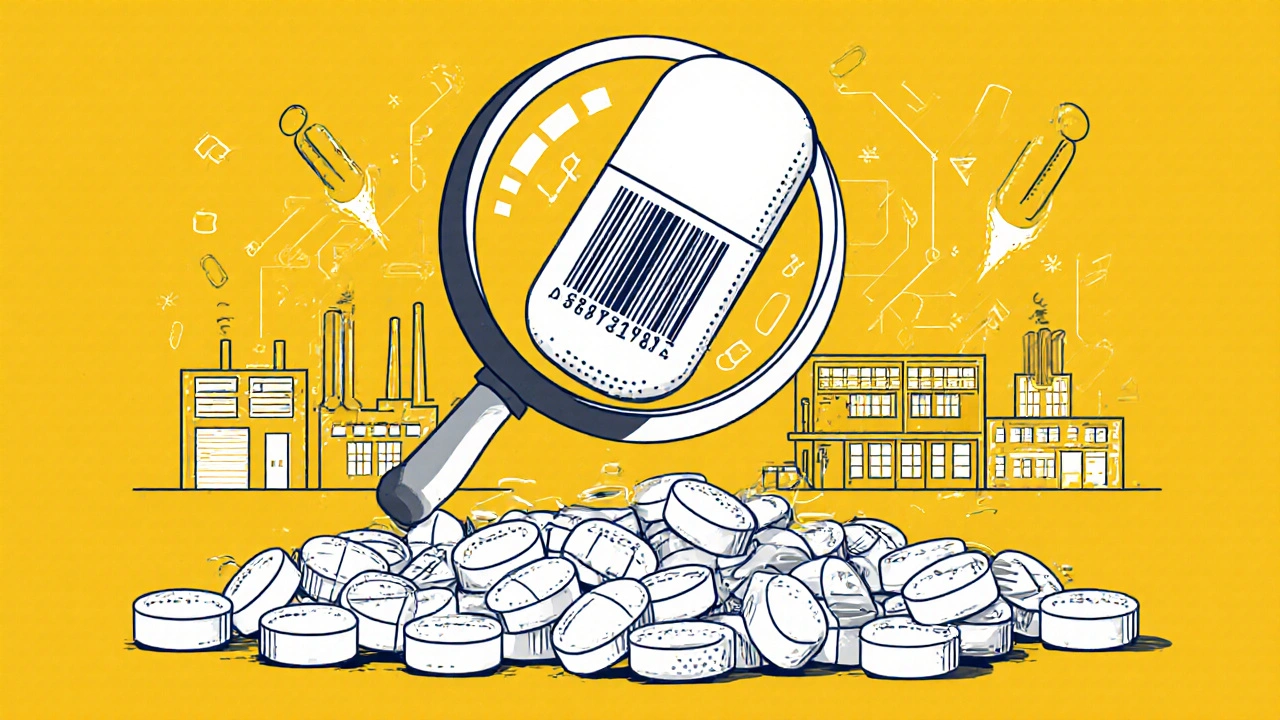
Every pill you take could be fake. Not because the pharmacy made a mistake, but because someone else made a copy - and slipped it into the supply chain. In 2023, the FDA reported over 1,200 cases of counterfeit medicines in the U.S. alone. Most of them slipped through because no one checked the lot number or serial code. That’s not just a risk - it’s a failure of systems that were built to prevent exactly this.
What Lot Numbers and Serial Codes Actually Do
Lot numbers and serial codes aren’t just random strings of letters and digits. They’re the fingerprints of your medicine.
A lot number identifies a group of products made together under the same conditions - same batch of raw material, same machine, same shift. If 10,000 bottles of blood pressure medicine were filled on June 12, 2025, at Plant 3, they all share the same lot number. It’s like a family ID for pills.
A serial code is different. It’s assigned to each individual unit. That means every single bottle, every blister pack, every vial has its own unique code. Think of it like a car’s VIN. If one bottle turns out to be contaminated or fake, you don’t recall 10,000 bottles - you recall just that one.
In the pharmaceutical world, these aren’t optional. Since the 1938 Food, Drug, and Cosmetic Act, manufacturers have been legally required to track batches. But today’s systems are digital, fast, and tied to barcodes or QR codes scanned at every step: from the supplier who delivers active ingredients, to the packaging line, to the warehouse, to the pharmacy shelf.
How Track-and-Trace Stops Fake Drugs
Counterfeiters don’t need to make perfect pills. They just need to make something that looks real. A fake label. A copied barcode. A stolen lot number. But they can’t replicate a full digital chain.
Here’s how the system blocks them:
- A legitimate manufacturer assigns a unique serial code to every product unit and links it to its lot number in a secure, encrypted database.
- Each time the product moves - from factory to distributor to wholesaler to pharmacy - the code is scanned and logged.
- If someone tries to sell a bottle with a fake serial code, the system flags it immediately. The code doesn’t exist in the official registry.
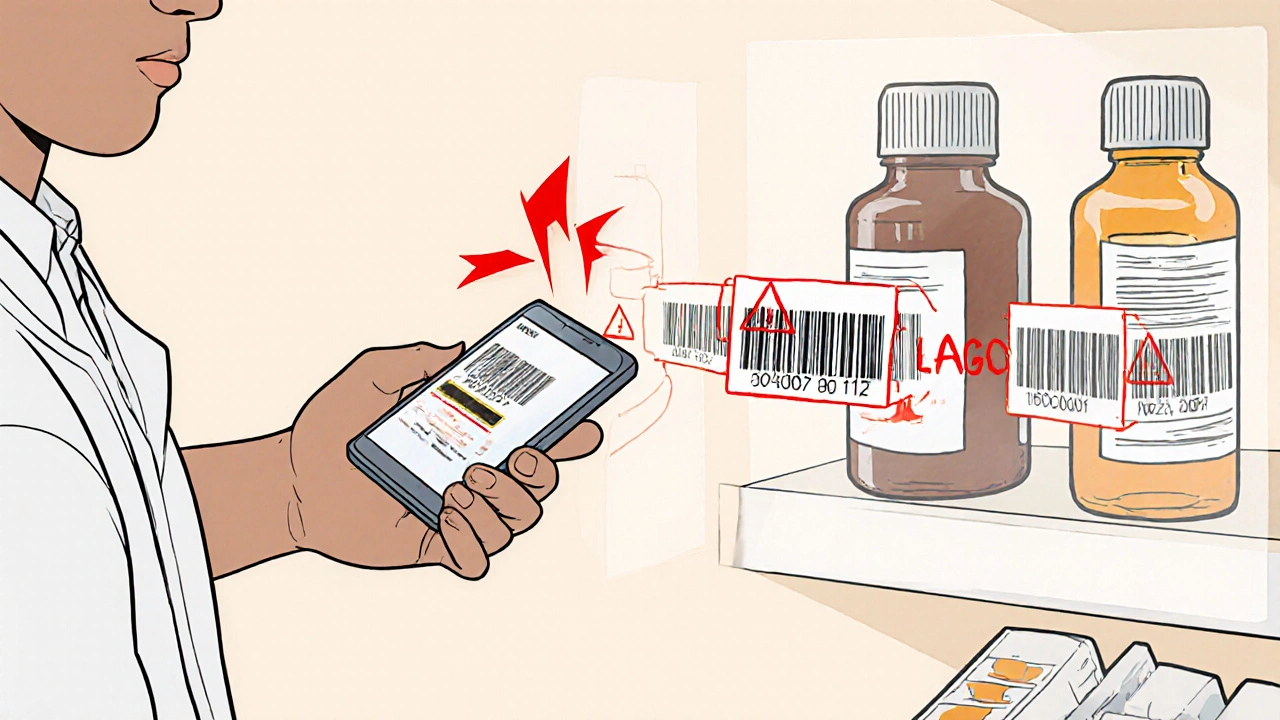
- If a real code appears in two places - say, one in London and one in Lagos - the system detects duplication. That’s a red flag for diversion or counterfeiting.
In 2024, a major U.S. pharmacy chain intercepted 14,000 fake insulin vials because their scanning system flagged serial codes that had already been used in Germany. The fake bottles were identical - same label, same color, same imprint. But the codes didn’t match the manufacturer’s database. That’s how track-and-trace wins.
Why Lot Numbers Alone Aren’t Enough
Some people think: “If I can trace the batch, why do I need serial numbers?” Because batch-level tracking is like finding a needle in a haystack.
In 2023, a contaminated blood pressure medication was found in one batch. The lot number covered 500,000 units. Without serial codes, the FDA had to recall every single one - even though only 12 bottles were actually bad. That cost the company $4.2 million in lost product, shipping, and legal fees.
With serial codes, they scanned every unit in the supply chain. They found the 12 bad bottles. The rest stayed on shelves. Savings? $3.9 million. And no patient was unnecessarily denied their medicine.
That’s the difference between a sledgehammer and a scalpel.
Real-World Failures - When Tracking Breaks Down
It’s not the technology that fails. It’s the people.
In 2022, a mid-sized pharmaceutical company in Ohio got an FDA warning letter. Their lot numbers were correct. Their serial codes were assigned. But warehouse staff didn’t scan them on receipt. They just wrote them down by hand. A month later, a fake drug with a stolen lot number entered the system. The company couldn’t prove which units were real - because there was no digital record. The entire lot had to be pulled. The cost: $1.8 million.
Another case: a pharmacy in Florida didn’t scan incoming shipments. They trusted the supplier’s paperwork. A fake opioid batch slipped in. Three patients overdosed. The serial codes were there - but no one checked them.
Track-and-trace only works if it’s used. Every time. Every scan. Every record.
What You Can Do as a Patient
You don’t need to be a tech expert. But you can protect yourself.
- Ask your pharmacist: “Can you show me the serial code on this bottle?” Most will scan it for you on a tablet.
- Check the label. Is the lot number printed clearly? Is the barcode intact? Faded or smudged codes are a warning sign.
- If you buy online - especially from sites that look like they’re selling at 70% off - be suspicious. Legitimate pharmacies don’t discount life-saving drugs that drastically.
- Use the FDA’s BeSafeRx tool. It lets you verify if a website is licensed to sell prescription drugs.
Counterfeiters count on you not asking questions. Don’t let them win.
The Future: AI, Blockchain, and Real-Time Monitoring
The system is getting smarter.
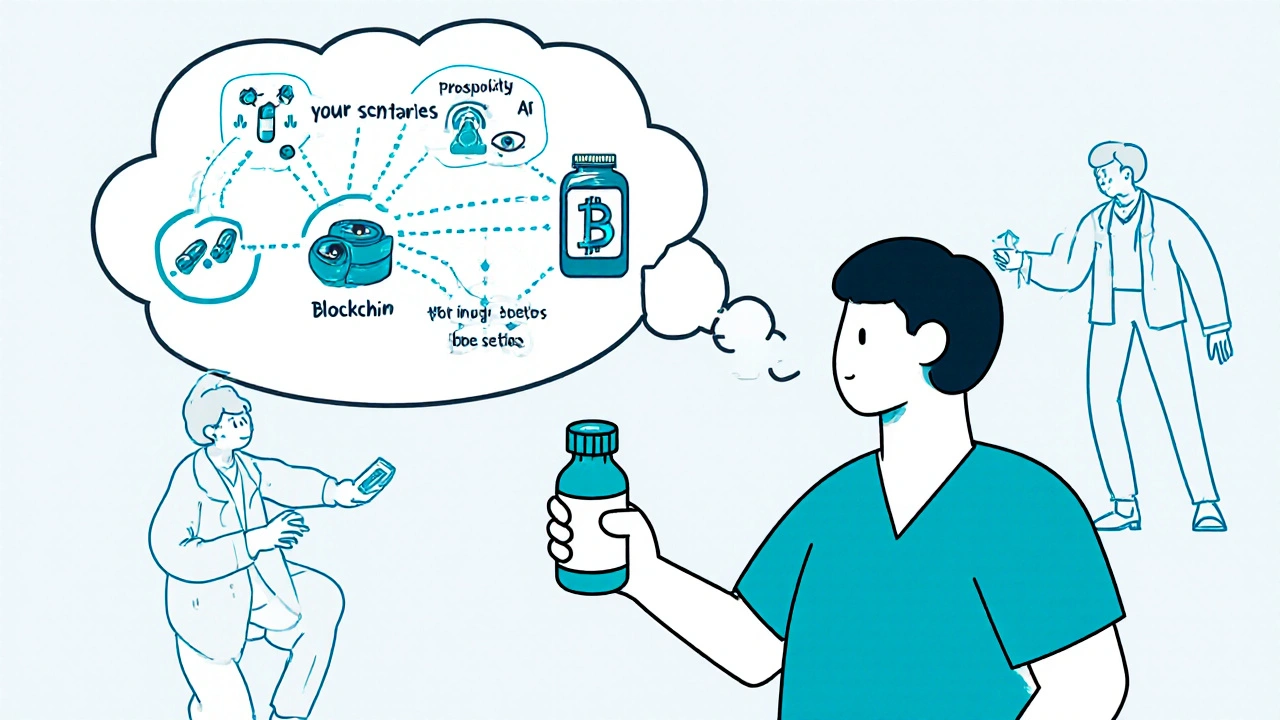
By 2025, over 60% of new pharmaceutical tracking systems use AI to spot anomalies. If a lot number appears in a country where the drug isn’t sold - or if 500 units from one batch show up in a warehouse with no order record - the system flags it before anyone even touches the box.
Blockchain is being tested to create unchangeable logs. Once a serial code is scanned and recorded, it can’t be altered. No backdating. No faking. No deleting.
And now, some companies are embedding temperature sensors in packaging. If a vaccine spends 12 hours outside the cold chain, the serial code automatically updates to say “compromised.” That’s not science fiction - it’s happening in the UK and Germany right now.
Bottom Line: It’s Not Just Compliance - It’s Survival
Lot numbers and serial codes aren’t about paperwork. They’re about keeping you alive.
Every time a drug is scanned, it’s a checkpoint. A guardrail. A second chance to stop something dangerous from reaching you.
The system works - if everyone plays their part. Manufacturers must assign real codes. Distributors must scan them. Pharmacies must verify them. And patients must ask for proof.
Because in the fight against counterfeit drugs, the most powerful tool isn’t a lab test. It’s a barcode - and the discipline to read it.

9 Comments
Nicole Ziegler
November 20 2025
This is wild 🤯 I had no idea my blood pressure meds had a VIN like a car. Just scanned mine at the pharmacy yesterday - felt like a spy. 👌
Bharat Alasandi
November 21 2025
In India, we see this shit every day. Fake insulin boxes with legit-looking QR codes - but scan it and it links to some guy in Bangalore selling ‘generic’ Glucophage. The system works, but half the clinics don’t even have scanners. Gotta fix the ground level first.
Ravi boy
November 22 2025
lol so u mean if i buy drugs off the street and they have a barcode it might still be fake? wow i learned something today
Shiv Karan Singh
November 23 2025
You’re all being manipulated. The FDA and pharma companies invented this ‘track and trace’ nonsense to push you into buying only their overpriced branded stuff. Real medicine used to be sold in brown bottles with handwritten labels. Now? You need a PhD to know if your aspirin is real. 🤡
Matthew Karrs
November 24 2025
Let’s be real - this whole system is a honeypot. Every scan is logged. Every bottle tracked. Who’s watching that data? Who owns the blockchain? It’s not about safety. It’s about control. You think they don’t know exactly how many of your pills you took last week? They do. And they’re selling that data to insurers.
Aruna Urban Planner
November 25 2025
The real tragedy isn’t the counterfeit drugs - it’s the systemic neglect of frontline workers. I’ve seen pharmacists in rural Punjab scan 300 bottles a day with cracked screens and no training. The tech is flawless. The human layer? Broken. We need community training programs, not just blockchain. A barcode won’t save someone who doesn’t know how to use a scanner.
Kristi Bennardo
November 25 2025
This entire narrative is dangerously misleading. The FDA’s ‘1,200 cases’ statistic is cherry-picked from a tiny fraction of global counterfeit activity. Meanwhile, the pharmaceutical industry uses track-and-trace as a monopolistic tool to crush generic manufacturers and inflate prices. This isn’t patient safety - it’s corporate consolidation dressed up as public health. I demand transparency. And I will not be fooled by QR codes.
Matthew Peters
November 25 2025
I just visited a hospital in Nairobi last month. They had a manual ledger for lot numbers - handwritten, ink smudged, pages torn. But they had a guy who knew every batch by heart. He could tell you which truck delivered what, and when. Tech is great, but human memory? That’s the original blockchain. We’re replacing wisdom with Wi-Fi.
Liam Strachan
November 25 2025
I’ve worked in pharma logistics for 15 years. The system works - but only if you treat it like a ritual. Not a checkbox. Every scan, every log, every handshake with the next handler. I’ve seen warehouses where they’d scan once and call it a day. That’s when things go sideways. It’s not the code that matters - it’s the care behind the scan.