
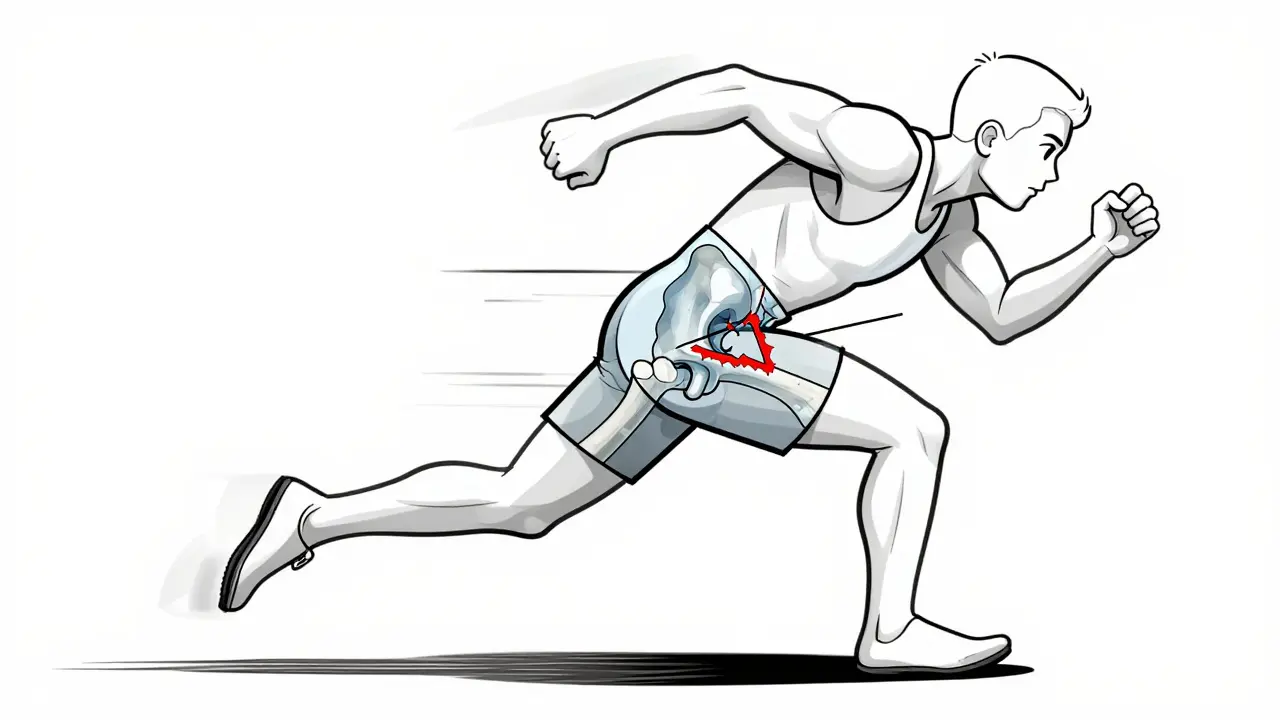
What Is a Hip Labral Tear?
A hip labral tear happens when the ring of cartilage around the hip socket - called the labrum - gets damaged. This cartilage acts like a seal, keeping the ball of the femur snug in the socket. When it tears, it doesn’t just hurt - it can make your hip click, catch, or lock during movement. Athletes, especially those in soccer, basketball, hockey, and dance, are at highest risk because their hips twist and rotate constantly under load.
Most labral tears aren’t caused by a single injury. They usually develop over time due to femoroacetabular impingement (FAI), where bone spurs on the hip joint rub against the labrum like sandpaper. Up to 55% of athletic hip pain cases involve this kind of tear, according to research from PMC. The good news? Many athletes can return to sport - but only if the problem is diagnosed and treated correctly.
How Do You Know You Have a Labral Tear?
There’s no single symptom that confirms a labral tear. Pain in the groin, deep in the hip, or even radiating to the buttock is common. But what really points to a labral issue is mechanical symptoms - like a clicking or locking feeling when you move your hip, especially during squats, pivots, or getting out of a car.
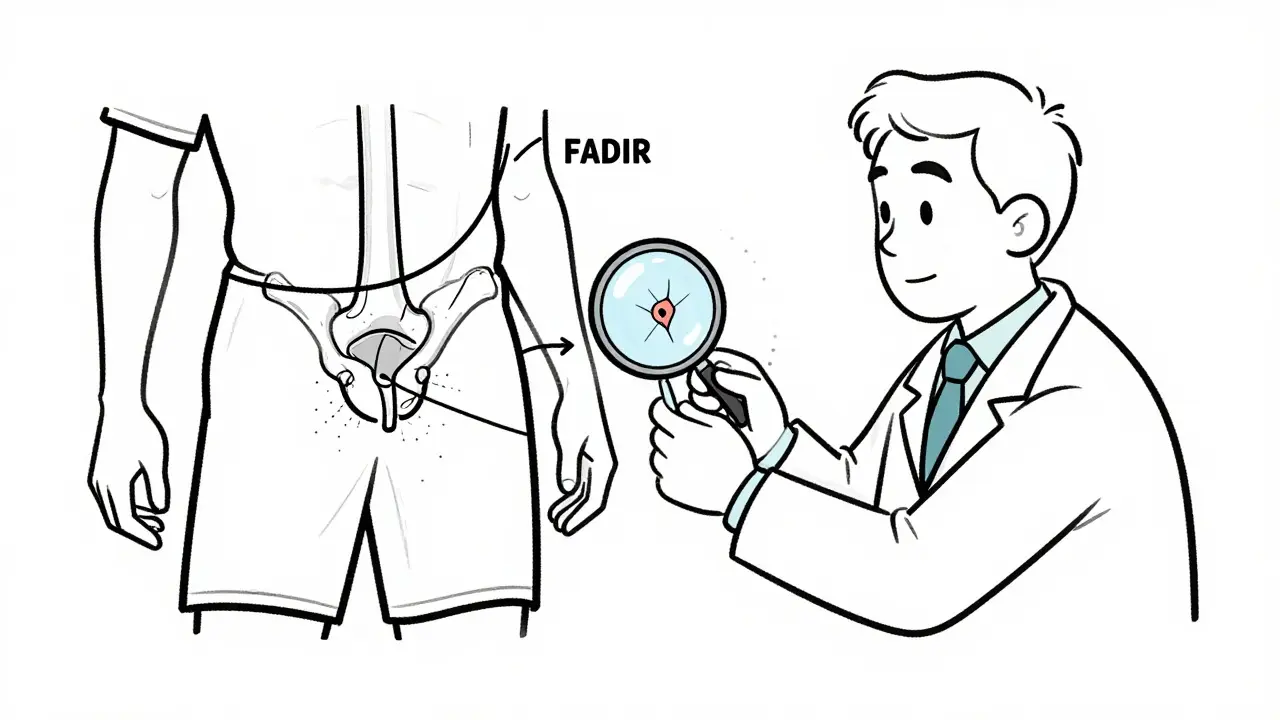
Doctors use two simple physical tests to screen for it. The FADIR test (flexion, adduction, internal rotation) and the FABER test (flexion, abduction, external rotation) reproduce the pain in about 78% of confirmed cases. If these tests hurt, it’s a red flag. But here’s the catch: these tests can’t tell you if the tear is small, partial, or full-thickness. That’s where imaging comes in.
Imaging: What Works and What Doesn’t
Many athletes get an X-ray first - and that’s right. X-rays check for bone problems like hip dysplasia or bone spurs that might be causing the tear. But X-rays won’t show the labrum itself. That’s where MRI comes in.
Standard MRI detects labral tears only 35-60% of the time. That’s not good enough. The real game-changer is magnetic resonance arthrography (MRA). This is an MRI done after injecting contrast dye directly into the hip joint. It makes the labrum stand out clearly. Studies show MRA catches 90-95% of labral tears with 85-92% accuracy. The International Hip Documentation Society recommends MRA as the gold standard for pre-op planning.
Even better? New 3D MRI sequences introduced in 2023 can detect partial tears that older machines miss. One multicenter trial showed 97% accuracy with this method. But access is limited. Most insurance plans won’t cover MRA unless you’ve already tried conservative treatment - and even then, many patients pay $1,200-$1,800 out of pocket.
Conservative Treatment: Can You Avoid Surgery?
Not every labral tear needs surgery. If your pain is mild and you’re not a high-level athlete, you might be able to manage it without cutting into your hip.
Start with 4-6 weeks of rest. Avoid deep squats, pivoting, and long runs. Take NSAIDs like ibuprofen or naproxen to reduce swelling. Then, physical therapy. But here’s the twist: not all PT works. Some studies say only 30-40% of athletes get full relief with PT alone. Others, like True Sports Physical Therapy, report 65% success - especially when therapy targets hip stability, core control, and movement retraining.
Corticosteroid injections can help too. They reduce inflammation and give you a 3-6 month window of relief. About 70-80% of patients feel better after one. But it’s not a cure. It’s a pause button. If the tear is from FAI or dysplasia, the bone problem stays - and the tear will likely come back.
Some clinics now offer PRP injections - injecting your own platelets into the area to promote healing. A 2022 trial at HSS showed 55% of patients avoided surgery after 12 months. It’s promising, but still experimental. Insurance rarely covers it.
When Surgery Becomes Necessary
If you’ve tried rest, PT, and injections for 3-6 months and still can’t run, pivot, or sleep without pain - it’s time to consider hip arthroscopy.
Arthroscopy is a minimally invasive surgery. Two small incisions, a camera, and tiny tools. The surgeon looks directly at the labrum - and this is the only way to know for sure what’s wrong. It’s 98% accurate. During the procedure, they either trim away the torn part (debridement) or stitch it back in place with anchors.
But here’s the critical point: if you have hip dysplasia or FAI, just trimming the labrum isn’t enough. Studies show 60-70% of these patients re-tear if the bone problem isn’t fixed. That’s why top sports surgeons now combine labral repair with osteoplasty - reshaping the bone to stop future impingement. The American Academy of Orthopaedic Surgeons says isolated debridement without fixing the bone leads to 40% higher revision rates.
Recovery: How Long Until You Play Again?
Recovery isn’t just about waiting. It’s about rebuilding strength, control, and movement.
If you had a simple debridement, most athletes return to sport in 3-4 months. If the labrum was stitched back, expect 5-6 months. The timeline is strict. Rush it, and you risk re-injury.
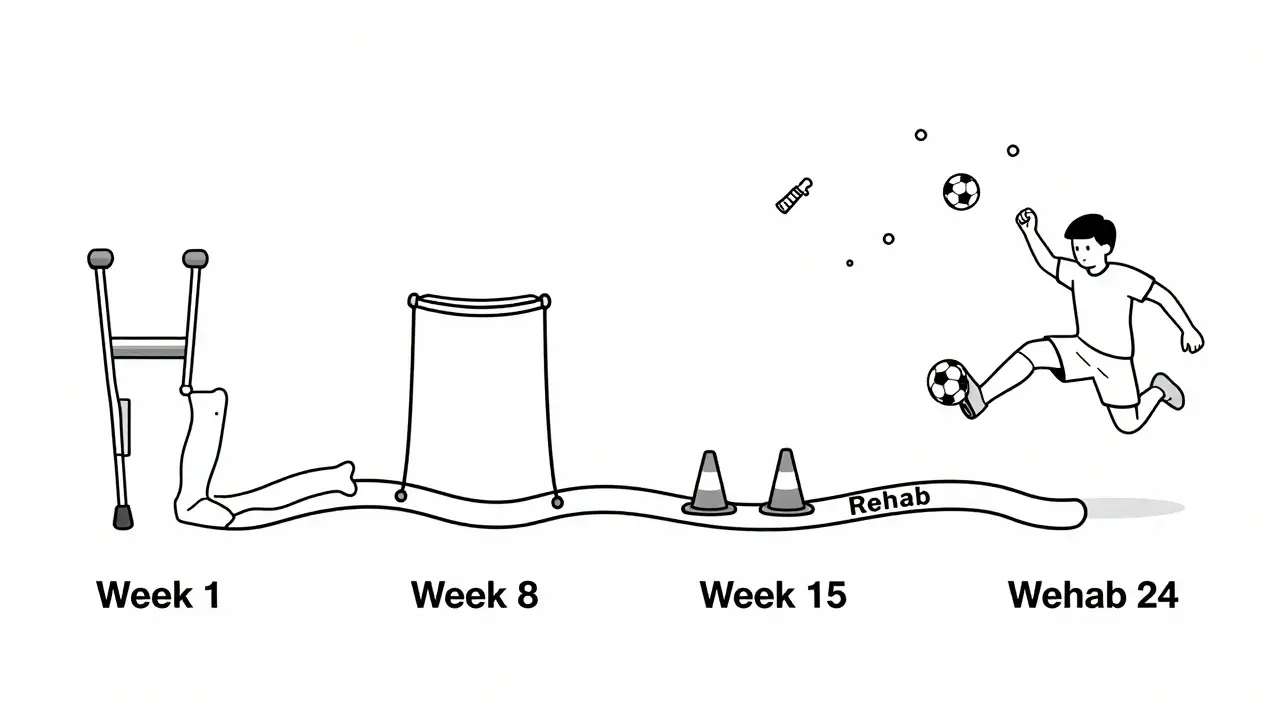
Rehab has four phases:
- Protection (weeks 1-6): No weight-bearing beyond walking with crutches. No hip flexion past 90 degrees.
- Strengthening (weeks 7-12): Focus on glutes, quads, and core. Use resistance bands, not weights.
- Sport-specific training (weeks 13-20): Agility drills, controlled pivoting, jumping progressions.
- Return to sport (weeks 21-26): Only when you have 90% strength symmetry and can rotate your hip internally to 30 degrees without pain.
Professional athletes like NHL’s Ryan Nugent-Hopkins took 5.5 months to return. But amateur athletes often struggle more - not because of the surgery, but because they lack access to specialized rehab. Athletes at dedicated sports medicine centers report 92% satisfaction. Those at general orthopedic clinics? Only 75%.
What Can Go Wrong?
Hip arthroscopy is safer than it used to be, but it’s not risk-free. About 15-20% of patients still have lingering pain. 5-10% develop heterotopic ossification - bone growing where it shouldn’t. Nerve injury is rare, but possible - about 1-2% of cases.
Revision surgery is needed in 8-12% of cases within five years. Most often, it’s because the original diagnosis missed an underlying bone issue, or rehab was skipped. The learning curve for surgeons is steep too. The Arthroscopy Association of North America says a surgeon needs 50-100 supervised cases to become competent. That’s why location matters. Don’t just pick the nearest surgeon. Look for one who specializes in hip arthroscopy and works with sports rehab teams.
Who’s Most at Risk?
Young athletes under 40 - especially those in sports with repetitive hip rotation - are the most common group. Basketball players (22%), soccer players (18%), hockey players (15%), and runners (12%) make up the majority of cases. Dancers and gymnasts have higher complication rates - 25% more - because their movements push the hip beyond normal limits.
Age also matters. Athletes over 35 have a 70-75% success rate returning to sport after surgery, compared to 85-90% for younger ones. That’s because cartilage healing slows with age. And if you already have early signs of arthritis, surgery won’t fix that - it just buys time.
The Bigger Picture: Preventing Arthritis
A labral tear isn’t just a sports injury. It’s a warning sign. A 15-year study in the Journal of Bone and Joint Surgery found that untreated labral tears increase the risk of hip osteoarthritis by 4.5 times within a decade. That’s why fixing the tear isn’t enough - you have to fix what caused it.
Whether it’s FAI, dysplasia, or muscle imbalance, addressing the root cause is what keeps you moving long-term. That’s why top surgeons don’t just repair the labrum - they rebuild the hip’s entire biomechanics.
What’s New in 2026?
Two big advances are changing outcomes. First, the FDA approved a new bioabsorbable suture anchor in 2023 - Smith & Nephew’s BioX. It dissolves over time, reducing long-term irritation. Early data shows 89% success at two years, better than traditional metal anchors.
Second, the market is booming. Over 150,000 hip arthroscopies were done in the U.S. in 2022 - triple the number from 2010. Experts predict 75% of repairs will be done with all-arthroscopic techniques by 2027. That means smaller cuts, less pain, and faster recovery.
Final Thoughts: What You Need to Do Now
If you’re an athlete with persistent hip pain:
- Don’t ignore it. Labral tears don’t heal on their own.
- Get an X-ray first - rule out bone problems.
- If pain continues, push for MRA. Don’t settle for standard MRI.
- If surgery is recommended, ask: Are they fixing the bone too?
- Find a rehab program that specializes in hip recovery - not just general PT.
- Be patient. Rushing back leads to re-tears.
There’s no magic fix. But with the right diagnosis, the right surgery, and the right rehab - most athletes don’t just return to sport. They come back stronger.

11 Comments
lorraine england
January 24 2026
I've had two labral tears and both times I skipped the MRA and went straight to PT. First time it came back worse. Second time I pushed for the dye MRI and thank god I did. Turned out I had FAI too. Surgery saved my ability to play soccer. Don't be like me and waste 6 months hoping it'll heal.
Shelby Marcel
January 24 2026
wait so if you have a tear but no bone spurs you dont need surgery? i thought the labrum just ripped and that was it
Michael Camilleri
January 24 2026
People think medicine is magic but its just physics and biology. You twist your hip like a broken gear for years then wonder why it screams when you squat. No one taught you how to move. No coach cared. Now you want a $1500 scan and a scalpel? Fix your movement first. Stop blaming your hip and start blaming your training. Most of you are just weak and sloppy. The labrum is a warning. Not a death sentence.
Patrick Gornik
January 25 2026
Let’s deconstruct this with a phenomenological lens. The hip labrum isn’t merely a structural component-it’s a somatic archive of kinetic trauma, a cartilaginous palimpsest inscribed by repetitive microviolence of rotational torque. The medical industrial complex, in its neoliberal fetishization of interventionism, reduces this embodied narrative to a binary: tear or no tear. But what of the pre-tear? The microfracture cascade? The silent erosion? PRP isn’t a treatment-it’s a placebo for the capitalist imperative to ‘fix’ the body before it has time to mourn its own degradation. And don’t get me started on osteoplasty-another surgical myth peddled by orthopedic influencers who’ve never watched a dancer move through a grand plié.
Jamie Hooper
January 26 2026
MRA costs $1800? That’s why Americans die from treatable injuries. In the UK, we get it covered. Over here you need to be rich to have a working hip. This isn’t healthcare, it’s a casino. And don’t even get me started on PRP-some rich guy injects his own blood and calls it science. Meanwhile, my cousin’s soccer coach in Manchester just had him do mobility drills and now he’s back on the pitch. No scalpel needed.
John McGuirk
January 27 2026
You know who profits from all this? The surgeons. The implant companies. The insurance middlemen. The ‘sports rehab centers’ that charge $200/hour. The whole system is rigged. Labral tears are overdiagnosed. They’re making you think you need surgery so they can sell you anchors, screws, and 20 sessions of ‘specialized’ PT. I’ve seen 3 guys with ‘tears’-all of them just had tight hips. Stretch. Roll. Breathe. Stop paying for scams.
blackbelt security
January 28 2026
I was a Marine, now I coach athletes. I’ve seen guys come back from worse. Surgery isn’t the end-it’s the start. But only if you do the work. Rehab isn’t optional. It’s the real fight. You don’t get to skip phase 2 because you’re bored. You don’t get to run at week 12 because you miss the field. If you want to play again, you earn it. One rep at a time.
Jenna Allison
January 29 2026
I'm a PT who specializes in hip rehab. Just wanted to say: the 65% success rate from True Sports? That's real. But it's because they do movement retraining, not just strengthening. Most PTs just do squats and bands. They don't fix the hip pattern that caused the tear. If you're doing PT, ask if they're using video gait analysis. If not, find someone who does.
Sharon Biggins
January 30 2026
you guys are all so intense lol. i had a tear last year, did 8 weeks of PT, didn't even get the mra, and now i'm hiking again. i'm not pro or anything, just a weekend warrior. sometimes the body just needs a break and some time. not every tear needs a scalpel. peace out and stretch more <3
Tommy Sandri
January 31 2026
In Japan, we approach hip injuries differently. There is less emphasis on surgical intervention and more on holistic movement re-education, often incorporating traditional kinesiology and breathwork. While the Western model prioritizes diagnostic precision and technical repair, our philosophy focuses on restoring systemic balance. This does not mean we ignore pathology, but rather that we view the labrum as a symptom, not the source. Recovery is measured not just in range of motion, but in harmony of movement.
Darren Links
February 2 2026
So let me get this straight. You're telling me that if I'm an athlete and I have pain, I need to pay $1800 for a scan that insurance won't cover, then get cut open, then do 6 months of rehab... just so I can go back to doing the same thing that broke me? And you wonder why people are getting fatter and sicker? This system is designed to keep you broken and paying. Fix the sport. Fix the training. Fix the culture. Not the hip.