
What Is Convergence Insufficiency?
Convergence insufficiency (CI) isn’t just eye strain. It’s when your eyes can’t turn inward properly to focus on something close-like a book, phone, or computer screen. You might think it’s just tired eyes, but if you’re regularly getting headaches after reading, seeing double, losing your place while reading, or feeling like words swim on the page, it could be CI. This isn’t rare. About 1 in 10 people, especially kids and young adults, have it. And most don’t even know why their eyes hurt.
Standard eye exams often miss CI. An optometrist checking your vision with an eye chart won’t catch it. You need specific tests: measuring how close your eyes can focus before they double (near point of convergence), how well they stay aligned under stress (positive fusional vergence), and answering a symptom survey like the CISS. If your near point is farther than 7 cm, or your fusional vergence is below 15 prism diopters, and your symptoms are high, you likely have CI.
Why Traditional Eye Exams Miss It
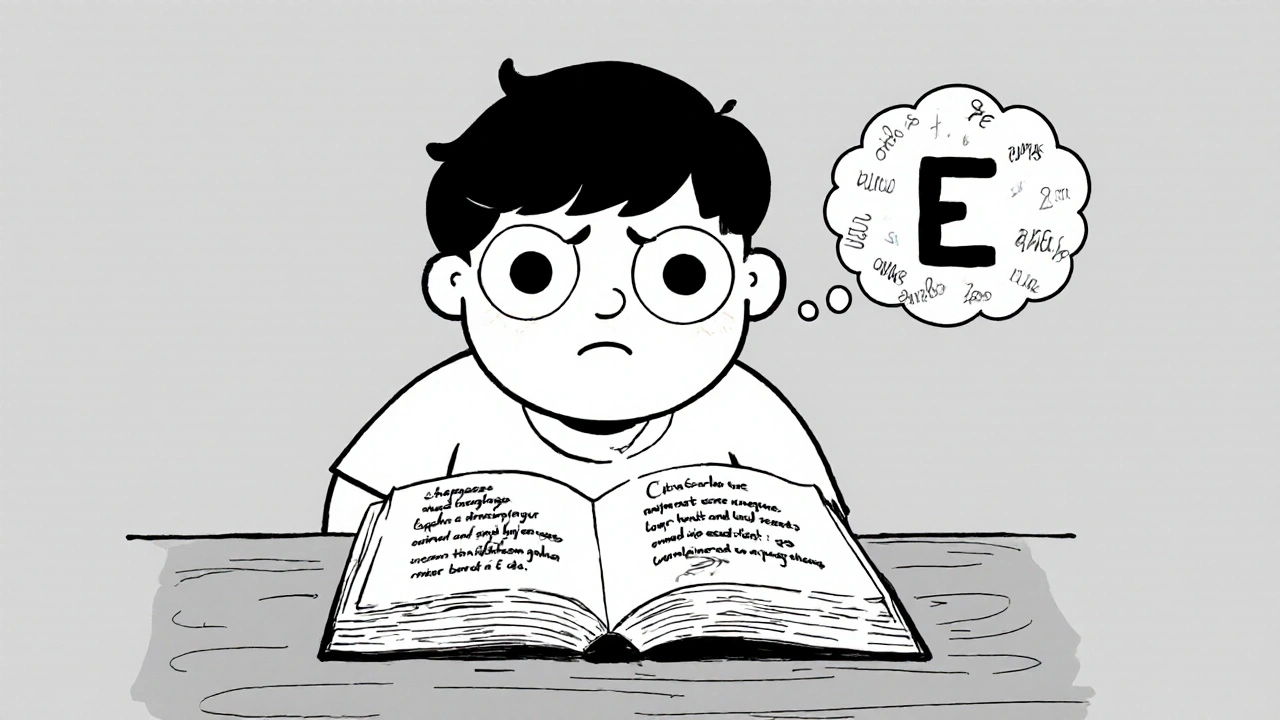
Most people think if they can read the big E on the chart, their eyes are fine. But CI doesn’t affect distance vision. It only shows up when you’re doing near work. That’s why so many kids are labeled as lazy readers or having attention problems when they’re actually struggling with their eyes working together. A 2022 survey found 78% of pediatricians don’t know how to screen for CI. Parents notice their child avoids homework, complains of headaches, or reads slowly-but doctors don’t connect the dots.
Without proper testing, CI gets misdiagnosed as ADHD, dyslexia, or just "not trying hard enough." That’s why so many kids fall behind in school. The eyes aren’t broken-they’re just not trained to work as a team. And that’s fixable.
The Gold Standard: Office-Based Vision Therapy
The best way to treat CI isn’t with eye drops, glasses, or pills. It’s with vision therapy-specifically, office-based vision therapy (OBVT) with home reinforcement. This isn’t a vague "do eye exercises" suggestion. It’s a structured, evidence-backed program backed by the National Eye Institute’s landmark Convergence Insufficiency Treatment Trial (CITT).
The CITT study compared three treatments: supervised in-office therapy, home-based pencil push-ups, and home-based computer therapy. After 12 weeks, 75% of kids in the in-office group had full or major improvement. Only 43% improved with pencil push-ups alone. And just 33% improved with computer-only therapy.
What happens in a typical OBVT session? You work with a trained vision therapist for 45 to 60 minutes once a week. You do exercises like:
- Pencil push-ups: Focus on a small target on a pencil as you slowly move it toward your nose, keeping it single and clear.
- Jump convergence: Rapidly shift focus between a near target and one farther away to train quick eye movement.
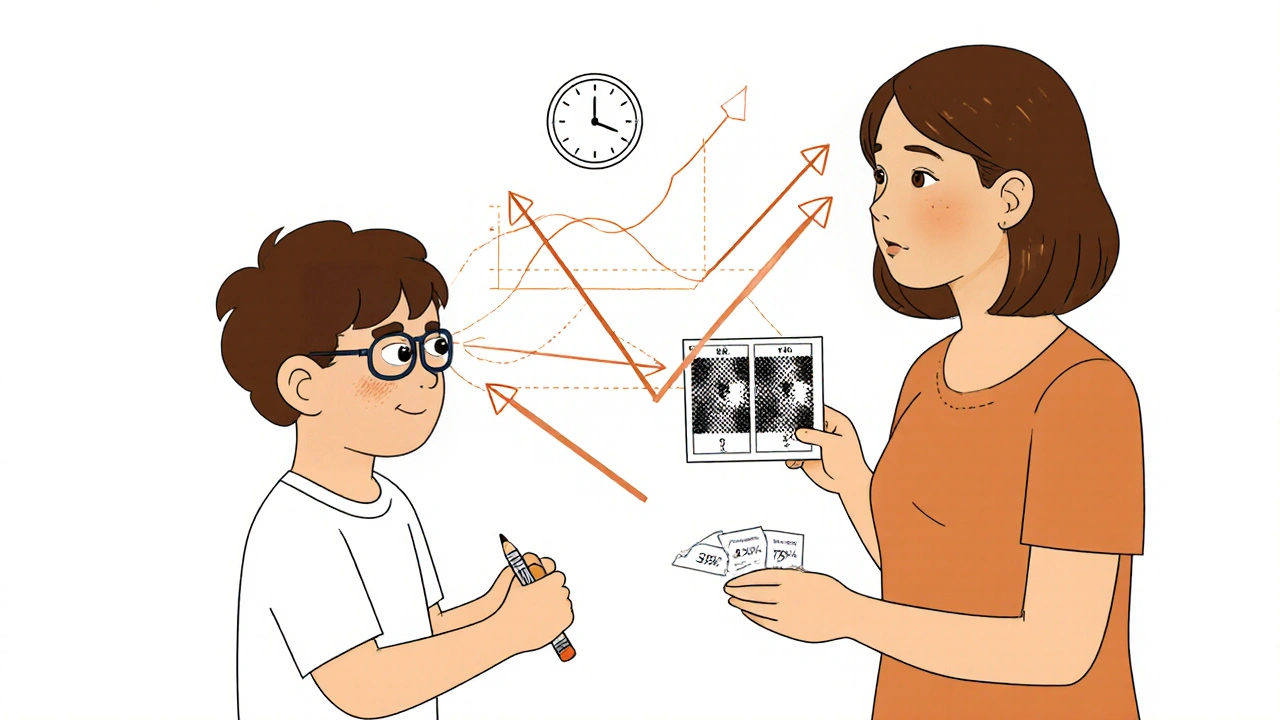
- Stereograms and convergence cards: Use 3D images or dot patterns that only appear as one image when your eyes converge correctly.
Then, you do 15 minutes of home exercises five days a week. This combo-professional guidance plus daily practice-is what makes the difference.
Why Pencil Push-Ups Alone Don’t Work
Many online sources still push pencil push-ups as the main treatment. It’s cheap, easy, and sounds logical. But the science says otherwise. The CITT study proved that doing pencil push-ups at home without supervision is only about half as effective as in-office therapy.
Why? Because people don’t do them right. You need to know when you’re seeing double (physiologic diplopia), when you’re suppressing one eye, and how to gradually increase difficulty. Without a therapist watching, you might just be staring at the pencil without actually training your brain and eyes to work together. One parent on Reddit wrote: "We did pencil push-ups for six months. Nothing changed. The moment we started in-office therapy, my son’s reading improved in two weeks."
Computer-Based Therapy: A Middle Ground
Systems like AmblyoPlay and HTS Instinctive offer a middle path. They’re more structured than pencil push-ups and more convenient than weekly office visits. They use games and real-time feedback to guide users through convergence exercises. Some even include remote supervision.
But they’re still not as effective as in-office therapy. The CITT study showed computer-only therapy had the lowest success rate. However, newer versions with live therapist check-ins (like AmblyoPlay’s 2023 telehealth update) are closing the gap. One 2023 study found telehealth-supervised computer therapy had 68% adherence-higher than traditional home programs.
If you can’t afford office visits, or live far from a specialist, computer therapy with supervision is a decent alternative. But if you want the best results, in-office therapy still wins.
Prism Glasses and Patching: What Doesn’t Help
Some optometrists suggest prism glasses to help with CI. Base-out prisms force your eyes to work harder to converge. But they’re tiring, and they don’t fix the underlying problem-they just mask it. The American Association for Pediatric Ophthalmology and Strabismus (AAPOS) says they’re only useful for short-term relief during therapy, not long-term treatment.
Base-in prisms? They help you read more comfortably by reducing eye strain, but they also make your eyes lazy. If you wear them all day, your brain doesn’t have to learn to converge on its own.
And patching? Don’t do it. Patching one eye prevents binocular vision. CI is about using both eyes together. Patching makes that worse. AAPOS is clear: "Patching is not a good option to strengthen convergence."
How Long Does It Take? What to Expect
Most people see improvement within 4 to 8 weeks. Full results usually take 12 weeks. The CITT study showed 82% of patients kept their gains one year later. That’s not temporary relief-that’s lasting change.
Success isn’t just about symptom reduction. It’s about reading stamina. One parent shared: "My 10-year-old used to quit reading after 15 minutes. After therapy, he read for over an hour without complaining. His grades improved too."
But it’s not magic. You have to do the work. Patients who completed at least 80% of their home exercises had an 82% success rate. Those who did less than half? Only 45% improved.
Cost, Insurance, and Access
Here’s the hard part: therapy costs money. A full course can run $2,500 to $4,000. Insurance rarely covers it. Only 32% of private plans in the U.S. pay for vision therapy, according to the American Optometric Association. Many families pay out of pocket or skip treatment entirely.
There are only about 1,200 COVD-certified vision therapists in the entire country. Finding one can take time. If you’re in a rural area, you might need to travel. That’s why telehealth options are growing fast.
But the cost of *not* treating CI is higher. Kids fall behind in school. Adults avoid reading. Headaches and fatigue affect work and mood. When you look at it that way, therapy isn’t a luxury-it’s a necessity.
What’s Next? The Future of CI Treatment
Research is moving fast. Virtual reality therapy is being tested at places like SUNY College of Optometry. Early results show symptom relief 23% faster than traditional methods. AI-driven programs are starting to adapt exercises in real time based on how a patient performs-making therapy more personalized.
The big question now isn’t whether vision therapy works. It’s how to make it faster, cheaper, and more accessible. The National Eye Institute just funded new studies in 2024 to find ways to shorten treatment time without losing results.
What to Do If You Suspect CI
If you or your child has reading fatigue, headaches, double vision, or trouble focusing on close work:
- Ask for a binocular vision assessment-not just a routine eye exam.
- Request the Convergence Insufficiency Symptom Survey (CISS).
- Ask about near point of convergence and positive fusional vergence tests.
- If diagnosed, consider office-based vision therapy as the first option.
- If cost is an issue, look for telehealth-supervised computer therapy as a backup.
- Avoid unproven methods like patching or unsupervised pencil push-ups alone.
CI is not a life-long condition. It’s a training issue. With the right therapy, your eyes can learn to work together again. And once they do, reading, working, and even watching TV can become effortless again.
Can convergence insufficiency go away on its own?
No, convergence insufficiency doesn’t usually resolve without treatment. While some mild cases in young children may improve slightly with age, most people-especially those with symptoms-need structured vision therapy to retrain their eyes. Left untreated, symptoms often persist into adulthood and can worsen with screen use or stress.
Is vision therapy just for kids?
No. While CI is commonly diagnosed in children, adults can have it too-especially those who spend long hours on computers or reading. Studies show adults respond just as well to office-based vision therapy as children. The brain’s ability to adapt (neuroplasticity) doesn’t disappear with age.
Do glasses fix convergence insufficiency?
Standard reading glasses or bifocals won’t fix CI. They help with focusing power, not eye alignment. Prism glasses can offer temporary relief by shifting the image to reduce strain, but they don’t train the eyes to converge. They’re a band-aid, not a cure. Vision therapy is the only treatment that addresses the root cause.
How do I find a qualified vision therapist?
Look for an optometrist certified by the College of Optometrists in Vision Development (COVD). These professionals have advanced training in binocular vision and vision therapy. You can search their directory online. Avoid therapists who offer quick fixes, rely only on pencil push-ups, or don’t use standardized testing before treatment.
What if vision therapy doesn’t work?
If you’ve completed a full 12-week course of office-based therapy and see no improvement, it’s possible you have another underlying condition-like a neurological issue or a different binocular disorder. A second opinion from a pediatric ophthalmologist or neuro-ophthalmologist may be needed. But true CI that’s properly diagnosed and treated has a success rate of over 75%.

9 Comments
Emily Craig
November 26 2025
I spent six months doing pencil push-ups with my kid and got zero results. Then we did real vision therapy and within two weeks he was reading novels without complaining. Why do people still think home exercises are enough? The science is right here and you're wasting time.
Josh Zubkoff
November 27 2025
Look, I get it, office-based therapy works, but let's be real here-$4,000 for something that's basically just eye yoga? That's a scam wrapped in a clinical trial. Insurance won't cover it because they know it's not medically necessary, it's a luxury for people who can afford to pay for their kids to not get headaches. Meanwhile, my cousin's kid just uses blue light glasses and he's fine. Maybe we're overmedicalizing normal eye fatigue?
fiona collins
November 27 2025
If you're experiencing headaches, double vision, or losing your place while reading, please get tested. It's not ADHD. It's not laziness. It's a treatable condition. Don't wait.
Rachel Villegas
November 29 2025
I'm a high school teacher and I've seen so many students labeled as 'disengaged' or 'slow readers' who just had CI. One student went from failing reading comprehension to acing it after therapy. It's heartbreaking that so many never get diagnosed. This post should be mandatory reading for every pediatrician and teacher.
giselle kate
November 30 2025
America's healthcare system is broken. You need to pay $4,000 to fix something that should be covered like any other medical issue. Meanwhile, in Germany, this is standard care. We're letting kids fall behind because we treat vision like a cosmetic problem. This isn't about therapy-it's about profit.
Arup Kuri
December 1 2025
You think this is new? My uncle in Delhi had this in the 90s and they fixed it with a simple mirror and flashlight. Now they sell you $3000 computer programs and call it science. Big pharma and optometry are in bed together. They don't want you to know the truth: your eyes just need rest and less screen time. No therapy needed.
Pallab Dasgupta
December 2 2025
I'm 34 and got diagnosed last year. I thought I was just bad at reading. Turns out my eyes were fighting each other every time I looked at a screen. After 10 weeks of therapy, I read my first book in years. Not because I'm smarter now, but because my eyes finally stopped lying to my brain. If you're tired of feeling like your brain is broken-check your eyes.
Ellen Sales
December 2 2025
I want to say this gently but firmly: if you're telling someone to just do pencil push-ups at home, you're not helping-you're delaying real relief. Vision therapy isn't about willpower. It's about neuroplasticity. Your brain can rewire, but only if you give it the right tools. And those tools? They need guidance. Not just a pencil and hope.
prasad gaude
December 4 2025
In India, we don't have access to this kind of care. But I've seen kids in rural areas improve just by using a simple string with beads and practicing focus daily. It's not fancy, but it's consistent. Maybe the real lesson isn't about technology-it's about patience and repetition. We don't need expensive machines. We need awareness.