
You take a pill for a headache. Then another for back pain. Maybe a cold medicine at night. It feels harmless because acetaminophen is an over-the-counter pain reliever and fever reducer available in millions of households worldwide. Also known as paracetamol outside the United States, it has been used since the 1950s and is considered safe when taken correctly. But cross a specific line, and that same medication becomes the leading cause of acute liver failure in the United States. Every year, roughly 56,000 people visit emergency rooms for acetaminophen toxicity. Of those, about 26,000 are hospitalized, and 500 die. The tragedy is that almost all of these deaths are preventable if you know what to look for and act fast.
The Hidden Danger of Stacking Medications
Most people don’t wake up and decide to take fifty pills. Acetaminophen overdose usually happens by accident. You might take Tylenol PM for sleep, then Vicodin for dental pain, not realizing Vicodin contains 300 mg of acetaminophen per tablet. Add a multi-symptom cold flu medicine, and you’ve easily blown past the safety limit without noticing.
The American Addiction Centers states the safe therapeutic dosage for adults is no more than 1,000 mg at one time or 4,000 mg (4 grams) within 24 hours. That’s eight standard 500 mg pills. If you drink alcohol regularly, have hepatitis, or are malnourished, your safe limit drops significantly. Chronic alcohol consumption increases your risk of liver damage three to four times. Pre-existing liver disease from hepatitis B or C makes you 65% more vulnerable. Even taking certain seizure medications like phenytoin can increase toxicity risk by 40% because they change how your liver processes the drug.
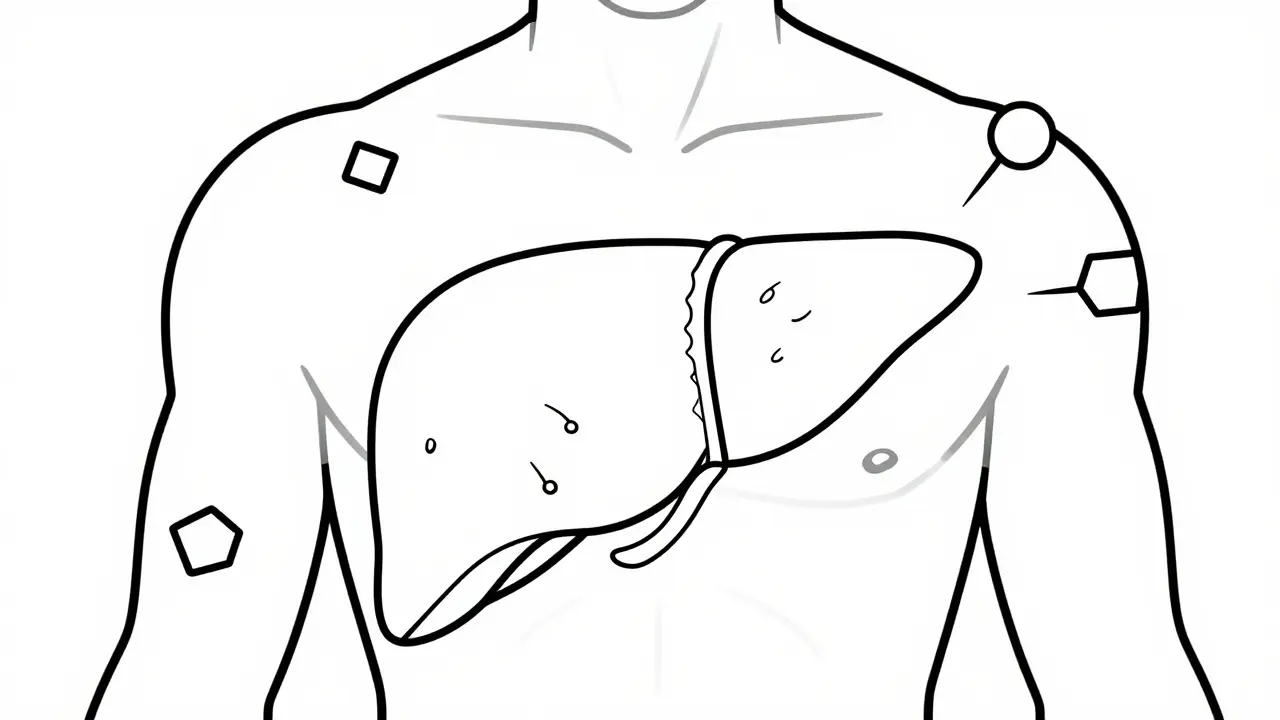
Why does this happen? Your liver breaks down acetaminophen using a protective molecule called glutathione. When you take too much, your body creates a toxic byproduct called NAPQI (N-acetyl-p-benzoquinone imine), which depletes glutathione stores and causes oxidative damage to liver cells. Once glutathione runs out, NAPQI starts killing liver tissue rapidly. This process is silent at first, which is why timing is everything.
The Four-Stage Timeline of Toxicity
If you suspect an overdose, you need to understand the clock. Clinical progression follows a predictable four-stage pattern documented in medical literature. Knowing where someone is on this timeline saves lives.
- Stage 1 (0-24 hours): Symptoms are vague or nonexistent. About 30-40% of patients feel fine initially. Others experience nausea (78% of cases), vomiting (65%), and loss of appetite (42%). Because these symptoms mimic a stomach bug, many people ignore them. This is the most dangerous phase because the damage is brewing silently.
- Stage 2 (24-72 hours): The patient may start feeling better, but the liver is under attack. Pain develops in the right upper quadrant of the abdomen (85% of cases). Blood tests show rising levels of alanine aminotransferase (ALT), a marker of liver stress.
- Stage 3 (72-96 hours): This is peak toxicity. ALT levels can skyrocket above 10,000 IU/L (normal is 7-56 IU/L). Jaundice (yellowing of skin/eyes) appears in 92% of severe cases. Confusion sets in as toxins build up in the blood. Kidney failure occurs in half of patients with frank liver failure. Coagulopathy-where blood doesn’t clot properly-is present in 88% of critical cases.
- Stage 4 (Beyond 5 days): The outcome is decided. With proper treatment, 85-90% of patients recover completely. Without intervention, mortality jumps to 25-40%. Those who survive typically see full liver function return within three months.
| Stage | Timeframe | Key Symptoms | Critical Action |
|---|---|---|---|
| 1 | 0-24 hours | Nausea, vomiting, or asymptomatic | Seek immediate care; do not wait for pain |
| 2 | 24-72 hours | Right upper abdominal pain, fatigue | Monitor liver enzymes closely |
| 3 | 72-96 hours | Jaundice, confusion, kidney issues | Intensive care; consider transplant criteria |
| 4 | 5+ days | Recovery or multi-organ failure | Long-term monitoring or transplantation |
Treatment: The 8-Hour Window
There is an antidote, but it is not magic-it is a race against time. The only federally approved antidote is N-acetylcysteine (NAC), which replenishes glutathione stores and directly binds to the toxic metabolite NAPQI. According to Merck Manuals, intravenous NAC is 98% effective if started within 8 hours of ingestion. Drop that window to 8-15 hours, and efficacy falls to 75%. After 15 hours, it drops to 55%.
Every hour of delay increases mortality risk by 8.5%. Yet, 60% of patients present after this critical window because they didn’t feel sick enough to go to the hospital during Stage 1. If you suspect an overdose, do not wait for symptoms. Go to the ER immediately.
In the emergency room, doctors will likely administer activated charcoal (50-100 grams) if you arrive within 1-2 hours of ingestion. This helps prevent further absorption of the drug. They will draw blood at the 4-hour mark to plot your acetaminophen level on the Rumack-Matthew nomogram. If your level is above 150 µg/mL at 4 hours, you need NAC treatment.
The standard IV protocol lasts 21 hours:
- Loading dose: 150 mg/kg over 1 hour
- Second infusion: 50 mg/kg over 4 hours
- Maintenance: 100 mg/kg over 16 hours
When Transplant Becomes Necessary
For the small percentage of cases where NAC cannot stop the damage, liver transplantation is the last resort. Only 1-2% of severe overdoses require this. Doctors use the King's College Criteria to decide. If a patient has a pH below 7.3, an INR (blood clotting measure) above 6.5, and creatinine above 3.4 mg/dL, the mortality rate without a transplant is nearly 100%.
However, outcomes for transplant recipients are generally positive. About 85% of patients survive at least five years after receiving a new liver following acetaminophen toxicity. The economic burden is high-hospitalization averages $38,500 per case-but the cost of prevention is zero.
Prevention and Future Directions
Public health efforts have made progress. In 2011, the FDA mandated that prescription products containing acetaminophen cap the single dose at 500 mg (down from 750 mg). This change contributed to a 21% decrease in acute liver failure cases between 2005 and 2016. Reading labels is your best defense. Look for "APAP" or "acetaminophen" in the active ingredients of any cold, flu, or pain medication.
Research is also advancing. Recent studies from the Harvard Stem Cell Institute suggest nitric oxide pathways could enhance liver regeneration, potentially extending the treatment window beyond the current 8-hour limit. Additionally, biomarkers like microRNA-122 show 94% sensitivity for detecting liver injury just 2 hours post-ingestion, which could revolutionize early diagnosis in the future.
What are the first signs of acetaminophen overdose?
The earliest signs, occurring within 24 hours, are often nonspecific and include nausea, vomiting, sweating, and pallor. However, 30-40% of patients have no symptoms initially. The absence of pain does not mean the absence of danger. Right upper quadrant abdominal pain typically appears later, between 24 and 72 hours.
How much acetaminophen causes liver damage?
For healthy adults, exceeding 4,000 mg (4 grams) in 24 hours poses a significant risk. For individuals who consume alcohol regularly, have liver disease, or are malnourished, toxicity can occur at lower doses, sometimes as low as 2,000 mg to 3,000 mg per day. Always consult a doctor if you have pre-existing conditions.
Can you reverse liver damage from acetaminophen?
Yes, if treated early. The antidote N-acetylcysteine (NAC) is 98% effective when administered within 8 hours of ingestion. It replenishes glutathione, allowing the liver to neutralize the toxic metabolite. Most patients who receive timely treatment experience complete recovery of liver function within three months.
Does alcohol increase the risk of acetaminophen toxicity?
Yes, significantly. Chronic alcohol consumption increases the risk of liver damage three to four times. Alcohol induces liver enzymes that produce more of the toxic metabolite NAPQI while simultaneously depleting glutathione stores, leaving the liver unprotected against acetaminophen.
What should I do if I accidentally take too much Tylenol?
Call Poison Control (1-800-222-1222 in the US) or go to the nearest emergency room immediately. Do not wait for symptoms to appear. Bring the medication bottle with you so medical staff can calculate the exact dose ingested. Early intervention with NAC prevents permanent liver damage.
