
Bridging Therapy Decision Calculator
Determine if Bridging Therapy is Needed
Your Recommendation
Enter your information above to see if bridging therapy is needed.
Switching between blood thinners isn’t just about swapping one pill for another. When a patient on long-term anticoagulation needs surgery, a dental procedure, or any intervention that increases bleeding risk, stopping their medication creates a dangerous window - the exact moment when clots can form. That’s where bridging therapy comes in. But here’s the twist: for most people, bridging isn’t needed anymore. In fact, doing it might be more harmful than helpful.
What Is Bridging Therapy - And Why It Used to Be Routine
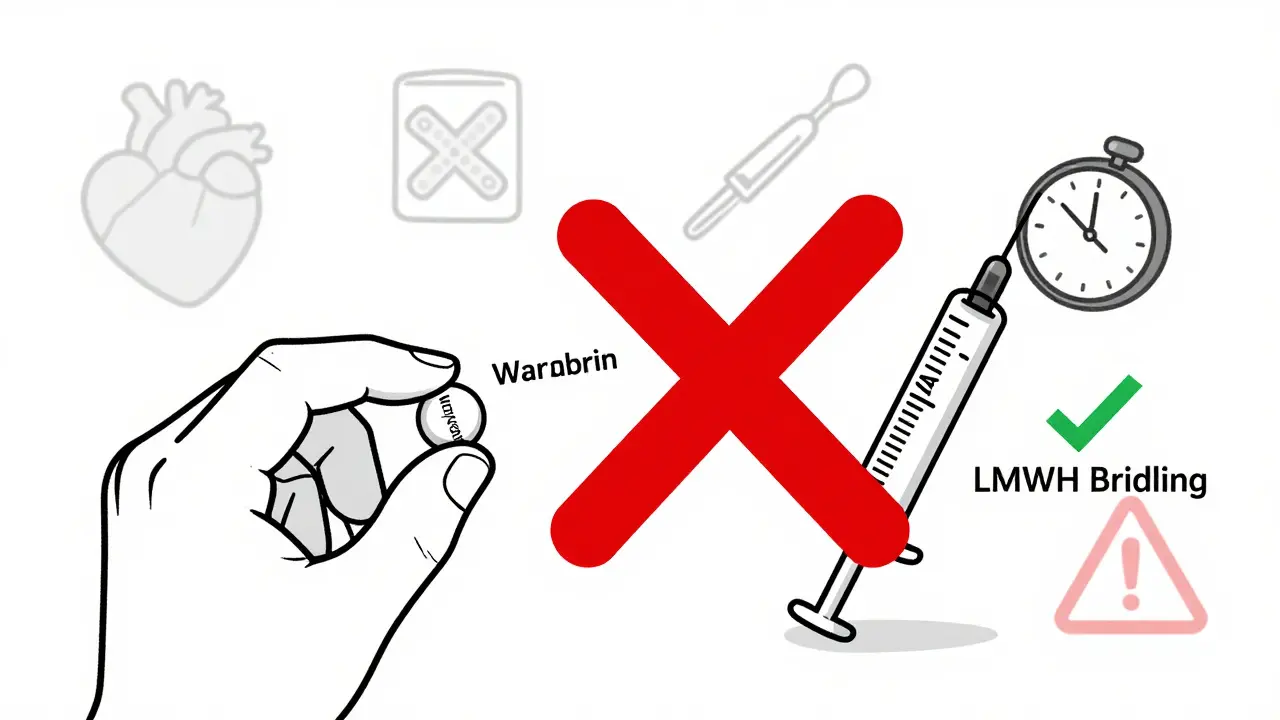
Bridging therapy means using a short-acting injectable blood thinner - usually low molecular weight heparin (LMWH) like enoxaparin - to cover the gap when a patient stops their long-term anticoagulant. This was once standard practice. If you were on warfarin and needed a knee replacement, your doctor would stop your warfarin a week before surgery, start you on daily injections, and then restart warfarin after the procedure. The logic was simple: don’t leave you unprotected. But that logic was built on fear, not data. Back in the 2000s, doctors assumed that stopping warfarin - even for a few days - meant your risk of stroke or clotting shot up. So they reached for heparin injections to fill the gap. By 2010, nearly half of all patients on warfarin undergoing surgery got bridged. Then came the BRIDGE trial in 2015. Researchers randomly assigned over 2,000 patients with atrial fibrillation who needed temporary interruption of warfarin to either receive LMWH bridging or no bridging. The results were shocking. Bridging didn’t lower the risk of stroke or clots. But it doubled the chance of major bleeding. 2.3% of bridged patients had serious bleeding. Only 1% of those who didn’t get bridged did. That study changed everything.When Bridging Is Still Necessary - And When It’s Not
Today, bridging isn’t a default. It’s a last resort. The American Heart Association, American College of Cardiology, and European Heart Rhythm Association now agree: only a tiny group of patients needs it. You likely need bridging if you have:- A mechanical heart valve in the mitral position (not just any valve - specifically the mitral one)
- A recent blood clot in the lungs or legs (venous thromboembolism) within the last 3 months
- You’re on a direct oral anticoagulant (DOAC) like apixaban (Eliquis), rivaroxaban (Xarelto), dabigatran (Pradaxa), or edoxaban (Savaysa)
- You have atrial fibrillation without a recent clot or mechanical valve
- You’re on warfarin but your CHA₂DS₂-VASc score is below 5
How Bridging Works - Step by Step (For the Few Who Need It)
If you’re one of the 10-15% who still need bridging, timing is everything. Mess it up, and you’re at risk for either a clot or a bleed. For warfarin patients needing bridging:- Stop warfarin 5-6 days before surgery. This lets your INR drop below 2.0. If your INR is still high at day 5, you may need to wait longer.
- Start LMWH 3 days before surgery. Most use enoxaparin 1 mg/kg once daily (or 0.5 mg/kg twice daily for higher-risk cases).
- Stop LMWH 24 hours before surgery. If it’s a high-bleeding-risk procedure like brain or spinal surgery, some doctors wait 36-48 hours.
- Restart warfarin 12-24 hours after surgery. Start at 15-20% higher than your previous daily dose. Your body may need more to get back into range.
- Check INR in 3-4 days. Don’t wait a week. You need to know if you’re back in the therapeutic range (usually 2.0-3.0 for most patients).
- Fondaparinux: Stop 36-48 hours before surgery
- Unfractionated heparin (IV): Stop 4-6 hours before surgery

Why DOACs Made Bridging Obsolete for Most
In 2023, 75% of new anticoagulant prescriptions in the U.S. were for DOACs. That’s not an accident. They’re easier. Safer. More predictable. Here’s how to handle DOACs around surgery:- Apixaban (Eliquis): Hold for 2 days before low-bleeding-risk procedures. Hold for 3-4 days before high-risk ones. Restart 6-24 hours after surgery if bleeding is controlled.
- Rivaroxaban (Xarelto): Hold 2 days before low-risk, 3 days before high-risk. Restart same day or next day post-op.
- Dabigatran (Pradaxa): Hold 2 days before low-risk, 3-4 days before high-risk. If kidney function is poor, hold longer.
The Hidden Dangers of Bridging
Even when done perfectly, bridging has downsides:- Bleeding risk: The BRIDGE trial showed a 2.3% major bleeding rate with bridging vs. 1.0% without. That’s more than double.
- Logistical burden: Daily injections are painful. Many patients skip doses - studies show 15-20% non-adherence. Missed doses mean clots. Extra doses mean bleeding.
- Cost: A 7-day course of LMWH in the U.S. costs $300-$500. That’s out-of-pocket for many. In the UK, NHS supply is limited, and delays can disrupt surgery schedules.
- Confusion: When do you restart warfarin? What dose? When to check INR? Patients often get conflicting advice from surgeons, pharmacists, and primary doctors.
What Doctors Get Wrong - And How to Avoid It
Many clinicians still default to bridging out of habit. Or because a surgeon says, “We need zero anticoagulation.” But that’s outdated thinking. Key mistakes:- Assuming all atrial fibrillation patients need bridging
- Starting LMWH too early (before INR is low enough)
- Restarting warfarin too late after surgery
- Not checking kidney function before giving LMWH
- Using bridging for DOAC patients - which is unnecessary and dangerous
- Use the CHA₂DS₂-VASc score to assess stroke risk - not just “I have AFib.”
- Use the HAS-BLED score to assess bleeding risk - don’t ignore it.
- Ask: “Is this patient truly at high thrombotic risk?” If not, skip bridging.
- Coordinate between surgeon, primary care, and pharmacy. A single plan prevents chaos.
- For DOACs: follow the half-life. No more guessing.

What Patients Should Ask Before Surgery
If you’re on a blood thinner and have a procedure coming up, don’t wait for your doctor to bring it up. Ask these questions:- “Am I on warfarin or a DOAC?”
- “Do I really need bridging, or is that just old practice?”
- “What’s my CHA₂DS₂-VASc score? Am I truly high-risk for stroke?”
- “If I stop my medicine, what’s the risk of a clot?”
- “If I don’t get bridging, how will you manage bleeding risk during surgery?”
- “When exactly do I stop and restart? Can I get this in writing?”
The Future: Less Bridging, More Precision
The trend is clear: bridging therapy is shrinking. It’s no longer a standard. It’s a niche intervention for a very small group. DOACs are replacing warfarin in 7 out of 10 new cases. As more patients switch, the need for bridging will drop even further. New guidelines in 2024 from the European Society of Cardiology are pushing for even stricter criteria - possibly limiting bridging to only mechanical mitral valves. Meanwhile, research is exploring “step-up” approaches: instead of injecting heparin before surgery, give a low-dose injection just after - and only if bleeding is controlled. This could eliminate the dangerous gap entirely. For now, the rule is simple: Don’t bridge unless you absolutely must. Most people don’t need it. And for those who do, precision matters more than tradition.Do I need bridging if I’m on warfarin and having a tooth extraction?
No, you don’t. Tooth extractions are low-bleeding-risk procedures. For most patients, continuing warfarin at therapeutic levels (INR 2.0-3.0) is safer than stopping and bridging. Studies show no increase in serious bleeding when warfarin is kept going. If your INR is above 3.5, your doctor may temporarily lower your dose - but don’t stop it.
Can I switch from warfarin to a DOAC without bridging?
Yes, and you should. When switching from warfarin to a DOAC, stop warfarin and start the DOAC when your INR is below 2.0. No bridging is needed. For example, if your INR is 1.8 on day 5 after stopping warfarin, start apixaban that day. The DOAC kicks in within hours. This approach is endorsed by the 2020 ACC guidelines and reduces bleeding risk compared to bridging with heparin.
Why is LMWH given twice daily in some cases and once daily in others?
It depends on your risk level. Once-daily dosing (1 mg/kg) is standard for most patients. Twice-daily dosing (0.5 mg/kg each time) is used for very high-risk patients - like those with mechanical mitral valves or recent clots - to maintain stronger anticoagulation. But this also increases bleeding risk. The decision should be made by a specialist, not a generalist.
What if I miss a dose of my bridging injection?
If you miss one dose of LMWH, take it as soon as you remember - unless it’s within 6 hours of your next scheduled dose. Then skip it. Don’t double up. Missing one dose doesn’t mean you’ll clot - but missing multiple doses does. That’s why many doctors now avoid bridging entirely: it’s too easy to mess up. If you’re worried about adherence, ask about DOACs instead.
Is bridging therapy covered by the NHS in the UK?
Yes, but only for approved high-risk cases. The NHS follows the 2020 AHA guidelines, which restrict bridging to patients with mechanical mitral valves or recent venous thromboembolism. For most other patients, bridging is not funded because it’s no longer considered clinically necessary. If your doctor recommends it and you don’t meet criteria, you may be asked to decline it - or pay out-of-pocket.

10 Comments
Lorna Brown
March 13 2026
It’s wild how much we’ve learned since the BRIDGE trial. I used to think bridging was just common sense - like, how could you leave someone unprotected? But the data doesn’t lie. Double the bleeding risk for zero benefit? That’s not medicine, that’s fear-based practice. I’m glad we’re moving toward evidence, not tradition. Still, I wonder how many docs are even aware of the updated guidelines. Education gap is real.
Rex Regum
March 14 2026
Oh please. You’re all acting like this is some revolutionary breakthrough. Bridging worked fine for decades. People didn’t die left and right before 2015. Now we’re throwing out decades of clinical wisdom because of one study? What’s next? No more antibiotics because some paper said they’re overused? This is how medicine becomes a corporate experiment.
Kelsey Vonk
March 15 2026
So much to unpack here 😊 I love how the post breaks it down - like, finally someone explained DOAC timing in a way that made sense. I’m on apixaban and had a colonoscopy last month. They just told me to skip two doses. No injections. No panic. Just… simple. It felt like a gift. Also, the part about kidney function? That’s critical. My grandma’s nephrologist never mentioned that. Thank you for highlighting it.
Emma Nicolls
March 15 2026
im so glad this is finally changing like why are we still doing all these injections?? like i had a tooth pulled last year and they wanted to bridge me and i was like nope not doing it and they were like okay fine and i was fine lol. also doacs are just better period. no more inr checks. no more warfarin diet. life is so much easier. also dont forget to ask your doctor about your chads2vasc score its like your secret weapon
Jimmy V
March 17 2026
Stop bridging. Period. It’s not a gray area. The data is clear. If you’re not a mitral valve patient or had a clot in the last 90 days, you’re just increasing bleeding risk for zero gain. DOACs? Hold, don’t bridge. Simple. If your surgeon says “zero anticoagulation,” they’re wrong. Tell them to read the 2020 ACC guidelines. Or better yet, send them this post. I’ve seen too many patients bleed out because someone was too lazy to update their playbook.
Sabrina Sanches
March 19 2026
So… I just had a knee scope last month… I’m on rivaroxaban… They told me to hold it 3 days… And restart the next day… And I didn’t get bridged… And I didn’t clot… And I didn’t bleed… And I didn’t even need pain meds… So… I guess… this works??
Shruti Chaturvedi
March 20 2026
as someone from india where access to doacs is limited and warfarin is still the norm i want to say this is life changing information for so many people who dont have the resources to even get a proper INR check every week. maybe we need more outreach in low income countries not just in the us. bridging is expensive and painful and many just skip doses because they cant afford it or dont understand. this needs to be translated and shared widely
Devin Ersoy
March 21 2026
Ohhhhh, I see you’re one of those people who thinks medicine is just following papers like a robot. Let me guess - you also think vaccines are just “evidence-based” and never consider the long-term consequences? Bridging isn’t about fear - it’s about prudence. You can’t reduce human life to a p-value. I’ve seen patients with AFib and a CHA₂DS₂-VASc of 5 have strokes after skipping bridging. Coincidence? Or is the data cherry-picked? I’ll tell you what - I trust my gut more than a 2015 trial.
Scott Smith
March 22 2026
Just want to say thank you for this. My dad had a mechanical mitral valve and went through bridging for a hip replacement. It was brutal. Daily shots. Confusing instructions. A week of anxiety. He switched to a DOAC last year and hasn’t had a single issue. No bridging. No injections. Just a pill. If I could send this to every cardiologist in the country, I would. This is what good medicine looks like.
Emma Deasy
March 22 2026
It is with profound gravitas - and an almost reverential sense of scientific evolution - that I must express my admiration for the paradigmatic shift in anticoagulation management delineated herein. The BRIDGE trial, a landmark epistemological rupture in the corpus of cardiovascular therapeutics, has irrevocably dismantled the archaic dogma of bridging therapy as a universal safeguard. Indeed, the empirical evidence, meticulously curated and statistically validated, demonstrates not merely a marginal improvement, but a fundamental reconfiguration of risk-benefit calculus. To continue bridging in non-high-risk populations is not merely suboptimal - it is, in the truest sense, a violation of the Hippocratic oath’s core tenet: primum non nocere. May this post serve as a beacon - a clarion call - to all practitioners still clinging to the vestiges of 20th-century protocols.