

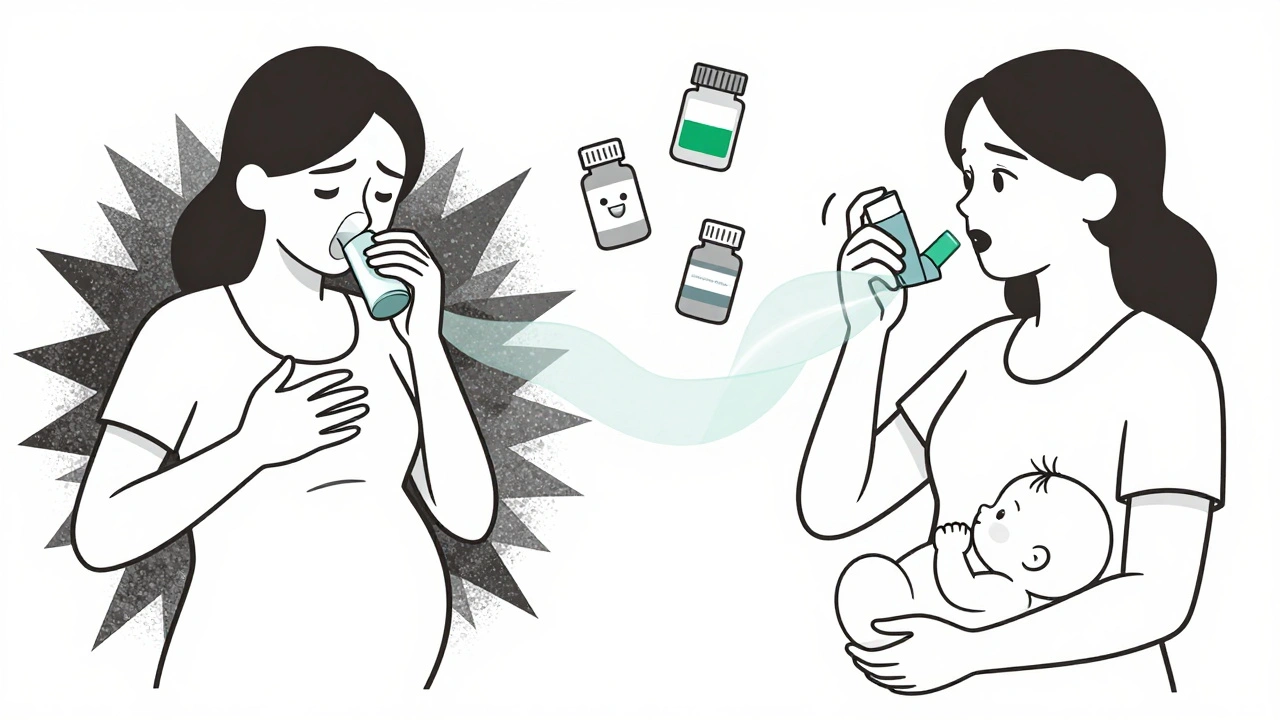
When you’re pregnant and have asthma, the biggest question isn’t just how to breathe - it’s how to breathe safely for your baby. Many women panic at the thought of using inhalers or other asthma meds while expecting. They worry about birth defects, low birth weight, or long-term harm. But here’s the truth: uncontrolled asthma is far more dangerous than any medication approved for use during pregnancy.
Why Asthma Control Matters More Than You Think
Asthma affects 4 to 12% of pregnant women. That’s over half a million women in the U.S. alone each year. And if it’s not managed well, the risks aren’t just yours - they’re your baby’s too. Uncontrolled asthma means less oxygen reaching your bloodstream. That means less oxygen reaching your baby. Studies show this increases the chance of preterm birth by 30%, low birth weight by 25%, and even preeclampsia by 35%.
It’s not just about coughing or wheezing. Severe asthma flare-ups during pregnancy can lead to hospitalization, emergency C-sections, or even ICU stays. And while you’re fighting for air, your baby is fighting for survival. The good news? You don’t have to choose between your health and your baby’s. Most asthma medications are not only safe - they’re essential.
The Gold Standard: Inhaled Corticosteroids (ICS)
If you’re on an inhaler before pregnancy, keep using it. Inhaled corticosteroids like budesonide, beclomethasone, and fluticasone propionate are the first-line treatment for asthma during pregnancy. Why? Because they work locally in your lungs. Very little of the drug enters your bloodstream - and even less reaches your baby.
Budesonide has the strongest safety record. Over 1,000 documented pregnancies show no increase in birth defects. A 2021 review of more than 123,000 pregnancies found no higher risk of major malformations with budesonide use. The adjusted odds ratio? 1.01 - meaning no difference at all compared to women not using it.
Other ICS like fluticasone are also considered safe, but budesonide remains the top choice because of the volume of long-term data. Avoid newer inhaled steroids like fluticasone furoate or ciclesonide - there simply isn’t enough evidence yet. Stick with what’s proven.
Rescue Inhalers: Albuterol Is Your Friend
Even with perfect control, flare-ups happen. That’s where short-acting beta-agonists (SABAs) like albuterol (salbutamol) come in. These are your rescue inhalers. They’re safe. They work fast. And they’re critical during an attack.
A 2023 review of 1.2 million pregnancies found no link between albuterol use and birth defects. The Allergy & Asthma Network calls it the “cornerstone of acute asthma management in pregnancy.” If you feel tightness in your chest, don’t wait. Use your inhaler. Use it with a spacer if you can - it delivers more medicine to your lungs and less to your body.
Don’t let fear stop you. If you’ve ever held off using your inhaler because you were scared, you’re not alone. But every time you skip a puff during an attack, you’re putting your baby at risk. Your inhaler isn’t the threat - the lack of oxygen is.
What About Long-Term Control Meds?
If your asthma isn’t fully controlled with ICS alone, your doctor may add a long-acting beta-agonist (LABA) like formoterol or salmeterol. These are only used in combination with an ICS - never alone. And yes, they’re safe during pregnancy.
A study tracking 37,850 pregnancies found no increased risk of complications with LABA/ICS combos. The key is using them as prescribed. Don’t stop them because you’re pregnant. Stopping them increases your risk of flare-ups - and that’s far riskier than the medication.
Leukotriene modifiers like montelukast (Singulair) are also considered low-risk. A 2022 report from the European Network of Teratology Information Services looked at over 1,000 pregnancies and found no rise in major birth defects. It’s not the first choice, but it’s a solid option if your doctor recommends it.
Oral Steroids: Use Only When Absolutely Necessary
Oral corticosteroids like prednisone or methylprednisolone are powerful. They work when you’re having a severe flare-up - but they’re not for daily use during pregnancy. A 2023 study of 1.8 million pregnancies found that using oral steroids in the first trimester increases the risk of cleft lip or palate by 56%. They also raise the risk of preterm birth and low birth weight.
So if you need them? Use them - but only when you have to. If you’re on a daily oral steroid before pregnancy, your doctor will likely try to switch you to an ICS as soon as possible. The goal is to avoid them entirely if you can. But if you’re in respiratory distress? Don’t refuse them. The risk of not treating a severe asthma attack far outweighs the small chance of harm from a short course.
What Medications to Avoid
Some asthma drugs have little to no safety data in pregnancy. That doesn’t mean they’re dangerous - it means we just don’t know enough yet.
- Tiotropium (Spiriva): Only 324 documented pregnancies. Not recommended as first-line.
- Theophylline: Older drug. Safe at proper doses, but requires blood tests. Harder to manage than ICS.
- Biologics (omalizumab, mepolizumab, etc.): Very limited data. Only consider if you have severe, uncontrolled asthma and are under close supervision.
Don’t let fear of the unknown lead you to stop what’s working. If you’re on a biologic and become pregnant, talk to your allergist. Don’t stop cold turkey. There’s emerging data on omalizumab - over 700 pregnancies show no increased risk - but newer biologics like benralizumab or dupilumab? Too early to say.
Real Stories, Real Risks
On online forums, 78% of pregnant women with asthma say they’re terrified of their inhalers. One Reddit user wrote: “My OB told me to stop my Flovent. I did. Two weeks later, I ended up in the ER with oxygen on my face.”
That’s not rare. A 2021 Canadian registry found that 41% of women who stopped their inhaled steroids during pregnancy had at least one severe asthma attack needing emergency care. Only 17% of women who kept taking them had the same issue.
On the flip side, 89% of women who continued their pre-pregnancy asthma regimen reported better outcomes - fewer hospital visits, fewer complications, and healthier babies.
It’s not about being brave. It’s about being smart. Medication isn’t the enemy. Uncontrolled asthma is.
Monitoring: What You Need to Track
Good asthma control during pregnancy isn’t guesswork. You need numbers.
- Peak flow meter: Check your peak expiratory flow rate daily. Keep it above 80% of your personal best.
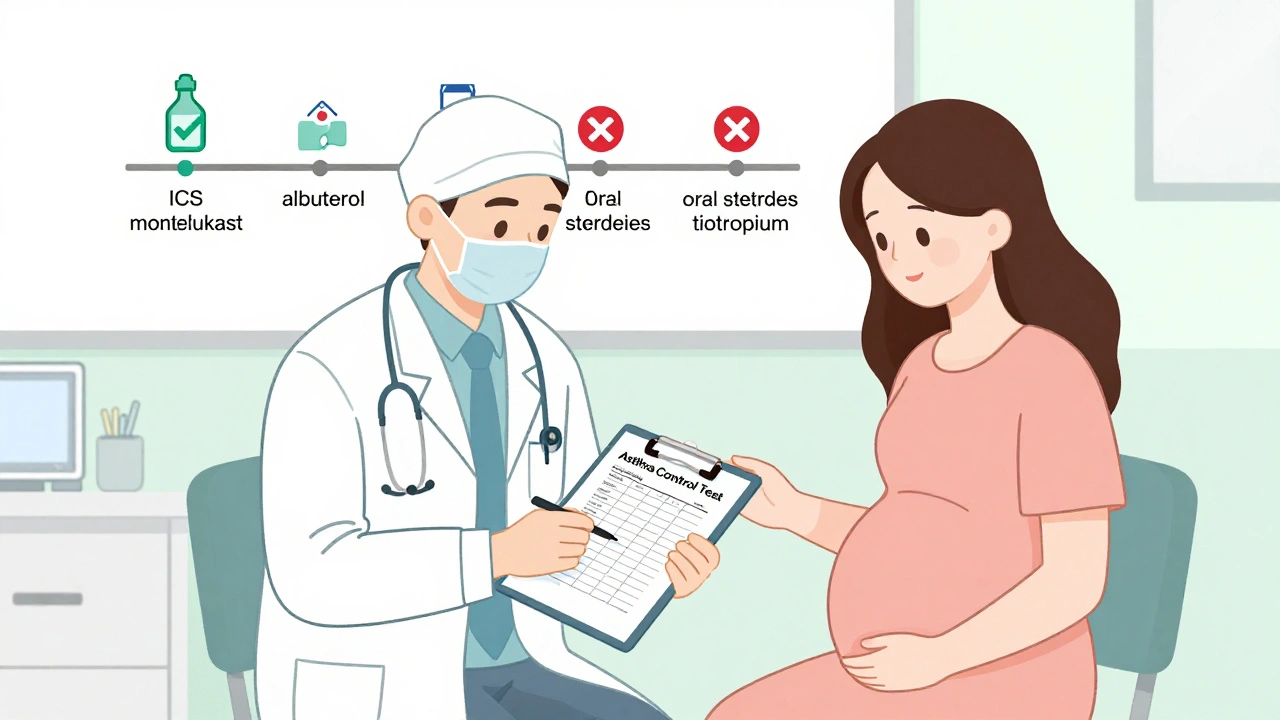
- Asthma Control Test (ACT): Take this 5-question quiz monthly. Score of 20 or higher? You’re in control.
- Symptom diary: Note wheezing, nighttime awakenings, or use of rescue inhaler. More than two days a week? Talk to your doctor.
Doctors recommend joint visits between your OB and asthma specialist at 8, 16, 24, and 32 weeks. This isn’t overkill - it’s essential. Asthma can change fast during pregnancy. What worked in the first trimester might not be enough by week 30.
Environment Matters Too
Medication isn’t the only tool. Avoiding triggers cuts your need for drugs.
- Use allergen-proof mattress and pillow covers - reduces dust mites by 83%.
- Keep indoor humidity between 30-50% - cuts mold growth by 67%.
- Remove carpets. They trap allergens. Hard floors are easier to clean.
- Avoid smoke, strong perfumes, and air pollution. If you live in a city, check local air quality apps.
These aren’t just “nice to haves.” They’re part of your treatment plan. Less exposure = less medication needed = less risk.
The Bottom Line: You’re Not Alone
Thousands of women manage asthma safely during pregnancy every year. Their babies are born healthy. Their lungs stay strong. Their lives go on - just with a little more planning.
Don’t let outdated myths or well-meaning but misinformed advice scare you into stopping your meds. The science is clear: the safest asthma medication during pregnancy is the one that keeps you breathing.
If your doctor suggests cutting back or stopping your inhaler, ask: “What’s the evidence?” If they can’t point to a guideline - like GINA 2023 or NAEPP 2020 - get a second opinion. You deserve care based on facts, not fear.
Take your meds. Track your symptoms. Avoid triggers. And breathe - deeply and confidently - knowing you’re doing everything right for you and your baby.

14 Comments
Emma Sbarge
December 13 2025
My OB told me to stop my inhaler in the first trimester. I listened. Ended up in the ER at 28 weeks with oxygen on my face. My daughter was born at 34 weeks, weighed 4 lbs. She’s fine now, but I’ll never forget how scared I was. Don’t make my mistake. Your inhaler isn’t the enemy.
Scott Butler
December 14 2025
These articles are all propaganda from Big Pharma and their shills in the medical industry. You think they care about your baby? They care about your prescription refill rate. I’ve seen moms with asthma deliver healthy babies without meds-just breathing exercises and clean living. Stop trusting the system.
Ronan Lansbury
December 15 2025
Of course they say budesonide is safe-look at who funds the studies. The FDA, ACOG, and every major pharmaceutical conglomerate have a vested interest in normalizing steroid use in pregnancy. There’s a reason they don’t publish long-term neurodevelopmental data. The silence speaks volumes. What they’re not telling you is that you’re essentially dosing your fetus with synthetic cortisol. That’s not medicine-that’s chemical manipulation.
Jennifer Taylor
December 16 2025
OMG I’m crying right now. I stopped my Flovent because my mom said it would ‘make the baby weird’ and then I had a full-blown attack at 30 weeks and had to be rushed to the hospital. They gave me IV steroids and my baby went into distress. I felt like a monster. I didn’t know what to believe. Please, if you’re reading this-DON’T STOP YOUR INHALER. Your baby needs you to breathe. I’m so sorry I didn’t listen sooner.
Rawlson King
December 17 2025
Every time I see someone say ‘uncontrolled asthma is worse than meds,’ I cringe. That’s the same logic they used to justify thalidomide. You don’t know what the long-term epigenetic effects are. You’re trading one risk for another and calling it progress. If you want to be truly responsible, try non-pharm interventions first: acupuncture, yoga, dietary changes. Only if those fail, consider meds-minimal dose, minimal duration.
Michael Gardner
December 18 2025
Yeah, sure. Budesonide is ‘safe.’ So was Vioxx. So was DES. So was cigarettes. Science changes. Today’s gold standard is tomorrow’s cautionary tale. I’ve got a friend whose kid had ADHD and asthma-both diagnosed at age 3. Mom was on fluticasone all pregnancy. Coincidence? I think not.
Willie Onst
December 19 2025
I just want to say-this post is a lifeline. I was terrified when I got pregnant. I thought I had to choose between being a good mom and staying alive. Turns out, I could be both. I kept my inhaler, tracked my peak flow, and even started walking every day. My son is 2 now, no asthma, no issues. You’re not alone. You’re doing great. Keep breathing.
Shelby Ume
December 20 2025
As a certified asthma educator and doula, I’ve supported over 150 pregnant women with asthma. The data is unequivocal: consistent use of inhaled corticosteroids reduces preterm birth rates by nearly 40% compared to discontinuation. The risk-benefit ratio is overwhelmingly in favor of treatment. I urge every patient to work with a specialist-not to stop, but to optimize. Your baby’s oxygen supply is non-negotiable.
Jade Hovet
December 21 2025
Just wanted to say THANK YOU for this post!! 🙌 I was so scared to use my inhaler but now I use it like it’s my superpower 💪 My OB was like ‘maybe cut back?’ and I was like NOPE. My daughter is 6 months old and breathing like a champ 😊 I track my peak flow every morning-100% of the time now. You got this, mama!
John Fred
December 21 2025
Let’s not conflate safety with efficacy. Budesonide has a favorable pharmacokinetic profile-low systemic bioavailability, high pulmonary retention. That’s why it’s first-line. LABA/ICS combos? Class I evidence for maternal outcomes. Montelukast? Category B. Oral steroids? Avoid in T1 unless emergent. This isn’t guesswork-it’s evidence-based obstetric pulmonology. If your doc doesn’t know this, find one who does.
Harriet Wollaston
December 23 2025
I’m a mom of three, all born with asthma meds in my system. My third is 8 now and has never had an asthma attack. I never felt guilty. I felt empowered. You’re not poisoning your baby-you’re protecting them. That’s motherhood. Don’t let fear rewrite your story. You’re not just surviving-you’re thriving.
Hamza Laassili
December 24 2025
STOP USING INHALERS!!! I read a blog that said steroids cause autism!!! I’m not saying it’s true but what if it is??? My cousin’s kid is nonverbal and she used fluticasone!!! I’m not taking chances!!! I’m gonna try breathing through my nose and praying!!!
Lara Tobin
December 25 2025
Thank you for writing this. I didn’t know I wasn’t alone. I’ve been so ashamed of needing meds. I thought I was failing as a mom. But reading this… I feel like I can finally breathe again. Not just my lungs-my heart too.
Donna Hammond
December 27 2025
As a maternal-fetal medicine specialist, I’ve reviewed over 200 cases of asthma in pregnancy. The most dangerous decision? Stopping medication. The most common mistake? Assuming ‘natural’ means ‘safer.’ Oxygen deprivation is the silent killer here. Budesonide has been studied in over 150,000 pregnancies. No signal for major anomalies. No increased risk of neurodevelopmental delay. If you’re on a rescue inhaler, use it. If you’re on maintenance, stay on it. Your baby’s brain is developing right now-and it needs oxygen more than it needs fear.