
What Are SGLT2 Inhibitors, and Why Do They Matter?
SGLT2 inhibitors are a class of diabetes medications that do something unusual: they make your kidneys flush out extra sugar through urine. Unlike insulin or metformin, they don’t rely on your body’s ability to produce or respond to insulin. That makes them especially helpful for people whose pancreas is struggling to keep up with type 2 diabetes. The first one, dapagliflozin (Farxiga), got FDA approval in 2013. Since then, four others joined the list: empagliflozin (Jardiance), canagliflozin (Invokana), ertugliflozin (Steglatro), and dapagliflozin’s generic version, Forxiga.
At first, doctors thought these drugs were just another way to lower blood sugar. But then came the trials - big, long-term studies that showed something shocking. People taking SGLT2 inhibitors didn’t just have better glucose numbers. Their hearts got stronger. Their kidneys slowed down their decline. Some even lived longer.
How Do SGLT2 Inhibitors Actually Work?
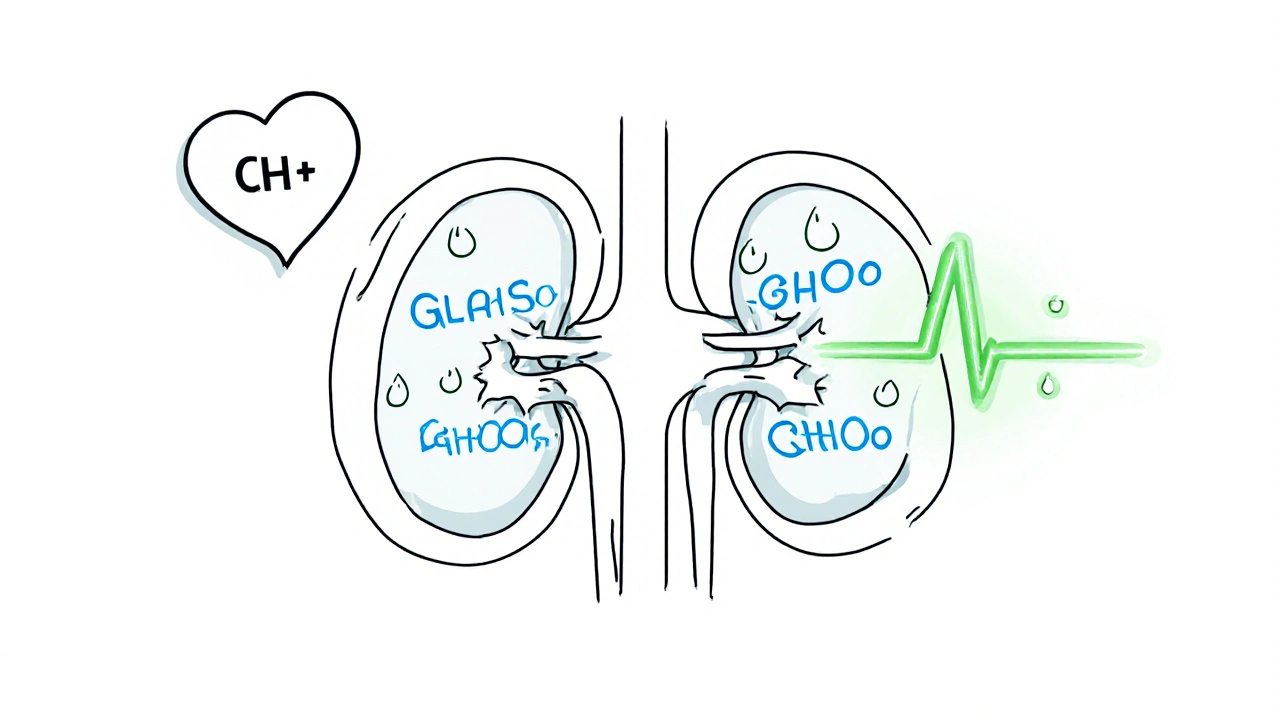
Your kidneys filter about 180 grams of glucose every day. Normally, almost all of it gets reabsorbed back into your blood through a protein called SGLT2. In type 2 diabetes, this system goes into overdrive - your kidneys start reclaiming even more sugar than usual, keeping your blood glucose high. SGLT2 inhibitors block that protein. As a result, 60 to 80 grams of glucose spill out in your urine each day.
This isn’t just about sugar. When glucose leaves your body, it pulls water and sodium with it. That’s why people on these drugs often lose 2-5 pounds and see their blood pressure drop by 3-5 mmHg. It’s not magic. It’s physics. Less fluid in your blood vessels means less strain on your heart and kidneys.
The mechanism is simple, but the effects are powerful. These drugs work even if your insulin is broken. They don’t cause low blood sugar when used alone. And they don’t make you gain weight - in fact, most people lose it.
The Heart Protection That Changed Everything
In 2015, the EMPA-REG OUTCOME trial changed how we treat diabetes. Researchers gave empagliflozin to over 7,000 people with type 2 diabetes and known heart disease. After three years, those on the drug had a 38% lower risk of dying from heart problems and a 32% lower risk of dying from any cause. That’s not a small win. It’s one of the biggest mortality benefits ever seen in a diabetes drug.
Other trials confirmed it. The CANVAS Program showed canagliflozin cut major heart events like heart attacks and strokes by 14%. DECLARE-TIMI 58 found dapagliflozin reduced hospital stays for heart failure by 17%. These weren’t just side effects - they were the main goal.
By 2021, the FDA approved empagliflozin for heart failure even in people without diabetes. Then came DAPA-HF and EMPEROR-Reduced, which showed SGLT2 inhibitors cut heart failure hospitalizations by 25-30% in patients with reduced heart pumping ability. The European Society of Cardiology now says every patient with heart failure and reduced ejection fraction - diabetic or not - should be on one.
Kidney Protection: Slowing Down the Silent Decline
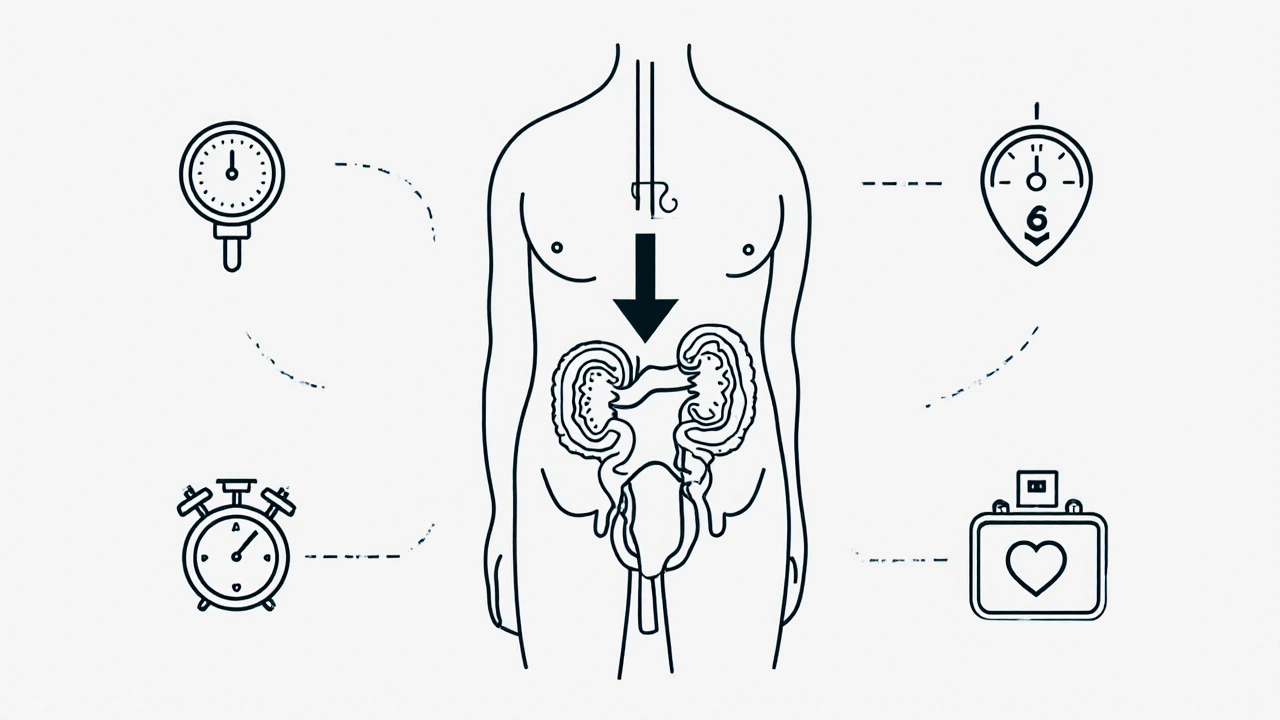
Diabetic kidney disease is the leading cause of dialysis in the U.S. And until recently, there was almost nothing that could slow it down. SGLT2 inhibitors changed that.
The CREDENCE trial in 2019 gave canagliflozin to over 4,400 people with type 2 diabetes and early kidney damage. After 2.6 years, the risk of kidney failure, doubling of creatinine, or death from kidney disease dropped by 30%. That’s huge. It meant fewer people needed dialysis or transplants.
Then EMPA-KIDNEY came along in 2023. This trial included over 6,600 people with chronic kidney disease - half had diabetes, half didn’t. Empagliflozin cut major kidney events by 28%. That’s the first time a drug showed kidney protection in people without diabetes. The FDA is expected to approve this use in early 2024.
Here’s something counterintuitive: when you start an SGLT2 inhibitor, your kidney filter rate (eGFR) might dip slightly for the first few weeks. That’s not damage - it’s a sign the drug is working. It reduces pressure inside the kidney’s filtering units, which protects them long-term. Think of it like lowering the water pressure in an old pipe to prevent cracks.
Who Should Be on an SGLT2 Inhibitor?
The American Diabetes Association updated its guidelines in 2023 to say this: if you have type 2 diabetes and also have heart disease, heart failure, or chronic kidney disease - start an SGLT2 inhibitor. Don’t wait. Don’t try metformin first. This isn’t a backup. It’s now a first-line choice for these patients.
Here’s who benefits most:
- People with type 2 diabetes and a history of heart attack or stroke
- Those with heart failure, especially with reduced pumping ability (HFrEF)
- Patients with albumin in their urine (a sign of early kidney damage)
- Anyone with an eGFR above 30 mL/min/1.73m² - even if they don’t have diabetes yet
Doctors now treat these drugs like they treat statins for cholesterol - not just for one condition, but for a cluster of related problems called cardiorenal metabolic syndrome.
Side Effects and Risks - What You Need to Watch For
No drug is perfect. SGLT2 inhibitors have real risks, and you need to know them.
The most common issue? Genital yeast infections. About 5% of women and 3% of men get them. They’re treatable, but annoying. Good hygiene and keeping blood sugar under control help prevent them.
A bigger concern is diabetic ketoacidosis - but not the kind you think. Most cases are “euglycemic,” meaning your blood sugar might only be 150-200 mg/dL, not 400+. That’s dangerous because you might not realize it’s happening. Symptoms: nausea, vomiting, stomach pain, extreme tiredness. If you’re sick, having surgery, or cutting carbs drastically, stop the drug and check ketones.
Canagliflozin carries a small but real risk of lower-limb amputations - about 6 out of 1,000 people over 2 years. That’s why doctors avoid it in people with foot ulcers, poor circulation, or prior amputations.
Some people feel lightheaded, especially if they’re elderly or on diuretics. Start with a low dose and drink plenty of fluids.
Cost and Access - Is It Worth It?
Brand-name SGLT2 inhibitors cost $520-$600 a month without insurance. That’s steep. But generics are coming. Dapagliflozin’s patent expires in 2025, and others will follow by 2028. In the meantime, most insurers cover them for heart or kidney patients - often with low copays.
And here’s the thing: they save money long-term. A 2022 study found each quality-adjusted life year gained with an SGLT2 inhibitor costs about $38,400 - well under the $50,000 threshold used by U.S. health economists. Fewer hospital stays for heart failure, fewer kidney transplants, fewer emergency visits. The drug pays for itself.
Real Stories - What Patients Say
On diabetes forums, people share their experiences.
One woman on the American Diabetes Association’s community wrote: “My A1c dropped from 8.5% to 6.8% on Jardiance. I lost 14 pounds. But I had two yeast infections. Worth it.”
A man on Reddit said: “I urinate every hour. At first, I thought I was losing control. Now I know it’s the drug. I sleep with a nightlight.”
And a heart failure patient on PatientsLikeMe shared: “My ejection fraction went from 25% to 35% after adding Farxiga. My cardiologist said he’d never seen that kind of improvement in someone my age.”
They’re not miracle drugs. But for many, they’re life-changing.
What’s Next for SGLT2 Inhibitors?
The science keeps evolving. The DELIVER trial showed dapagliflozin helps people with heart failure and normal pumping ability (HFpEF) - a group that used to have no effective treatment. The SUGAR-DM trial is testing whether ketones - a fuel source your body makes when fasting - are the secret behind the heart and kidney benefits.
By 2025, experts predict nearly half of all heart failure patients in the U.S. will be on an SGLT2 inhibitor. The American College of Cardiology already calls them the new standard of care for cardiorenal metabolic disease.
And the biggest shift? We’re no longer just treating diabetes. We’re treating the whole body - heart, kidneys, metabolism - together. SGLT2 inhibitors are the first class of drugs to prove that’s possible.

8 Comments
David Cunningham
November 22 2025
I’ve been on dapagliflozin for a year now. Urinating every 90 minutes at first was wild, but now I just keep a bottle by the bed. Lost 18 lbs, BP down 10 points, and my doc says my kidneys are stable. No more panic when my A1c hits 7.5. Honestly? Best decision I ever made.
Holly Schumacher
November 23 2025
I’m sorry but if you’re not checking your ketones daily while on these, you’re playing Russian roulette with your brain. Euglycemic DKA isn’t a myth-it’s a silent killer. And no, ‘drinking more water’ isn’t a fix. You need to monitor. Period.
ann smith
November 23 2025
I just started Jardiance last month and I’m already feeling more energy 😊 My doctor said my eGFR dipped a little but it’s normal-so I’m trusting the science. Thank you for explaining it so clearly!
Rahul Kanakarajan
November 23 2025
These drugs are just fancy diuretics with a marketing budget. My cousin in Mumbai got a yeast infection so bad he had to quit. And now he’s on insulin anyway. All this hype and still no cure.
Justin Daniel
November 25 2025
Rahul, I get where you’re coming from-but your cousin’s story doesn’t negate the data. These aren’t magic bullets, but they’re the closest thing we’ve had in decades to a drug that treats multiple organ systems at once. It’s not about ‘hype,’ it’s about shifting from symptom-chasing to organ-protection. That’s huge.
New Yorkers
November 26 2025
We’ve been treating diabetes like a sugar problem for 70 years. What if the real disease is metabolic entropy? What if the kidney isn’t failing-it’s *screaming* for help? SGLT2 inhibitors don’t lower glucose-they restore balance. And balance? That’s the only real medicine.
Melvina Zelee
November 27 2025
i just read this and i’m like… wait so i don’t have to be scared of my kidneys anymore? like… that’s it? no more doomscrolling about dialysis? i’m crying a little. thank you for writing this like a human.
steve o'connor
November 27 2025
My dad’s on empagliflozin. His ejection fraction went from 28% to 38% in 6 months. He’s 72. No surgery. No stents. Just a pill that makes him pee out sugar. The future’s weird, but I’ll take it.