

The Biggest Red Flags in FDA Inspections
When the FDA walks through a facility, they aren't looking for perfection, but they are looking for consistency. Some deficiencies appear far more often than others. If you're reviewing your own processes, these are the areas where most companies trip up.Aseptic processing controls are the most frequent culprit, appearing in nearly half of all 2025 warning letters. This isn't just about wearing gloves; it's about the science of sterility. The FDA often finds inadequate media fill studies-essentially "fake" runs to prove the process stays sterile-or failures to maintain a controlled environment during critical steps. If you can't prove your environment is sterile, the FDA assumes your product isn't.
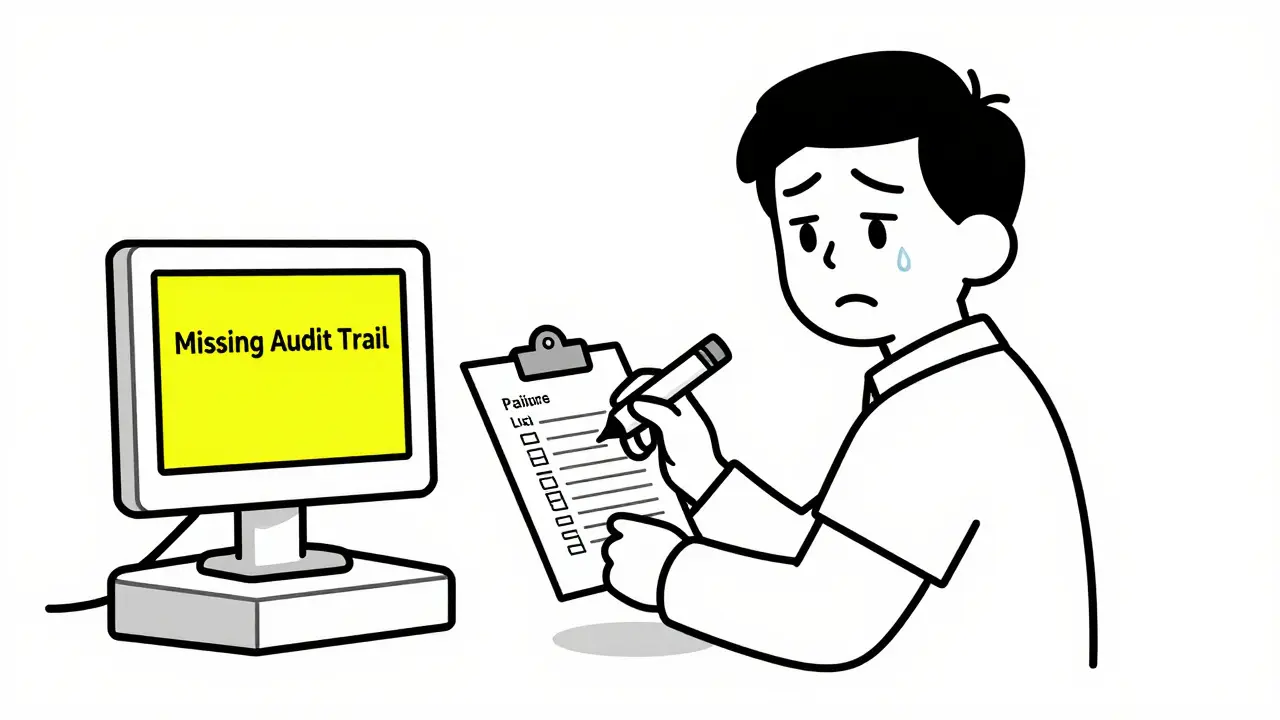
Then there is the nightmare of Data Integrity. This is where the agency gets aggressive. Imagine a technician using a laminated sheet and an erasable marker to record production data. To an inspector, that is a massive red flag because the data can be changed without a trace. The FDA demands ALCOA+ principles, meaning data must be Attributable, Legible, Contemporaneous, Original, and Accurate. In 2025, 39% of warning letters highlighted a lack of audit trails in instruments like UV-Vis and IR spectrometers. If there's no digital footprint of who changed a value and why, the data is considered unreliable.
Material control is another common pitfall. A recurring issue is the failure to test raw materials for contamination. For example, glycerin and sorbitol must be tested for diethylene glycol (DEG), a deadly contaminant. Some companies rely solely on the supplier's word, but the FDA expects you to verify that reliability yourself. If you aren't testing high-risk components to a sensitivity of 0.1% w/w, you are gambling with patient safety.
Comparing Common Manufacturing Failures
Not all deficiencies are created equal. Some are technical errors, while others are signs of a broken management system. Here is how the most common issues break down by their impact and typical cause.| Deficiency Type | Frequency (2025) | Typical Root Cause | FDA Expectation |
|---|---|---|---|
| Aseptic Controls | 47% | Poor environmental monitoring | Validated media fill studies |
| Data Integrity | 39% | Lack of electronic audit trails | ALCOA+ compliant records |
| Material Control | 35% | Over-reliance on supplier COAs | In-house verification of high-risk chemicals |
| Process Validation | 28% | Insufficient scientific justification | Three consecutive successful batches |
The "Quality Culture" Problem
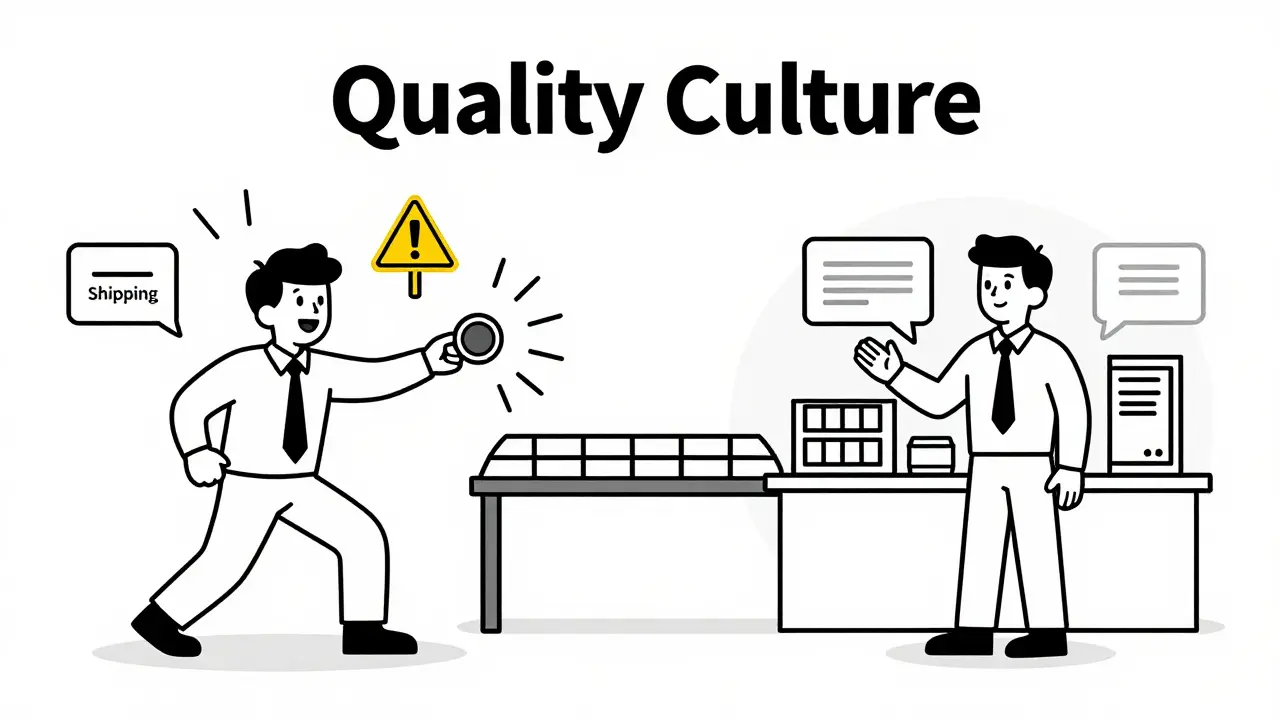
There is a reason why some facilities keep getting the same citations year after year. It's rarely about a broken machine; it's usually about the people in charge. Experts have noted that roughly 78% of facilities cited in 2025 showed a pattern where leadership prioritized production speed over regulatory compliance. This is what the FDA calls a failure of Quality Culture. When the Quality Unit doesn't have real authority to stop a production line, you have a systemic problem. We see this frequently in global manufacturing. Some facilities in China struggle with giving their Quality Units enough power, while sites in India often struggle with basic data integrity controls. The FDA is responding to this by launching the Quality Management Maturity (QMM) initiative. Instead of just checking if you meet the bare minimum Current Good Manufacturing Practice (CGMP) requirements, the QMM program looks at how you proactively manage quality. Facilities that embrace this cultural shift see 63% fewer repeat findings during inspections.How to Fix Deficiencies When the FDA Finds Them
Getting a Form 483 or a Warning Letter is a high-stress event, but the remediation process is predictable if you know what the agency wants. You can't just "promise to do better"; you need a validated plan.First, the FDA almost always requires the hire of an independent CGMP Consultant. In 92% of 2025 cases, the agency mandated an external expert to oversee the cleanup. This typically takes 6 to 18 months depending on how deep the rot goes.
If your issue is data integrity, you need to implement validated audit trails. This means your systems must have user-specific access controls, sequential timestamping, and at least a 180-day retention period for electronic records. No more shared passwords or manual overrides.
For process validation gaps, the gold standard is the "rule of three." You must demonstrate three consecutive successful validation batches. These batches need to meet pre-specified acceptance criteria and include rigorous in-process controls. If you're making something as simple as toothpaste, you still need a scientifically sound analytical method to prove the product is consistent from the first tube to the last.
The New Era of Unannounced Inspections
If you think you have time to "get the house in order" before an inspector shows up, think again. The FDA has shifted its strategy. In 2025, they increased unannounced foreign inspections by 40%, with a heavy focus on Asian manufacturing hubs. These surprise visits are designed to see how the plant actually operates on a random Tuesday, not how it looks after a month of frantic cleaning. Starting in 2026, this trend is hitting home. The FDA plans to conduct 1,200 unannounced domestic inspections, a significant jump from the 850 they did in 2025. They are also looking at new frontiers, such as digital quality management systems and cloud-based controls. If your quality data lives in the cloud but your access controls are weak, you're a prime target for a citation.What is the difference between a Form 483 and a Warning Letter?
A Form 483 is issued at the end of an inspection to list observations of potential non-compliance. It's essentially a "heads up" that things need to change. A Warning Letter is much more serious; it's a formal notification that the agency has reviewed the 483 response and found it insufficient, or that the violations are so severe that official action is required. Warning Letters are public and can lead to product seizures or import bans.
What does ALCOA+ actually mean in practice?
ALCOA+ is a framework for data integrity. Attributable means you know who recorded the data; Legible means it's readable; Contemporaneous means it was recorded at the time of the event; Original means it's the first record; and Accurate means it's correct. The "+" adds requirements for the data to be complete, consistent, enduring, and available. In a digital system, this means having an audit trail that cannot be deleted or edited by the user.
How do I handle an unannounced FDA inspection?
The best way to handle a surprise visit is to be "inspection-ready" every day. This means having your batch records current, your cleaning logs signed, and your staff trained on how to answer questions honestly and concisely. Never guess an answer; if you don't know, tell the inspector you will find the documentation and get back to them. Have a designated "war room" where you can review documents before handing them over.
Why is the FDA focusing on "Quality Culture" now?
The agency realized that technical fixes are often temporary. If a company fixes a machine but maintains a culture of "speed over safety," the same problems will reappear in a different form. By assessing quality culture, the FDA is trying to identify companies where management actively supports compliance, which leads to far fewer repeat violations and safer products.
What happens if my facility is placed on Import Alert 66-40?
Import Alert 66-40 is a severe penalty used for facilities with critical CGMP violations. It means your products are effectively blocked from entering the U.S. market. Every single shipment will be detained without physical examination until you can prove the deficiencies have been remediated. This usually requires a successful re-inspection by the FDA and a formal removal from the alert list.

14 Comments
Olushola Adedoyin
April 21 2026
This is just a smokescreen! The FDA isn't hunting for 'systemic failures,' they're hunting for control over every single molecule in our bodies.
Why now? Why the sudden jump in 'unannounced' visits? It's a total power grab to shake down the small guys and protect the giant corporate puppets who actually run the show. This 'Quality Culture' talk is just fancy words for psychological warfare to make companies beg for permission to exist. Wake up people, the digital audit trails are just a way to keep a permanent leash on every technician in the world! It's a global surveillance web disguised as 'patient safety' and it smells like a total scam!
Tanya Rogers
April 22 2026
One finds it quaint that the author assumes 'quality culture' is a tangible metric capable of being measured by a government agency. In reality, what the FDA is attempting to quantify is the inherent tension between industrial efficiency and bureaucratic perfectionism-a dichotomy that can never be truly reconciled. The obsession with the 'rule of three' is a particularly simplistic approach to validation, bordering on the superstitious. True quality is an ontological state, not a checklist of three consecutive batches. It is quite amusing to see such a rigid framework presented as a panacea for systemic failure.
Valorie Darling
April 23 2026
basically just telling us to pay expensive consultants lol
Aaron McGrath
April 23 2026
LFG! If you aren't implementing a full-stack QMS with real-time telemetry and AI-driven CAPA, you're basically begging for a 483. Stop playing defense and start crushing your KPIs! We need to pivot from a reactive compliance mindset to an aggressive quality-first architecture. If your Quality Unit doesn't have the power to kill a batch in ten seconds, your leadership is failing. Get your audit trails locked down and your validation protocols tighter than a drum or get out of the game!
Brigid Prosser
April 25 2026
I love the energy here, but let's keep it real: the transition to a 'quality culture' is a marathon, not a sprint. It's all about supporting your team so they feel safe reporting a mistake rather than hiding it with a whiteboard marker. We've all been there, feeling that pressure to ship. The key is building a bridge between the floor and the C-suite. You've got this, just take it one gap analysis at a time!
Venkatesh Venky
April 26 2026
Very true points. In my experience, the ALCOA+ guidelines are the gold standard for CGMP. We can definitely use the QMM initiative to motivate our teams to improve. Let's all work together to make the industry safer for everyone!
Akshata Kembhavi
April 28 2026
It's interesting to see the focus on the Asian hubs. We see a lot of these challenges in the local plants here too, and usually, it just comes down to a misunderstanding of the expectations versus the reality on the ground. Just a bit of patience and better communication usually fixes the root cause.
Cynthia Didion
April 28 2026
American standards are the only ones that matter. If you can't meet FDA requirements, you shouldn't be in the market. Period.
Arthur Luke
April 29 2026
I'm curious about the 180-day retention period for electronic records. Is that a hard limit or more of a suggested baseline for the audit trails?
julya tassi
April 30 2026
That's a great question! I think it varies by the specific product risk level, but having a solid buffer is always safer :) 🌸
Charlotte Boychuk
May 2 2026
The whole vibe of this is a bit stressful, but honestly, the part about the erasable markers is just wild. Who actually does that? I guess some people really just wing it and hope for the best. Let's just try to find a middle ground where we follow the rules without losing our minds in the process!
Lesley Wimbush
May 4 2026
Oh honey, please. A 'war room' for documents? How quaint. In a truly sophisticated operation, the documents speak for themselves because the quality is simply an inherent part of the brand's DNA. I've seen so many 'consultants' come in and just rearrange the deck chairs on the Titanic. It's honestly tragic how some of these facilities operate on a prehistoric level of management. I simply cannot imagine the horror of a laminated data sheet.
William Young
May 4 2026
For those feeling overwhelmed, remember that the goal of an inspection is ultimately patient safety. If we focus on the person receiving the medication, the documentation becomes a way to protect them, not just a way to satisfy a regulator.
aman motamedi
May 5 2026
I concur with the necessity of rigorous adherence to the ALCOA+ principles. It is imperative that all operational staff are trained in these standards to avoid the aforementioned deficiencies.